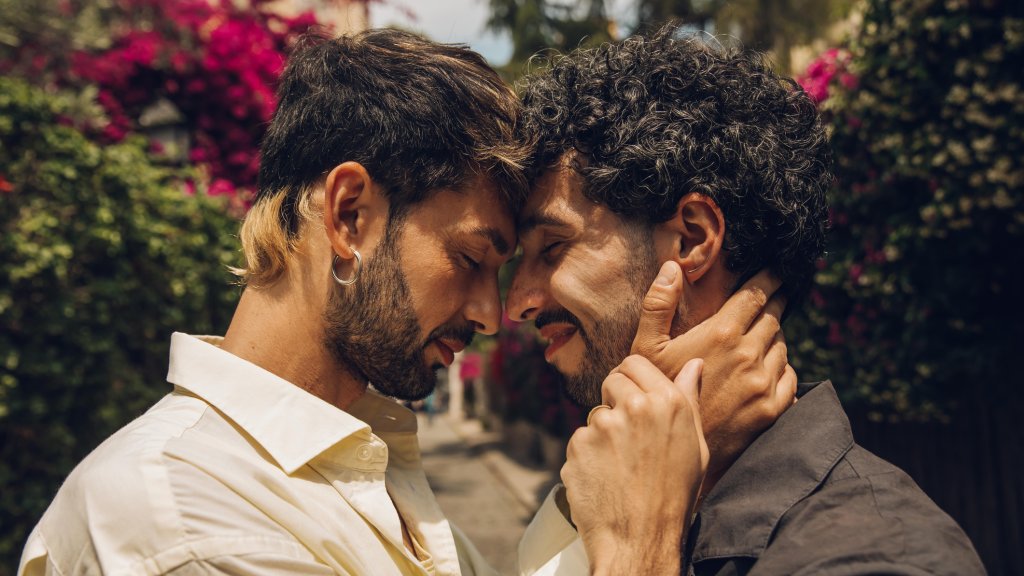
A queer Torah study group in Portland, in the US state of Oregon, wants to show LGBTQ+ people that they have always been part of Jewish history – and is making headlines in the US. At the Shir Tikvah congregation, the group studies biblical texts, questioning traditional interpretations.
Key points at a glance
- A queer Torah study group in Portland wants to show LGBTQ+ people that they have always been part of Jewish history.
- Rabbi Emerita Ariel Stone stresses that Jewish texts can be read from many different perspectives.
- The group does not seek to prove that biblical figures were gay, but to question traditional assumptions about the texts.
- For many queer participants, the group is an important and “incredibly healing” experience.
- Within Orthodox Judaism, disputes over the recognition of gay and queer people continue.
- In 2025, Tadhg Cleary became the first openly gay rabbi ordained at an Orthodox rabbinical school in New York.
A new perspective
One of the initiators is Rabbi Emerita Ariel Stone. What matters is the perspective from which the Torah is read, she told Oregon Public Broadcasting (OPB). “If you look at Jewish teachings about the Torah, they say there are 70 different ways to understand every passage of the Torah, every word, every commandment and every story,” Stone said. “It is not fully understood unless you keep turning it over and looking at it from different angles,” she added. “You change, or ‘queer’, your perspective on it simply by studying it as it is actually intended to be studied.”
Biblical texts
Angel Ya’el Murauskas, a volunteer leader in the congregation, stressed that the group was not seeking to prove that particular biblical figures were gay or queer. Rather, it was about reading the texts with a more open mind and questioning long-standing assumptions. As an example, Murauskas cited the first part of Genesis. “Genesis 1 is incredibly queer,” Murauskas said. “God creates an ‘Adam’, a being that is, in a sense, both man and woman. It is not really clear-cut, but they have to be separated from one another. That raises an interesting question about what is actually happening here.”
The relationship between Ruth and Naomi also plays a part in this reading. Murauskas referred to a passage in which Ruth expresses her close bond with Naomi. “One of the most beautiful passages and declarations of love in the entire Bible takes place between two women. Ruth says to Naomi: ‘I will literally go where you go. I will die where you die.’ I mean, what is that if not a marriage?”
The group as an important experience
For many gay and queer people, the study group is a particularly important experience, Murauskas said, describing it as “incredibly healing”. It can help participants feel welcome in the Jewish faith. “It is the first time someone has told them: ‘You are actually not an outsider in this community. This book is full of people like you.’” Shir Tikvah is regarded as a progressive synagogue. In other branches of Judaism, however, attitudes towards LGBTQ+ people are more contentious.
Queer people from Orthodox Jewish backgrounds and their supporters have been campaigning for years to be recognised as full members of the Jewish community. They oppose exclusion on the grounds of sexual orientation or gender identity. Orthodox rabbis, by contrast, have argued that religious hostility towards queer people is primarily based on adherence to Jewish religious law, rather than a fundamentally anti-LGBTQ+ stance. Critics of this argument point out, however, that Orthodox institutions do not exclude people in the same way when they break other religious rules. These include, for example, people who drive on Shabbat. The Jewish day of rest begins on Friday evening and ends on Saturday evening. Breaches of Jewish dietary laws likewise do not lead to exclusion in the same way.
First openly gay Orthodox rabbi
One example of Orthodox institutions slowly opening up is the rabbinical school Yeshivat Chovevei Torah in New York’s Riverdale neighbourhood. In 2025, the all-male Orthodox institution ordained an openly gay rabbi, Tadhg Cleary, for the first time. Cleary’s ordination on 12 June came six years after the school had refused to ordain another gay student as a rabbi. The student’s public engagement and planned wedding had previously gone viral online. Last year, the private Orthodox Jewish university Yeshiva also finally recognised an LGBTQ+ student club on its campus after years of legal proceedings.








