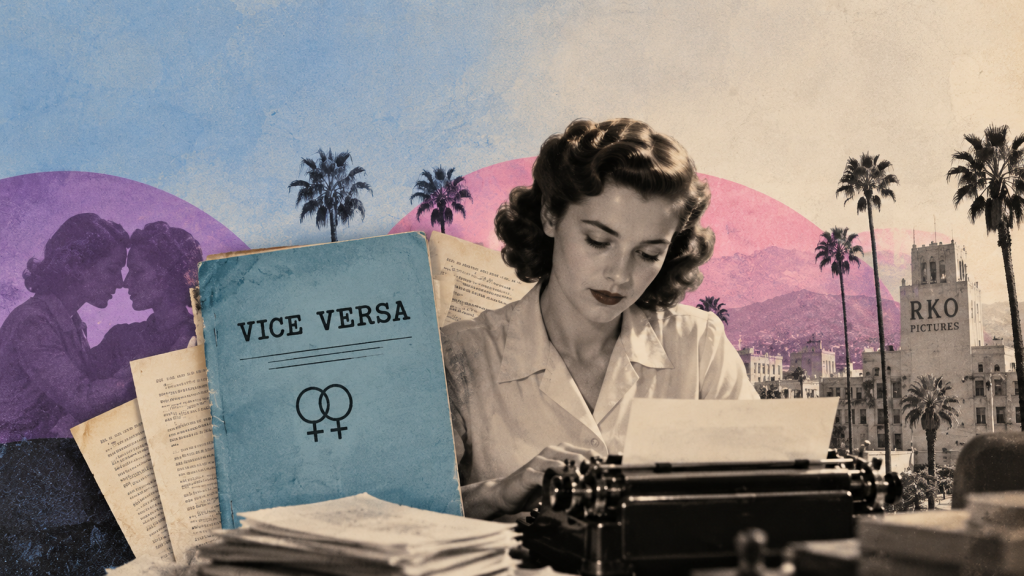
A typewriter, some carbon paper and plenty of courage: that was all Edythe Eyde needed to make American media history in the summer of 1947. The then 26-year-old secretary founded the first known gay magazine in the United States in Los Angeles. Nobody was supposed to find out who was behind the publication.
Key points at a glance
- A historic pioneering achievement: in 1947, Edythe Eyde founded Vice Versa in Los Angeles, the first known gay magazine in the US.
- Working in secret: the 26-year-old secretary wrote and duplicated the issues during her working hours at the film studio RKO Pictures.
- A dangerous undertaking: gay people faced severe social and legal persecution at the time. The magazine was therefore published anonymously.
- Just nine issues: by February 1948, nine issues had been produced, with around twelve copies of each, which Eyde distributed personally.
- Belated recognition: under the pseudonym Lisa Ben, Eyde became a pioneer of lesbian media history. Her later life, however, was marked by personal difficulties.
A small, free magazine
The magazine was called Vice Versa. Eyde herself described it as “America’s gayest magazine”. It was a small, free publication with typewritten pages stapled together under a blue cover. There were no photographs, advertisements, publication details or authors’ names. The magazine was produced under unusual circumstances: Eyde worked as a secretarial assistant at the film studio RKO Pictures. During quiet hours in her working day, she wrote the articles, almost all of which were her own work. She used carbon paper to make copies. Only around twelve copies of each issue were produced. She passed them on to friends, distributed them in gay and lesbian bars and occasionally sent them by post.
A magazine challenging exclusion
Eyde had moved from Northern California to Los Angeles to escape her strictly authoritarian family. In the big city, she sought a life in which she could live more freely as a lesbian. Yet the situation was dangerous there too. In the 1940s, every US state had laws against so-called sodomy. Gay people faced criminal prosecution, social ostracism and consequences for their careers. With Vice Versa, Eyde wanted to create a space where lesbian women could see their experiences and interests reflected.
In the first issue, published in June 1947, she explained why she had founded the magazine. Newsstands, she wrote, carried publications on almost every subject, but none for gay people. “And yet there is one kind of publication which I believe would be of great interest to a particular group. Such a publication has never appeared on newsstands,” Eyde wrote. She attributed the fact that even offensive magazines could be sold, but a magazine for gay people could not, to social prejudice. “Why? Because society decrees it.” She then set out the purpose of her new magazine: “Hence the appearance of VICE VERSA, a magazine dedicated in all seriousness to those of us who will never quite manage to conform to the iron rules of social convention … This is your magazine.”
Historian highlights her courage
Historian Lillian Faderman has now explained just how risky Eyde’s undertaking was. The emerita academic at California State University in Fresno is regarded as one of the leading researchers into lesbian and gay history. She said that even visiting a gay or lesbian bar had required courage at the time. Such meeting places were regularly raided by police. Nevertheless, women went to these places to find a sense of community. Faderman described Eyde as brave and clever, but also naive. The young woman had apparently underestimated the legal risks of her publishing activities.
“Someone had to tell her that it was against the law to send homosexual publications through the post. And her answer was: ‘But I haven’t written anything offensive in it.’ Well, she didn’t have to.” Faderman, who is herself a lesbian, recalled harassment at gay meeting places during the 1950s. “The very fact that she wrote this publication was wonderful,” she said of Eyde. “It grew out of a certain naivety … It is a wonderful piece of history.”
The end after nine issues
The ninth and final issue of Vice Versa appeared in February 1948. Its closure was mainly due to changes at work. After businessman Howard Hughes took over the film studio RKO, Eyde lost her previous position. Instead of having an office of her own, she now worked in a large typing pool with numerous other employees. The opportunity to work on her magazine unnoticed had disappeared. In the final issue, she bid farewell to her small readership with a personal Valentine’s greeting: “Although this little magazine does not contain much lace, hearts or other decorations appropriate to February, I would like, through VICE VERSA, to extend my heartfelt personal Valentine’s greetings to everyone to whom this magazine is dedicated.” After the magazine ended, Eyde continued to work as a secretary. She also began singing in lesbian bars and clubs.
Eyde became Lisa Ben
In 1956, another significant lesbian publication, The Ladder, appeared in the US. It was published by the Daughters of Bilitis, a lesbian organisation from San Francisco. There, too, women published their contributions under pseudonyms to protect their identities. Eyde was among the contributors. Initially, she wanted to call herself “Ima Spinster” — a play on “I’m a spinster”. An editor rejected the suggestion, however. Eyde then chose Lisa Ben, an anagram of the English word “lesbian”. It was under this name that she later became known. Her identity initially remained hidden, but became public at some point after the 1950s.
A difficult life in old age
Although Eyde had made history with her magazine, she increasingly withdrew from the gay community in later years. She gave no more interviews after the early 2000s. Exactly why she distanced herself from her former social circle remains unclear. Historian Faderman suspects that Eyde’s difficult family history and disappointed hopes of a lasting romantic relationship may have played a part. Eyde had lived with a woman for three years. By her own account, the relationship ended badly. “I think that when you have parents who are so strict, authoritarian and unloving, it makes life as an adult very difficult,” Faderman said.
She continued: “She was not a happy woman. I think that is the only way to describe her. Her relationship with her parents shaped the rest of her life. She never found lasting love, and that shaped her life too.” Faderman also considers it possible that Eyde developed a deep-rooted, internalised homophobia as a result of her upbringing. She described this feeling as “that voice in your head that you never entirely get rid of”. “Somehow, as she grew older, she returned to the attitude her mother had held when she was still a teenager.”
A pioneer of media history
Edythe Eyde died in 2015 at the age of 94. She was buried at Forest Lawn Memorial Park in California. Her small, secretly duplicated magazine is now regarded as an important record of early gay community organising in the United States. Decades before gay people gained wider social acceptance, Eyde created a publication that explicitly addressed lesbian women. For Faderman, this achievement remains particularly significant despite its founder’s difficult later life. “I think that I and other people interested in lesbian history should be forever grateful to her for Vice Versa. But she had a very sad life,” the historian said. “It really is very tragic.”








