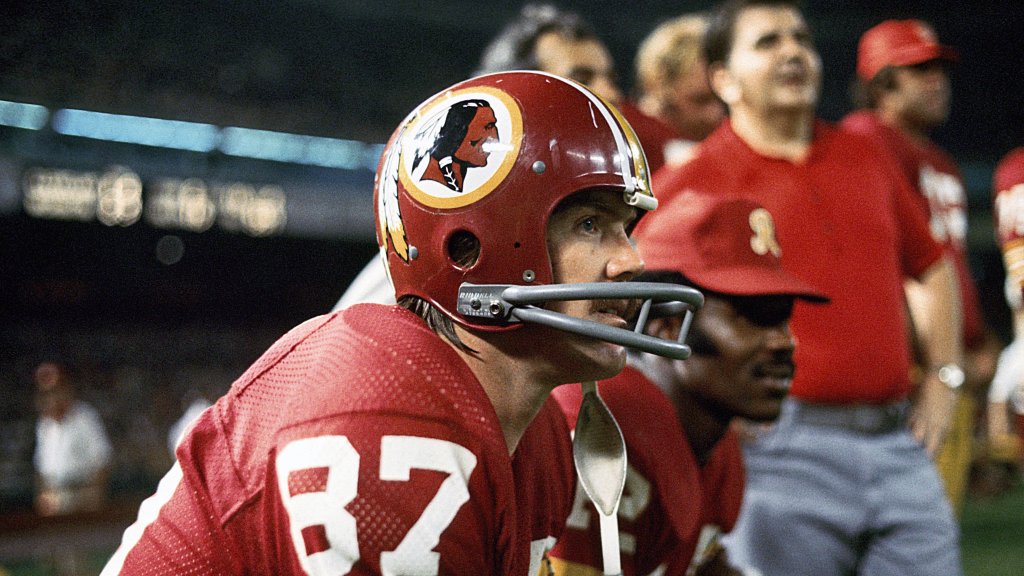
He was one of the outstanding American football players of his generation, set new standards in his position and was also a gay man in a sporting world where homosexuality was largely taboo. On 15 October 1986, Jerry Smith, the long-serving tight end for the Washington Redskins, died of AIDS-related complications aged just 43. This week, he is being remembered in the US on the 40th anniversary of his death.
Key points at a glance
- Death 40 years ago: Former NFL star Jerry Smith died of AIDS-related complications on 15 October 1986 at the age of 43.
- Exceptional career: The Washington Redskins tight end caught 421 passes and scored 60 touchdowns over 13 seasons. He was one of the pioneers of his position.
- Homosexuality remained hidden: Smith was one of three gay players at the Redskins’ 1969 training camp. Only shortly before his death did he speak publicly about it and about having AIDS.
- Support from the NFL: Former teammates visited Smith in hospital. Around 300 people attended his funeral, while thousands of fans paid tribute to his courage in letters.
- Despite his sporting achievements, Smith is not a member of the Pro Football Hall of Fame.
Sports star and pioneer
Four decades later, US journalist John Casey is remembering the former NFL professional. His retrospective paints a picture of an exceptional athlete whose death became a defining experience for many gay men. Smith spent his entire NFL career with the Washington Redskins. Over 13 seasons, he caught 421 passes and scored 60 touchdowns. This made him one of the most successful pass receivers in his position. At a time when tight ends were mainly used to block opposing defenders, Smith became an important part of the passing game. Alongside John Mackey of the Baltimore Colts, he is considered one of the early pioneers of the modern tight end’s attacking role. Yet while his sporting successes were widely known, a significant part of his private life remained hidden.
Three gay NFL players
Smith was gay. However, the public only learnt this through later accounts of his life. There were no fewer than three gay players at the Washington Redskins’ 1969 training camp: Smith and running backs Dave Kopay and Ray MacDonald. MacDonald was cut from the squad before the season began. Smith and Kopay continued their NFL careers. The fact that three gay players were involved with an NFL team at the same time remained largely unknown then. Social conditions were different from today. Coming out publicly could have serious professional and personal consequences for professional athletes. Homosexuality was considered a taboo subject, particularly in American football, a sport with strongly defined notions of masculinity. Smith was nevertheless a mainstay of his team.
AIDS diagnosis becomes public
By the mid-1980s, the AIDS crisis had developed into a global health catastrophe. Effective treatments of the kind available today did not yet exist. For many people, an AIDS diagnosis carried a very poor prognosis. At the same time, people with HIV and AIDS faced severe stigma. Gay men in particular experienced social exclusion and prejudice. When the actor Rock Hudson died of AIDS in 1985, his death caused shock around the world. Images of the seriously ill Hollywood star alongside his former co-star Doris Day made the effects of the disease visible.
In August 1986, it finally became public that Jerry Smith also had AIDS. By then, the former NFL professional was already seriously ill in hospital. He spoke publicly about his diagnosis to the Washington Post. Smith did not want to discuss how he might have acquired HIV or his private life. Instead, he explained that people should understand what he had been through and how terrible the disease was. He hoped that his openness could help advance medical research. For a former football star, this was an extraordinary step given the social prejudices of the time. Just a few weeks after his public statement, Smith died on 15 October 1986. He was 43.
A warning to gay men
For Casey, the athlete’s death brought a frightening realisation: if even a strong, fearless elite athlete like Jerry Smith could die of AIDS, no one seemed safe from the disease. This fear also affected how he dealt with his own homosexuality. For many other gay men, too, Smith’s death became a warning. Casey describes this experience with a powerful image: Smith’s death had, in a sense, turned the closet door behind which many gay men lived at the time into a vault door. The journalist also stressed how difficult it was to convey the scale of that fear to younger generations.
Former teammates
Despite the climate of social prejudice, Smith was not abandoned by his former colleagues. Former teammates visited him in hospital and stood by him during his serious illness. Almost 300 mourners attended his funeral. Numerous fans also responded to Smith’s illness and death. His family received thousands of letters in which the football player’s supporters thanked him for his courage. Looking back, Casey found this support particularly remarkable. The very people he had assumed at the time would reject a gay man had shown Smith their sympathy and solidarity. A year after Smith’s death, in February 1987, the entertainer Liberace died of AIDS-related complications.
No posthumous honour
Four decades later, Casey recalls how many people lost their lives to the AIDS crisis. Among them were artists, athletes, teachers, friends and people whose names never became publicly known. Many died alone. Others were afraid to disclose their illness or sexual orientation. For Casey, this historical experience remains closely linked to Jerry Smith’s fate. The former football player had decided to speak publicly about his illness just weeks before his death – at a time when HIV and AIDS were associated with severe social prejudice.
Through his statement, he wanted not only to tell people about his own situation but also to support research. As well as remembering Smith’s personal courage, Casey reflects on his sporting legacy. To this day, the former tight end has not been inducted into the Pro Football Hall of Fame. Casey argues that Smith’s sporting record alone, with 421 catches and 60 touchdowns over 13 NFL seasons, makes the case for induction. Added to this is his importance as one of the first tight ends used not only as blockers but also as outstanding pass receivers. For Casey, there is no doubt that Smith deserved more than to remain merely a footnote in the history of American football.








