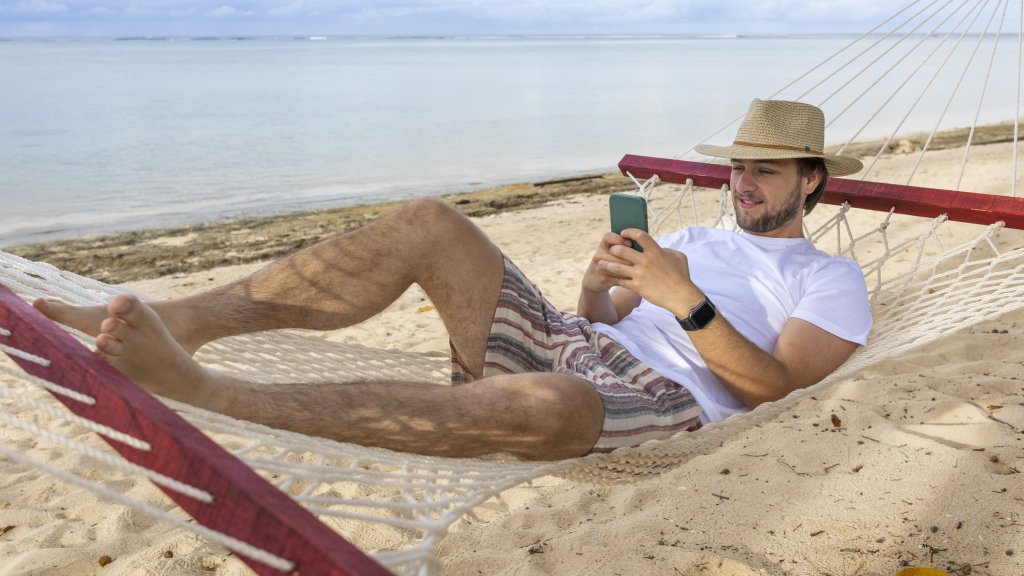
A plane selfie, a hotel reel and a big photo round-up after the trip: for many young people, posting on social media is now an integral part of a holiday. For Generation Z in particular, Instagram, TikTok and the like have long been part of the travel experience – a generation in which 22 per cent now identify as LGBTQ+. At the same time, there is growing recognition that a digital break can benefit mental health, particularly for queer people, for whom the digital world is sometimes becoming an increasingly indispensable part of life and a kind of safe space within their own bubble.
The key points at a glance
- For 57 per cent of holidaymakers, posting holiday content is now a natural part of the experience.
- This behaviour is particularly pronounced among 16- to 29-year-olds.
- One in four openly admits to wanting to make others envious with holiday photos.
- A new study shows that just one week without social media can significantly reduce psychological distress.
- Experts also advise against sharing holiday destinations and locations in real time for security reasons.
Most people stay online on holiday
A representative survey commissioned by the digital industry association Bitkom shows just how closely social media now accompanies holidays. According to the survey, 57 per cent of holidaymakers say posting content is a natural part of their holiday. The previous year, the figure was 50 per cent. This behaviour is particularly pronounced among young people. Among 16- to 29-year-olds, 69 per cent say they post content on social media while on holiday. At 66 per cent, the figure for 30- to 49-year-olds is only slightly lower.
These posts are not meant to go unnoticed. Of those surveyed, 44 per cent explicitly want attention for their holiday pictures and videos. One in four (26 per cent) even openly admits to wanting to make others envious with their images. Social media often plays a special role in the queer community. Many use platforms such as Instagram not only to present themselves, but also to discover travel destinations, hotels or events, meet other LGBTQ+ people or find positive role models. At the same time, this very constant visibility can increase the pressure to present a holiday that looks as perfect as possible.
Less depression and anxiety
A study published in the journal JAMA Network Open in 2025 shows that taking a break from social media can have positive effects. Researchers initially followed 18- to 24-year-olds for two weeks as they used social media as normal. The participants then stayed off social media for one week. During that week, symptoms of depression fell by 24.8 per cent. Anxiety symptoms decreased by 16.1 per cent and insomnia by 14.5 per cent. Loneliness scores, however, remained unchanged. The authors stress that further studies are needed to examine long-term effects. Nevertheless, the findings suggest that even short digital breaks can improve wellbeing. A holiday could be a suitable time for this. Rather than constantly looking for the next perfect photo or waiting for likes, people could make a conscious choice to enjoy their time off offline.
A question of security
Security experts also recommend restraint when posting. The Federal Office for Information Security (BSI) advises against sharing holiday photos or your current location on social media in real time. Such information could give criminals clues that a flat or house is unoccupied during a trip. Gay and queer people could also face other problems if they post live locations from countries that, for example, still criminalise homosexuality – a prime example is Egypt, where police continue to try to lure gay men in particular into online traps (German).
The trend thus has two sides: for many young people, including numerous queer users, social media is a natural part of a holiday. At the same time, both scientific findings and security experts make a case for putting the smartphone aside, at least some of the time – and experiencing a holiday through more than just a screen.








