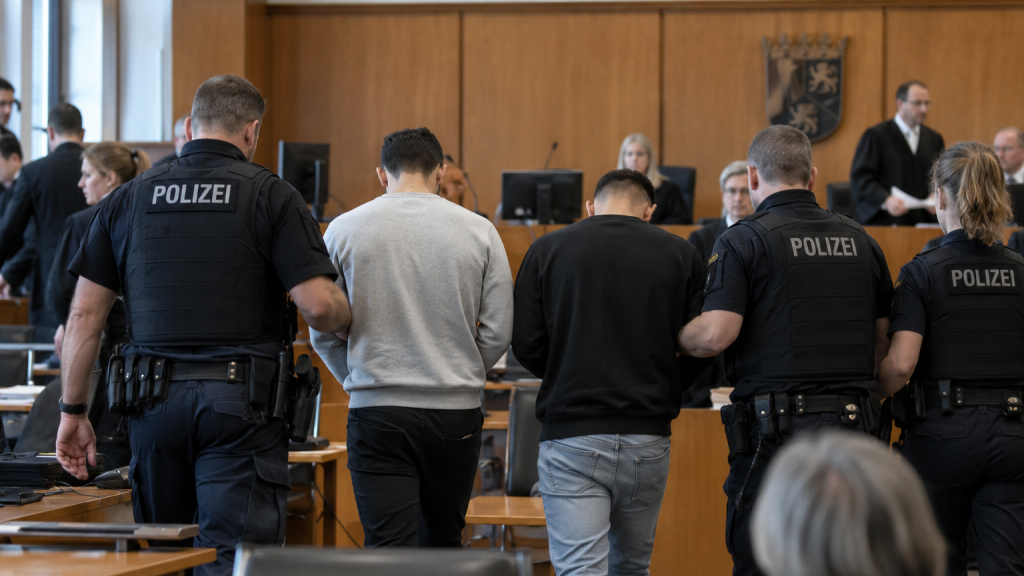
A violent robbery targeting a gay man in Mainz's Hartenbergpark has resulted in lengthy prison sentences for two young men. The Fifth Criminal Chamber of Mainz Regional Court sentenced a 23-year-old to seven years and six months in prison. His 22-year-old co-defendant received a prison sentence of seven years and one month. The court found it proven that the two Syrian men had attacked a 31-year-old out of homophobic motives.
Key points at a glance
- Lengthy prison sentences: Mainz Regional Court sentenced two Syrian men, aged 23 and 22, to seven and a half years and seven years and one month in prison respectively.
- Homophobia as the motive: The judges were convinced that the defendants attacked the 31-year-old because of his homosexuality.
- Violence and threats: The victim was beaten, threatened with a knife and robbed of his mobile phone in Hartenbergpark.
- Severe psychological impact: Since the attack, the 31-year-old has suffered from nightmares, anxiety and significant restrictions on his daily life.
- Conflicting accounts: While the prosecution argued that the attack was planned and religiously motivated, the defence lawyers denied that it had been a targeted attack.
Religious death threats
The two convicted men are from Syria and were most recently living in Saarland. They had been held in pre-trial detention since February. They were found guilty of particularly aggravated robbery in conjunction with aggravated assault. According to the judgment, the men attacked their fellow Syrian on the evening of 13 January in Hartenbergpark. They beat him, threatened him with a knife and snatched his mobile phone, which had €300 in its case. During the attack, they allegedly threatened to kill the 31-year-old. “You must die; Islam does not tolerate men like you,” they allegedly threatened. In reaching their decision, the judges largely followed the arguments of the Prosecutor General's Office. It had sought prison sentences of eight and a half years for the defendants. The defence lawyers, by contrast, had each called for a suspended sentence of no more than two years.
Deliberate preparation
The proceedings centred on why the two defendants had travelled to Mainz and how the violence had come about. The chief public prosecutor argued that the attack on the 31-year-old had been prepared out of a religiously motivated rejection of his homosexuality. According to the prosecution's account, the 23-year-old had initially contacted the eventual victim via Snapchat. He had then travelled from Saarland to Mainz with his 22-year-old acquaintance. The plan had been to lead the 31-year-old from Mainz's Neustadt district towards the car park on Bruchweg and overpower him there.
The younger defendant allegedly waited by the vehicle while the 23-year-old walked with the Mainz resident. The prosecution regarded the analysis of messages on their mobile phones as a key piece of evidence. It said these showed that an attack had already been planned at the car park. However, the 22-year-old had expressed concerns because other people were present. “Not by the car, there are too many people here.” In the prosecutor's view, this message explained why the planned attack was not carried out at that point. Instead, the 23-year-old had continued walking with the eventual victim.
Further escalation
The 23-year-old allegedly eventually set upon the 31-year-old in Hartenbergpark. Shortly afterwards, the second defendant allegedly joined in the attack. The proceedings also examined remarks which, in the prosecution's assessment, indicated a particularly serious threat to the victim. During the attack, the 23-year-old allegedly said: “I will go to paradise if I kill him.” His companion reportedly pointed out that the location was too public for such an act. In her closing address, the chief public prosecutor also noted that a cyclist had happened to pass by during the incident. She questioned whether the attack would have had even more serious consequences had other people not been present. “What would have happened if it had worked by the car, or if a cyclist had not happened to pass by in the park?” The possible consequences could only be imagined, the prosecutor said.
Nightmares and self-blame
The profound impact of the attack on the 31-year-old became clear during his testimony in court. Since the robbery, he has suffered significant psychological distress. He has nightmares and lives in fear of being attacked again. According to his account, his former daily routine is now barely possible. He rarely leaves the house and feels particularly threatened when he is out on the street alone. In court, the man also spoke about his reasons for fleeing to Germany. He said he had left his home country because he wanted to live openly as a gay man here without fear of punishment. The attack had not only shaken his sense of security. The 31-year-old also blamed himself and felt partly responsible for what had happened. “I hate myself. If I weren't like this, I would never have met these men,” he said in the witness box.
Background to the meeting
The defendants' lawyers disputed the account of a planned, homophobically motivated act of violence. In particular, the 23-year-old's defence lawyer presented a different explanation for the initial contact and the subsequent confrontation. According to this account, his client had himself experienced same-sex attraction and had therefore sought contact with the 31-year-old via Snapchat. During the meeting, a situation had arisen which the defendant had felt unable to cope with. “He wanted to try it, but then it became too much for him and he lashed out,” the lawyer explained. The 23-year-old had only put forward this account on the final day of the trial. No members of his family were in the courtroom at that point.
The defendant had previously given a different reason for travelling to Mainz. He had assumed that his online acquaintance could help him find a job in the care sector. According to his original account, however, the 31-year-old had behaved inappropriately towards him during the meeting. The chief public prosecutor found the changing explanations unconvincing. She maintained her view that the contact had been intended from the outset to lure the eventual victim into a trap.
The defendant's online activities
Another focus of the trial was the 23-year-old's possible religious radicalisation in the months before the attack. In this context, the court examined, among other things, his online behaviour. An analysis of his searches had revealed indications of websites belonging to the terrorist group Islamic State (IS). The defendant also allegedly listened repeatedly to so-called nasheeds. These are religious chants, including songs praising Allah and jihad. According to the findings presented during the proceedings, some of the content he listened to came from an IS media site.
Statements from people close to him also played a role. Friends called as witnesses sought to play down the significance of these activities. One of them reported that the 23-year-old had engaged intensively with the Koran, studying and interpreting it. The defence did not consider these circumstances sufficient evidence of radicalisation or a religiously motivated plan to commit the offence. Instead, the lawyers described the behaviour as an expression of young men's curiosity.
Criticism of security measures
Alongside the allegations, the circumstances of the trial also drew criticism from the defence lawyers. They objected in particular to the extensive security checks outside the courtroom and the involvement of the Prosecutor General's Office. In their view, the scale of the measures was disproportionate. “The Prosecutor General's Office is here, and there is a huge security operation outside the courtroom. As if we were dealing with terrorists here,” the lawyers criticised. The defence regarded this as excessive treatment of the case and objected to the impression that their clients were being associated with terrorist offenders.
The prison sentences imposed by the Fifth Criminal Chamber were below those sought by the Prosecutor General's Office. However, the court rejected the suspended sentences requested by the defence lawyers. The decisive factor was the court's conviction that the attack on the 31-year-old had not merely arisen from an encounter that spontaneously escalated. Rather, the judges found that it was a targeted attack motivated by the victim's homosexuality.








