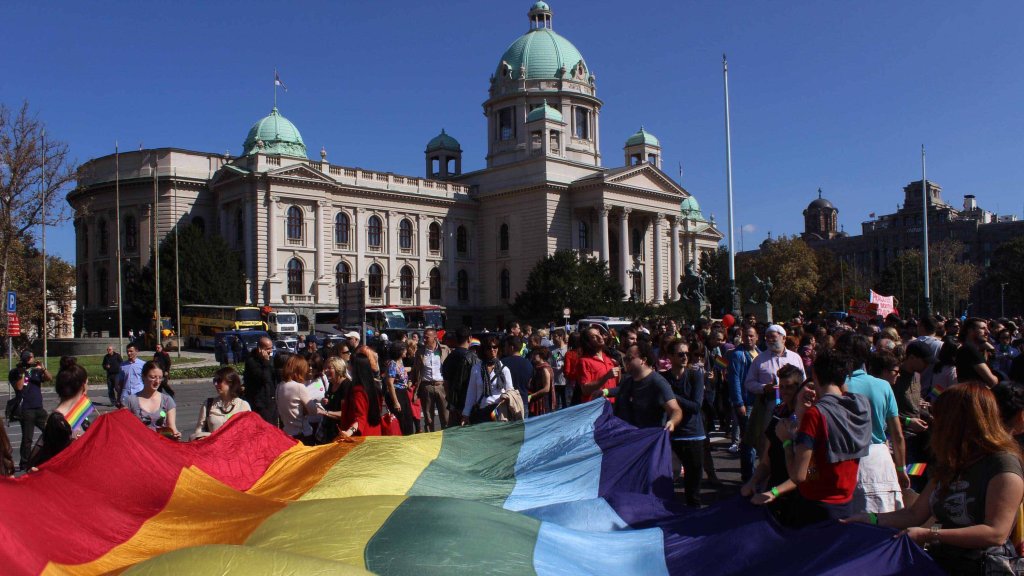
Under the slogan “There is room for us all”, hundreds of people marched through central Belgrade last weekend to stand up for the rights of gay and queer people at Belgrade Pride. The route passed the seat of the Serbian government and the National Assembly. Numerous streets were closed for the march.
Key points at a glance
- Under the slogan “There is room for us all”, hundreds of people marched through Belgrade on Saturday.
- The route passed the seat of the Serbian government and the National Assembly.
- The Pride took place 25 years after the first Belgrade Pride, which was marred by widespread violence in 2001.
- Belgrade Pride has been held annually again since 2016.
- Serbia’s ambition to join the EU plays an important role in protecting the rights of LGBTQ+ people.
- In 2021, around 6,000 people took part in Belgrade Pride and Euro Pride – more than ever before.
25 years after “Bloody Pride”
The Pride took place 25 years after the first Belgrade Pride. The memory of 30 June 2001 remains vivid and deeply rooted in Serbia’s LGBTQ+ community. For many, the event was traumatic, with some still affected today. Back then, only a few dozen people took part in the Pride. Anti-LGBTQ+ organisations, including numerous hooligans prepared to use violence, had called for a counter-demonstration. The police failed to keep the counter-demonstrators away from the Pride. More than 40 participants were injured, some seriously. The event subsequently became known as “Bloody Pride”.
For fear of further attacks, no more Prides were planned in the following years. It was not until 2010 that another attempt was made. Once again, there were large counter-demonstrations. In the years that followed, permits were repeatedly refused because the authorities could not guarantee participants’ safety. Belgrade Pride has only been held annually again since 2016. Serbia’s ambition to join the European Union also plays a role in this. As part of the process of moving towards EU membership, the country must also guarantee the fundamental rights of gay and queer people.
Record numbers at Euro Pride
In 2021, around 6,000 people took part in Belgrade Pride – more than ever before in Serbia. There were only comparatively minor attempts at disruption. A year later, the conflict between the organisers and the Serbian government escalated again. Belgrade was hosting Euro Pride at the time. President Aleksandar Vučić intervened and refused to grant the Pride a permit, citing tensions between Serbia and Kosovo. Once again, pressure from the European Union helped ensure that the event could ultimately go ahead. However, the situation in the country remains tense to this day, with an irritant gas attack on a gay club in Belgrade as recently as May this year (German).








