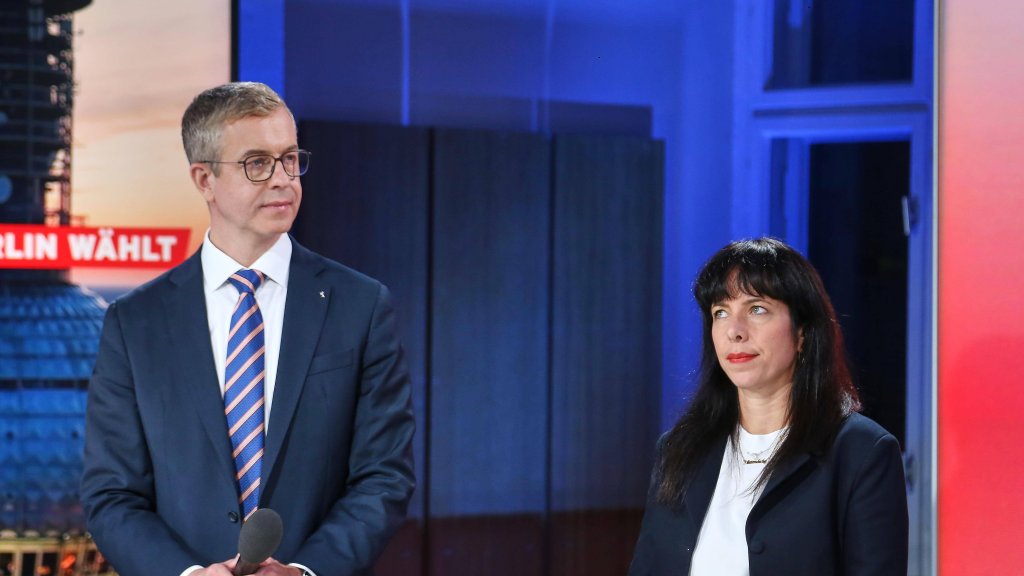
Following the elections in Mecklenburg-Vorpommern and Berlin, Germany's CDU/CSU bloc faces a major political defeat. The result is particularly stark in Mecklenburg-Vorpommern: the CDU secured just 4.9 per cent and is therefore no longer represented in the state parliament. The AfD won 38.2 per cent, ahead of the SPD on 35.5 per cent. The Left and the Greens also won seats.
The key points at a glance
- The AfD wins the state election in Mecklenburg-Vorpommern with 38.2 per cent, ahead of the SPD on 35.5 per cent.
- With 4.9 per cent in Mecklenburg-Vorpommern, the CDU fails to enter a state parliament for the first time. The BSW also misses out with 4.8 per cent.
- The Left and the Greens enter the state parliament in Schwerin with 6.5 and 5.7 per cent respectively.
- In Berlin, the Left becomes the largest party with 25.7 per cent. The CDU wins 18.8 per cent, the AfD 16.3 per cent, the Greens 14.3 per cent and the SPD 12.1 per cent.
- The BSW remains below the five per cent threshold in Berlin with 4.7 per cent.
- Chancellor Friedrich Merz describes the CDU's result in Mecklenburg-Vorpommern as a “disaster”, but intends to maintain his policies.
- Following its result in Mecklenburg-Vorpommern, the AfD claims a mandate to govern. With the other parties refusing to work with it, there is currently no prospect of the AfD entering government.
- In Berlin, the outgoing CDU-SPD coalition loses its majority. The Left, led by its lead candidate Elif Eralp, aims to form a government; the Greens signal openness to an alliance with the Left and the SPD.
- For the LGBTQ+ community, Berlin's future coalition agreements could be particularly relevant: the city adopted a state strategy against anti-LGBTQ+ hostility only in March 2026.
Merz intends to carry on
Following the elections in Mecklenburg-Vorpommern and Berlin, Germany's CDU/CSU bloc faces a major political defeat. The result is particularly stark in Mecklenburg-Vorpommern: the CDU secured just 4.9 per cent and is therefore no longer represented in the state parliament. The AfD won 38.2 per cent, ahead of the SPD on 35.5 per cent. The Left and the Greens also won seats. Chancellor and CDU leader Friedrich Merz responded to his party's performance on election night. He said the CDU's result in Mecklenburg-Vorpommern in particular was a “disaster” for his party, which was also attributable to a “lack of support from Berlin”. There was no glossing over the result.
At the same time, the Chancellor and CDU leader reaffirmed his intention to stay the course. “I want to move our country forward,” he said at the Konrad-Adenauer-Haus in Berlin. “The reforms must come.” There was no going back for Germany, he said. The country had to be made fit for the future. “What needs to be done now requires backbone, steadfastness and patience,” Merz said. “I will show those qualities as leader of the CDU and, above all, as Chancellor of our country.” He was firmly convinced that the success of the reforms would “not only improve the way we live together, but also our self-image and our image in the world”. Germany was capable of reform, he said. “I would even go so far as to say that these reforms are the antidote to the authoritarian poison that is penetrating ever deeper into our society through the fascination with authoritarianism,” Merz said.
CDU suffers heavy losses in Berlin
The CDU also faces substantial losses in Berlin. With all votes counted in the election to the House of Representatives, it secured 18.8 per cent. In 2023, it won 28.2 per cent. This puts the party behind the Left, which becomes the largest party with 25.7 per cent. The AfD won 16.3 per cent, the Greens 14.3 per cent and the SPD 12.1 per cent. In Mecklenburg-Vorpommern, the result is even harsher for the Christian Democrats. With 4.9 per cent, the party fails to enter a state parliament for the first time. In the 2021 state election, it won 13.3 per cent. Merz said: “The CDU fought, but in the end the CDU was squeezed out as the contest became a showdown between the SPD and the AfD.” According to the result, both parties are well ahead of the rest, with the AfD in the lead.
In Berlin, where the CDU holds the office of Governing Mayor with Kai Wegner, Merz described the performance as a “respectable result” despite the losses. He said lead candidate Stefan Evers had led the CDU with wholehearted commitment and great dedication. Pressure on Merz had already been mounting before election Sunday. Following the CDU's poor performance in the state election in Saxony-Anhalt, individual CDU representatives had called for his resignation. However, four days before the elections in Mecklenburg-Vorpommern and Berlin, the eight CDU state premiers had backed the Chancellor in a joint statement. Merz himself had consistently struck a defiant tone.
SPD must analyse election results
The SPD also faces a difficult political situation following the elections. In Mecklenburg-Vorpommern, it secured 35.5 per cent, putting it in second place behind the AfD. This represents a decline from its 39.6 per cent in 2021. Nevertheless, the SPD remains the largest of the parties that rule out working with the AfD. In response to the election results, SPD leader and Vice-Chancellor Lars Klingbeil wants to put the government's actions under scrutiny. “As the federal government, we need to analyse why there is such great uncertainty in the country,” Klingbeil told ARD. He said the government had failed to communicate its reforms in a way that allowed people to see them as changes for the better.
SPD General Secretary Tim Klüssendorf also called for a change of course by the CDU/CSU-SPD federal government in light of his party's losses. The state elections were “a very clear message that you cannot simply try to force things through and carry on as before”, he told ZDF. It was not about abandoning change, he said, but the focus must not be solely on cuts: it had to be on structural changes.
Schwesig can continue governing
Mecklenburg-Vorpommern's State Premier Manuela Schwesig expressed satisfaction after the election with her SPD's progress during the campaign. The party had made up ground in recent weeks, she said. However, its result of 35.5 per cent is not enough to maintain the existing governing majority. “The AfD will not be able to form a government,” she stressed. “The majority has clearly voted for democratic parties.” According to Schwesig, the SPD also lost votes to the AfD because of its position on Ukraine. She said there were many people in Mecklenburg-Vorpommern who opposed financial and military support for Ukraine and also wanted energy supplies through the Nord Stream pipeline to resume.
Schwesig herself comfortably defended her constituency in Schwerin against the AfD's lead candidate Leif-Erik Holm. According to the state electoral authority, she received 54.4 per cent of first votes, while Holm secured 28.2 per cent. In Berlin, by contrast, the SPD's performance was particularly weak. The party won 12.1 per cent, placing it behind the Left, CDU, AfD and Greens. This marks a decline from its result in 2023, when it secured 18.4 per cent. Berlin SPD lead candidate Steffen Krach described his party's worst-ever result as a “watershed”. “For decades, we were the party of Berlin,” Krach said. That could no longer be said today.
AfD wins in Mecklenburg-Vorpommern
The AfD emerges from the state election in Mecklenburg-Vorpommern as the largest party with 38.2 per cent. Its share of the vote has more than doubled compared with 2021, when it won 16.7 per cent. AfD federal leader Tino Chrupalla therefore sees his party as the clear winner of the election. “We clearly have the mandate to govern here,” he told ARD. However, there is no sign of a government being formed that includes the AfD. The other parties have ruled out a coalition with it. The AfD's candidate for state premier, Leif-Erik Holm, acknowledged: “I know it is difficult to put a government together — but we will invite all parties.” “We are absolutely delighted with the result in Mecklenburg-Vorpommern,” said AfD co-leader Alice Weidel. She said the CDU was hovering around the five per cent threshold, “and that will, of course, also mean that, from our perspective, Chancellor Friedrich Merz's position will no longer be tenable”. Chrupalla also called on Chancellor Merz to resign.
The Left becomes Berlin's largest party
In Berlin, the Left has won the election to the House of Representatives by a clear margin. With counting complete, it secured 25.7 per cent, its best-ever result in the capital. In 2023, it won 12.2 per cent. Party members greeted even the first projections with loud cheers. “From today, we will change Berlin together,” lead candidate Elif Eralp called out at the election party. “The people of Berlin have given me, have given us, a clear mandate to take over at the Rotes Rathaus,” Eralp told ARD.
This marks the first time a female politician from the Left has topped the poll in an election to Berlin's House of Representatives. Whether Eralp actually becomes Governing Mayor, however, depends on the forthcoming talks on forming a government. Left party leader Ines Schwerdtner told ARD that, following its election success, the party stood by its pledge to bring large property companies into public ownership. “There was a referendum in Berlin with a clear majority. We want to take that majority wish of Berliners seriously.” She said the SPD-CDU coalition had failed on rents. “The issue must be tackled,” she demanded. The Greens secured 14.3 per cent in Berlin, putting them in fourth place. Their state co-leader Nina Stahr interpreted the result as a signal for an SPD-Green-Left government. The outgoing CDU-SPD government had been voted out, she said; the Greens now wanted to explore with the other parties “whether we can get a different, progressive government off the ground”.
Greens see prospect of a change of government
Green party leader Felix Banaszak expressed relief at the election results. Overall, it had been “a good election year for Bündnis90/Die Grünen”, he said in an interview with phoenix. In Mecklenburg-Vorpommern in particular, he was pleased that the party had managed to hold its own against Manuela Schwesig's election campaign. In Berlin, “the city has voted for a change of direction, and we want to be part of that change of direction”, he said, referring to possible participation in a government led by the Left. The Greens secured 14.3 per cent in Berlin, down from 2023, when they won 18.4 per cent. In Mecklenburg-Vorpommern, they won 5.7 per cent and will once again enter the state parliament. The BSW, by contrast, narrowly missed the five per cent threshold in both states. The party secured 4.8 per cent in Mecklenburg-Vorpommern and 4.7 per cent in Berlin.
What are the implications of the election for the LGBTQ+ community?
For LGBTQ+ people, political decisions in Berlin could be particularly significant. In March 2026, the Berlin Senate adopted a state strategy for queer safety and against anti-LGBTQ+ hostility. Among other things, it provides for measures to improve safety in public spaces and on public transport, as well as expanded protection against violence, prevention work and psychosocial counselling. Following the election result, it is now unclear which of these plans a new state government will continue, change or expand. The Left made substantial gains in Berlin, and the Greens are signalling a willingness to hold talks on a joint government with the SPD and the Left.
The specific implications for LGBTQ+ policy are therefore also likely to depend on the coalition negotiations and the eventual government programme. For the community, funding for counselling and protection services, the response to anti-LGBTQ+ violence and the implementation of the state strategy adopted in March could be particularly important. According to the Berlin Senate, the strategy was developed through a participatory process involving more than 400 people from civil society and public administration.
In Mecklenburg-Vorpommern, too, the composition of the future government is likely to be relevant to equality and anti-discrimination policy. There, the SPD, the Left and the Greens face the question of whether, and in what form, they can form a joint government. Although the AfD is the largest party, the other parties have ruled out working with it.








