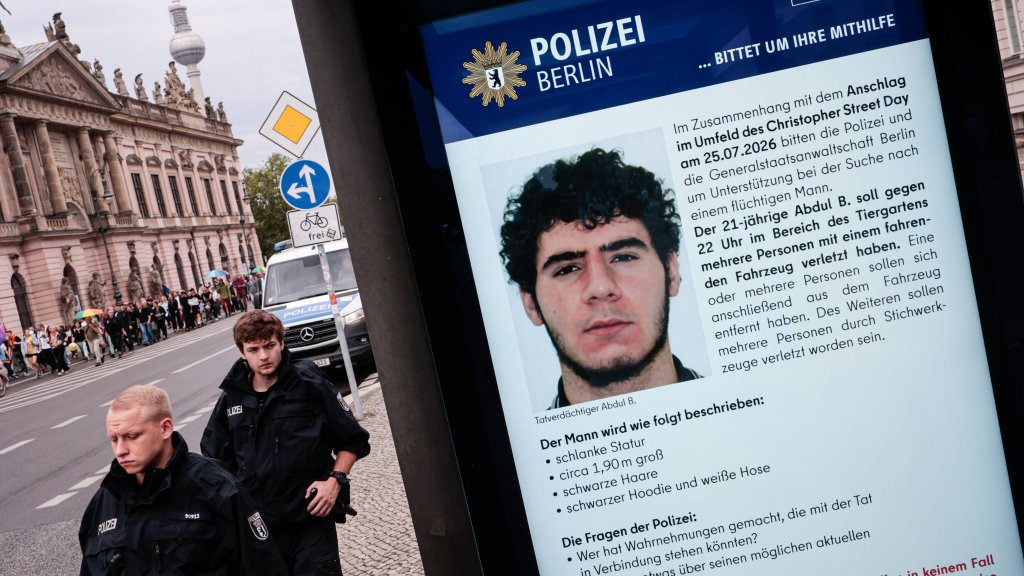
A video claiming responsibility recorded by Berlin Pride attacker Abdul Ballout was apparently sent to a contact with links to the terrorist militia Islamic State (IS) in Syria, according to reporting by WDR and Süddeutsche Zeitung. The video was stored on the mobile phone that investigators found in the man's vehicle after the attack. In it, a masked person pledges allegiance to IS in Arabic. Findings so far suggest that the recording was made on the day of the attack.
Key points at a glance
- Berlin Pride attacker Abdul Ballout apparently recorded a video claiming responsibility on the day of the attack.
- In it, the masked person pledges allegiance to the terrorist militia Islamic State (IS) in Arabic.
- According to findings by WDR and Süddeutsche Zeitung, Ballout is believed to have sent the video to a British female Islamist in Syria.
- Investigators' findings so far suggest that the woman was not privy to specific plans for the attack and did not instruct Ballout.
- The video may have been intended for wider distribution through a contact involved in IS propaganda. This apparently did not happen.
- Ballout was already known to the German security authorities and had been classified as a potential security threat and a high-risk individual.
- A woman was killed and 30 other people were injured in the attack in Berlin's Tiergarten park.
- Police have so far recovered only one of the attacker's at least three mobile phones. The suspected weapon used in the attack has also not yet been found.
Attack plans in the recording
The new information also sheds further light on the attacker's contacts before the crime. According to security sources, 21-year-old Abdul Ballout was in contact with a British female Islamist in Syria via his mobile phone in the days before the attack. Whether, and to what extent, these contacts were connected to the subsequent attack is the subject of the ongoing investigation. The video claiming responsibility is said to have contained no specific details about the planned attack. Unlike recordings of other Islamist-motivated attacks, it was not distributed through known IS propaganda channels. It was therefore initially unclear whether Ballout had shared the video with anyone else at all.
According to the investigative findings that have now emerged, he is believed to have sent it. The recipient is said to have been a known female Islamist from Britain who had joined IS in Syria as a teenager. According to the reporting, security authorities also examined communications between her and Ballout. The findings reportedly provide no evidence so far that the woman knew specific details of the planned attack. She is said neither to have instructed Abdul Ballout nor to have given him specific directions for the crime. A spokeswoman for the Federal Public Prosecutor's Office declined to comment to WDR and Süddeutsche Zeitung on either the video claiming responsibility or the attacker's contacts in Syria. She referred to the ongoing investigation.
Recording was intended for distribution
According to the reporting, security authorities believe that the British female Islamist was supposed to pass the video to someone involved in IS propaganda. From there, the recording was apparently intended to be distributed through the terrorist organisation's usual channels. This apparently did not happen. The contact in question is reportedly now dead. German security authorities are said to have information suggesting that the Islamist was killed in fighting in the Gaza Strip. His death could explain why the video was not published through IS channels after the attack in Berlin. The suspected recipient of the video was born in London to parents who had immigrated from Bangladesh. According to security authorities' findings, she became radicalised as a teenager. In December 2014, aged 15, she left Britain and travelled to Syria. There, she joined IS. According to what is known of the investigation so far, she had no active role in planning Abdul Ballout's attack.
Attacker under scrutiny
The attack took place on 25 July in Berlin's Tiergarten park. Abdul Ballout drove a vehicle into a crowd, then attacked several people with a machete. A woman was killed and 30 other people were injured, some seriously. A day later, Ballout was shot dead during a police operation (German). He had been hiding in a relative's garden hut in Berlin-Spandau.
The man was already known to the security authorities before the attack. He had spent several months in pre-trial detention. He is also said to have made two unsuccessful attempts to join IS terrorists abroad. He reportedly first intended to travel to Mauritania, then later to Syria. The security authorities listed Ballout as a potential security threat. An analytical tool used by the Federal Criminal Police Office had classified him as a high-risk individual weeks before the attack. He remained under scrutiny by the authorities after his release from custody. The technical examination of Abdul Ballout's devices has also not yet been completed. According to the current state of the investigation, he most recently had at least three mobile phones. So far, however, investigators have only been able to recover the phone left in his vehicle after the attack. The suspected weapon used in the attack also remains missing.








