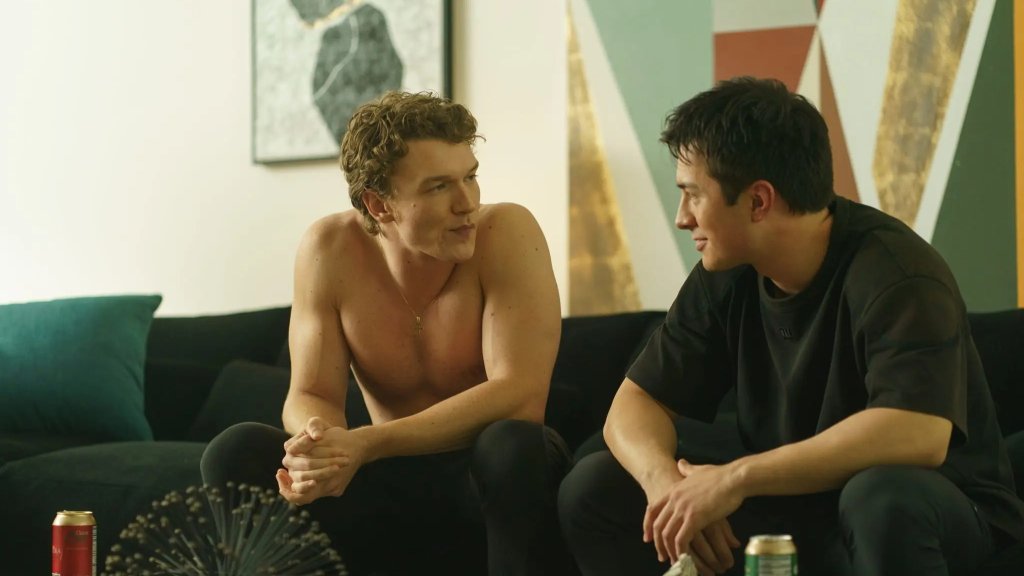
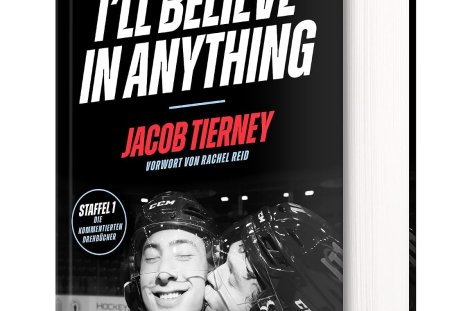
The gay ice hockey series “Heated Rivalry” has become an international television hit. Now its creator Jacob Tierney is offering insights into how the love story between rival players Shane Hollander and Ilya Rozanov came about. In a new book, the writer and director publishes the scripts for the first season and explains decisions made during production.
The key points at a glance
- New book about the hit series: “I'll Believe in Anything” contains the six annotated scripts for the first season, alongside previously unpublished behind-the-scenes material.
- Creator explains his decisions: writer and director Jacob Tierney discusses adapting Rachel Reid's novels, deleted scenes and spontaneous changes during filming.
- Coming-out scene rewritten at short notice: a rain delay prompted Tierney to fundamentally rework the scene between Shane and his mother Yuna.
- Actors shaped key moments: Connor Storrie and Hudson Williams contributed some of the best-known lines and gestures themselves.
- Groundwork already laid for a continuation: references to Ryan Price and Kyle Swift were deliberately included in the first season. Season two is set to adapt Rachel Reid's novel “The Long Game”.
The relationship between Shane and Ilya
The book “I'll Believe in Anything: The Making of Heated Rivalry Season 1” contains all six scripts, Tierney's personal notes and previously unpublished material. In several interviews, Tierney described how he adapted Rachel Reid's successful novels for television, why certain scenes were cut and how the actors influenced the finished series. “Heated Rivalry” tells the secret love story of two rival ice hockey players. Canadian Shane Hollander is played by Hudson Williams, while Russian player Ilya Rozanov is portrayed by Connor Storrie. Produced for Canadian streaming service Crave and HBO Max, the series explores themes including toxic masculinity, suppressed feelings and the difficulties of a same-sex relationship in professional sport.
For Tierney, preserving the emotional impact of the original novels was crucial. “I like the books. I enjoy them. I'm a fan,” he said. “That's how it started. I love the books. That's why I wanted to secure the rights to them.” However, he said he had never aimed for a word-for-word adaptation. “The truth about adaptations is that things have to change. They are simply different media, and so they demand different things.” The characters' internal monologues posed a particular challenge. Feelings and thoughts that Reid could describe at length had to be conveyed on television through dialogue, looks and physical behaviour. “I wanted it to feel the same as it does in the book,” Tierney explained. That meant staying true to the source material, but making changes where necessary to help the audience understand the story.
Memories shape the storytelling
Memory was an important storytelling device for Tierney. The main characters' relationship spans almost a decade. Rather than recounting every event chronologically, the director focused on how Shane and Ilya perceive their shared past. “It's there throughout, but especially at the beginning, when memories still seem blurred. For me, it was as though everything they remember revolved around each other,” Tierney said.
He cited Shane's first World Junior Championship as an example. If asked about it, Shane would probably talk above all about his first encounter with Ilya: “Oh, I met Ilya. I saw him in that tunnel. He was smoking, which was completely crazy.” This approach to storytelling allowed Tierney to make bigger leaps in time without losing sight of the relationship. It was also why the opening of the series was rearranged. The two players' first encounter was originally intended to be the eleventh scene. Tierney ultimately decided to begin the story with it instead. Shane's awkward politeness was meant to stand out in particular. He asks questions such as “How are your parents?” or “Do you miss Christmas?”, even though a different kind of tension is already palpable between the characters.
A sex scene open to several interpretations
The end of the fourth episode also explores the connection between memory, fantasy and reality. While Shane has sex with Rose, Ilya masturbates in the shower. Fans debated whether the events shown in parallel actually happen or exist in the characters' imaginations. Tierney accepts both interpretations. “For me, both answers are right,” he said. “Shane is thinking about Ilya, and Ilya is thinking about Shane.” He said the scene marks the moment when it becomes clear that their fixation on each other is mutual. At the same time, Shane and Ilya have different ideas about what the other is experiencing. Each sees the other as a threat in some way.
Body language conveys feelings
In his direction, Tierney placed great emphasis on physical expression. Shane's tense restraint and Ilya's intense looks were intended to reveal as much about the characters as their conversations. “Small physical moments are enormously important,” the director explained. “You reveal everything through the way you move, and through how you watch someone move through the world. Acting is deeply physical, and I think good writing is too. Because dialogue is often a way of talking around something. The body doesn't lie – at least not in the same way.” That was also why Tierney used camera shots that gave the actors enough room to move.
A deleted encounter
The book documents several scenes that were originally planned but later dropped. Ilya was supposed to meet Shane's parents Yuna and David, played by Christina Chang and Dylan Walsh, as early as the fifth episode. The encounter was planned to take place outside another ice hockey player's hospital room. In the finished series, however, the characters do not meet until the end of the sixth episode. Tierney ultimately felt the earlier scene was unnecessary. “Honestly, that scene felt like an unnecessary embellishment. I liked it at first, but I didn't need that moment.” His criterion, he said, was whether a scene advanced the central relationship. “The essential scenes are Shane and Ilya. Everything else can happen around the edges,” he explained. As a result, the storytelling is more reminiscent of a film about a single relationship than a conventional television series.
Rain changes the coming-out scene
One particularly far-reaching change concerned Shane's coming out to his mother Yuna in the final episode. It began to rain during filming. The scene had to be interrupted and resumed the following day. Tierney used the break to rewrite the dialogue. “I just thought, ‘I don't like this, this isn't working.’ When two actors are that good and a scene still isn't working, then it's down to me,” he continued. “It was too long.” It was only when the scene was performed that he realised there was too much talking around the real issue. He tightened the scene and had it begin practically in the middle of the conversation. He deliberately wanted to make the revision during production rather than later in the edit. “There is a way to fix something like that in the edit, but I don't particularly like doing that. I'd rather resolve it on the day of filming.” The actors quickly adapted to the changes, he said. In Tierney's view, they made the scene considerably better.
The declaration of love
Tierney took a different approach to the declaration of love between Shane and Ilya. The scenes take place at Shane's holiday home, where the two can spend an extended period together without outside pressure for the first time. Here, the director deliberately wanted a slower pace. “I prefer writing this way. I don't like it when conversations happen too quickly. Then I feel as though I'm watching a bad play,” he said. Previously, the characters had constantly been occupied with actions and decisions. Now viewers were meant to experience them simply spending time together. One scene was particularly important to Tierney: the two sitting side by side on the sofa, looking at their smartphones. That would be an everyday occurrence for other couples, but something extraordinary for Shane and Ilya. In their situation, they could hardly believe they were allowed simply to sit together on the sofa and watch Instagram videos. These unremarkable moments in particular were intended to show how much their relationship means to them.
Famous lines
Although Tierney prepared his scripts in detail, he gave the actors increasing freedom. Towards the end of production, he said, Connor Storrie and Hudson Williams understood their characters so well that they could make important creative decisions themselves. Several fan-favourite moments were not originally in the script. These include Ilya's “I'm sorry” as he breaks down emotionally in front of Shane, and his insistent “Gimme Kiss”. Shane's halting “bet-ter” in hospital, while Ilya holds his hand, also emerged during filming.
Tierney stressed that such additions did not automatically make it into the series. “People say, ‘That's improvisation.’ Improvisation is one thing, but I chose to use it.” During the holiday-home scenes, which were filmed last, he had particularly encouraged the actors to make their own decisions. “These are your characters now. You can make decisions for them,” he told them. His general invitation to the cast, he said, was: “Surprise me.”
Laying the groundwork for more characters
The published scripts also contain hints about the continuation. Ice hockey players Ryan Price and Eric Bennett from Rachel Reid's novels were originally supposed to appear in the first season. Ryan was ultimately only mentioned, while Eric was cut entirely. “We kept talking about Ryan Price, but there is a right time and place for everything,” Tierney said. Bartender Kyle Swift, played by Matthew Finlan, was also introduced deliberately. The character appears only briefly in the first season, but has a much bigger role in Reid's novel “Common Goal”. “Casting Kyle was so important because there is a world in which he gets his own series or the story continues,” Tierney explained. He praised Finlan as a very good actor. At the same time, he said, it was difficult to cast roles that initially involved only a brief appearance but could become much more important later.
The work behind the camera
With “I'll Believe in Anything”, Tierney wants not only to explain individual decisions but also to shine a light on the work of the entire production team. The notes cover subjects including costumes, production design, cinematography, intimacy coordination and the integration of Scott and Kip's story into the plot. “I hope it gives them a fuller understanding of how many people it takes to make a series like this,” Tierney said. Alongside the actors, numerous other contributors had played a crucial part in its success, including musicians, camera crews, costume designers, production designers and the editing team. The series brought Hudson Williams and Connor Storrie international recognition and received a Peabody Award. Its portrayal of gay intimacy and the emotional development of its main characters attracted particular attention. The second season is set to continue the story based on Rachel Reid's novel “The Long Game”. Production is already under way, with the new episodes scheduled for release on HBO and Crave in April 2027.








