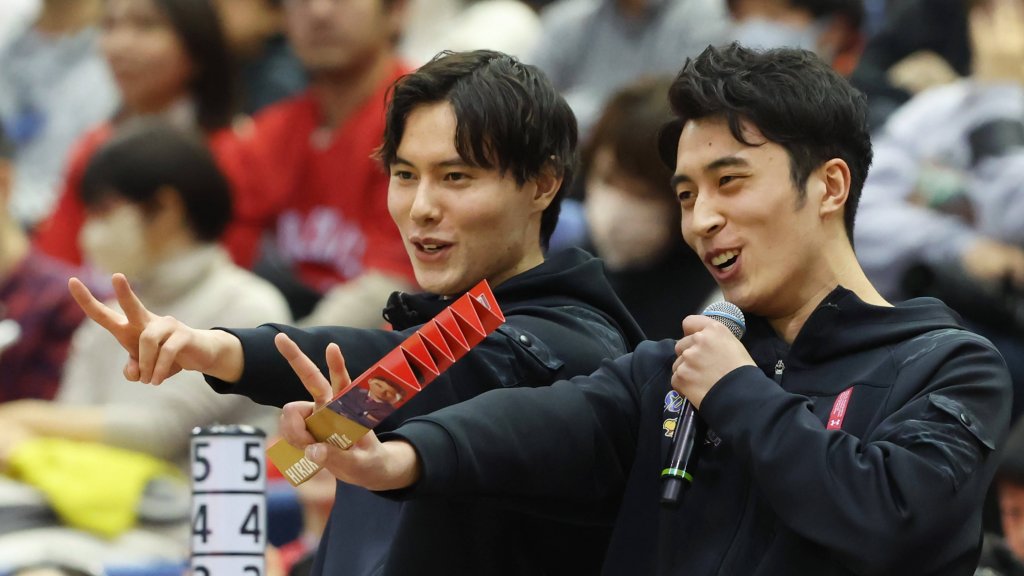
Japanese professional volleyball player Rui Takahashi has spoken at length for the first time about coming out and the fears surrounding it. In an interview with the newspaper Asahi Shimbun, the 26-year-old explained that before his public announcement, he had even been prepared to give up his sporting career. The support of his younger brother Ran had been particularly important to him.
Key points at a glance
- Historic coming out: The 26-year-old professional volleyball player Rui Takahashi came out as gay in late September. He is considered the first Japanese male professional athlete to have taken this step publicly.
- Fears for his career: Takahashi had prepared for fierce rejection and had even anticipated having to end his volleyball career.
- Family support: His younger brother Ran, a Japanese national team player, responded calmly and assured him of his support.
- Positive reactions: Teammates, his club and fans from around the world responded largely positively. His family also received considerable support.
- Another coming out: A day later, volleyball player Reon Arao also publicly announced being part of the LGBTQ+ community. Arao described Takahashi as an inspiration.
- The organisation Pride House Tokyo sees these events as a potential turning point, but is calling for binding measures against discrimination in sport.
A historic coming out
Takahashi publicly announced in late September that he is gay. As the first Japanese male professional athlete to take this step, he said he had faced an uncertain response. Instead of the rejection he had feared, however, he received largely supportive reactions. Rui continues to play for Suntory Sunbirds Osaka in Japan's SV.League. His younger brother Ran, who plays as an outside hitter for the Japanese national team, was also under contract with the club until recently. He has since joined the Polish club LKPS Lublin. As Asian champions, the Japanese national team have qualified for the Olympic Games in Los Angeles.
Feelings long suppressed
In the interview, Rui Takahashi describes how he immersed himself in volleyball from childhood. The sport had also been a way for him to distract himself from his own feelings. During his teenage years, friends would occasionally speculate about his sexual orientation. However, he would deny or play down such rumours. It was only in his early twenties that Takahashi began to explore his identity more deeply. In 2024, his cousin became the first person in his personal circle he confided in. She is around the same age and is close to both brothers. According to him, a personal experience prompted the conversation. “For the first time, I had the opportunity to fall in love with a man. Until then, I hadn't understood myself, had denied who I was and hadn't tried to examine my feelings,” Takahashi said.
Brother Ran's surprising response
Shortly afterwards, Rui also told his younger brother that he was gay. At the time, Ran had just joined Suntory Sunbirds and was already one of Japan's best-known volleyball players. His response was different from what Rui had expected. “When I first told Ran, he said, ‘That's interesting.’ I hadn't expected that answer at all.” Rui had prepared himself for a difficult conversation. “I thought, ‘No, I'm really worried about this!’ His relaxed attitude was an incredible relief.” The brothers then discussed the subject in greater depth. What mattered most, however, was that Ran had treated his sexual orientation as something entirely natural from the outset. “Afterwards, of course, we talked about all sorts of things. But rather than getting caught up in the seriousness of the situation, his initial reaction made me realise that I didn't have to take it all so heavily.”
Aiming to come out before turning 30
Over the following two years, Takahashi spoke to several close friends about his sexual orientation. Eventually, he began to think about coming out publicly too. He explored the experiences of other openly gay athletes, including British diver Tom Daley (German) and American volleyball player Erik Shoji (German). In Japan, however, he lacked comparable role models. The possible impact on his career and private life therefore continued to worry him.
Nevertheless, he decided to take the step. “Whether I play volleyball or not, once I picture the kind of person I want to become, I'm the sort of person who becomes unhappy if I don't achieve that goal,” Takahashi explained. “I think that's probably because I'm a serious person. And once I say I want to make it public, I go through with it.” He also wanted to encourage other people with similar experiences. “When I thought about the possibility of being accepted for being gay, and that there must be many fans and other people struggling with the same feelings, I felt a strong desire to make it public as soon as possible.” He had also set himself a deadline. “Besides, I didn't want to turn 30 without having come out.”
Family support
Before his public announcement, Rui also considered the possible consequences for his brother. As a national team player, Ran is particularly well known in Japan. Rui therefore feared that his coming out could have a negative impact on Ran's reputation or career. “I realised that the public sees me as ‘Ran Takahashi's brother’. So I was afraid that it might put him at some kind of disadvantage.” He spoke openly about this fear. “When I told Ran about it, he said, ‘No, that doesn't matter.’ His exact words were: ‘It's your life, so I support you.’ And that meant a great deal to me.” His parents also received a positive response after he came out. Their mother runs a café in Kyoto, the brothers' home city. “After I came out, so many people came up to my parents and said, ‘We'll keep supporting you.’ Not a single person turned their back on us,” Rui reported.
Reon Arao follows by coming out
Just one day after Takahashi's public announcement, another player in Japan's volleyball league publicly shared an LGBTQ+ identity. Reon Arao, who plays for league rivals Voreas Hokkaido, posted a message on social media. Beforehand, Arao had contacted Takahashi to ask for advice. “Reon asked me for advice and explained that there was something Reon was struggling with too. Reon also asked whether it would be all right to mention in the message that my coming out had been an inspiration,” Rui reported. His answer was unequivocal. “I replied, ‘Of course that's all right.’” For Takahashi, being able to help another person immediately after coming out himself was a special experience. “I'm simply incredibly happy that I was able to support Reon in finding the courage to speak publicly.”
Signs of change
The Japanese LGBTQ+ organisation Pride House Tokyo is also following both coming-out stories closely. The initiative runs Japan's first large, permanent LGBTQ+ community centre in Tokyo's Shinjuku district. The project was originally established in connection with the Tokyo 2020 Olympic and Paralympic Games. It was the first Pride House to be officially recognised by an Olympic organising committee. It has since developed into a broad support network extending beyond sport. Non-profit organisations, businesses and foreign embassies are involved.
Speaking to the sports website Outsports, chair Yuri Igarashi particularly praised Takahashi's decision to speak on his own terms. “We have great respect for Rui Takahashi for speaking publicly in his own words and at a time of his own choosing.” The situation of openly gay and queer men in elite sport has long been an international issue, she said. “The difficulty of coming out as a male elite athlete in a team sport has long been discussed – in every country.” Igarashi sees Arao's decision to go public immediately afterwards as significant. “One person's step leads to the next. It feels like a moment of real change in Japanese sport.”
Clubs must take responsibility
In Igarashi's view, however, public recognition alone is not enough. What matters is that openly gay and queer athletes can continue their careers without disadvantage. Different institutions need to work together to achieve this. “Teams, leagues, sponsors, the media and every single fan all play a part in creating such an environment.” Igarashi also pointed out that the reactions had not been exclusively positive. “The responses on social media were largely warm. However, we also saw some sensationalist headlines and hurtful comments.” She warned against reducing the two players solely to their sexual or gender identity in future. “We hope the media will continue to cover them as athletes, and not just as ‘athletes who have come out’.”
Protection against discrimination and marriage
Despite these positive experiences, Pride House Tokyo still sees structural difficulties for LGBTQ+ athletes in Japan. Igarashi pointed out that Japan has no comprehensive law explicitly banning discrimination based on sexual orientation or gender identity. Coming out could therefore still entail personal and professional risks. Sports federations and leagues need to establish binding rules and support services. “Change should not depend solely on the courage of individuals. Sports federations and leagues need clear guidelines and support systems.” The long-term consequences of the two coming-out announcements for Japanese sport remain uncertain. The community hopes that they might also finally give fresh impetus to the fight for same-sex marriage (German) – Japan remains the only G7 country without a marriage law for gay men and lesbians.








