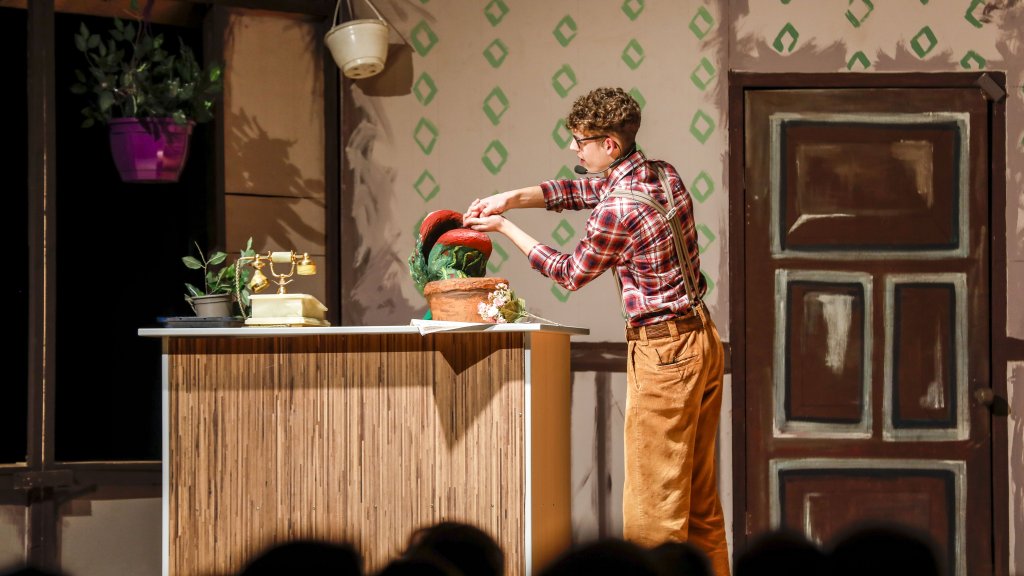
A casting decision at a high school in the US state of Texas has sparked a dispute over gender roles, artistic freedom and legal requirements, and is currently fuelling debate nationwide. After student Ana Mota was chosen to play the traditionally male lead in a musical, the school district responsible cancelled the entire production.
The key points at a glance
- Musical cancelled: A high school in the US state of Texas has cancelled its planned production of “Little Shop of Horrors” (“Der kleine Horrorladen”) after a female student was given the traditionally male lead role.
- Ana Mota was told to give up the role of Seymour after about a week of rehearsals. Instead, she was offered the chance to share the female lead with another student.
- School district cites law: Officials attribute the cancellation to problematic relationship themes in the musical and Texas’s Senate Bill 12, which restricts school activities concerning sexual orientation and gender identity.
- Family considers legal action: Mota believes she has been disadvantaged because of her sex. Her mother questions the school’s legal justification and is considering legal action.
Girl barred from role
The production affected is “Little Shop of Horrors” (“Der kleine Horrorladen”) at South Grand Prairie High School in the Dallas–Fort Worth metropolitan area. The Grand Prairie Independent School District (GPISD) confirmed the cancellation, citing Texas’s Senate Bill 12 among other reasons. Mota, who is in her final year at school, was originally cast as Seymour. In the musical, Seymour works in a florist’s shop, discovers a bloodthirsty plant and at the same time tries to grow closer to his colleague Audrey. According to those involved, the casting of a female student in the male lead was the result of a selection process that did not take gender into account. But after rehearsals began, those responsible changed their decision.
As theatre journalist Howard Sherman reported in his publication “Downstage Center”, Mota was informed about a week after rehearsals began that she would no longer be allowed to play Seymour. The lead role was instead to go to the male understudy. Mota was offered the female role of Audrey, which she would share with another student. For her, this was not an acceptable alternative. “I was frustrated because I had earned a role and worked hard for it, and then I wasn’t allowed to play it,” Mota told broadcaster WFAA-TV. She also criticised the consequences for the entire theatre group: “That’s not a compromise at all. It feels more like a punishment for everyone involved in the cast.” In an open letter on Instagram, Mota said the school district’s decision was denying her an educational opportunity because she was a girl. The dispute did not remain confined to casting. Eventually, the entire musical production was cancelled.
School district explains cancellation
In a statement, the school district said officials had concerns about the plot and the portrayal of an abusive relationship. “When district leadership became aware of this issue, it was decided, taking into account the musical’s themes, including an abusive relationship, to cancel the production and find something more appropriate,” the school district said. The school administration also said the decision was linked to efforts to bring all school provision into line with Senate Bill 12 and other applicable laws.
The Texas law came into force in September 2025. It places restrictions on school teaching, activities and programmes concerning sexual orientation and gender identity. Whether casting a female student in a male theatre role actually falls within these legal restrictions is, however, disputed. In its public explanation, the school administration emphasised the musical’s themes and compliance with legal requirements. However, the sequence of events raises questions about the decisive reason for the cancellation.
Same musical, different school
The website “Friendly Atheist” covered the controversy and asked why the musical’s content was only deemed problematic after Ana Mota had been cast. After all, South Grand Prairie High School had already staged “Little Shop of Horrors” four years earlier. In addition, the Grand Prairie Fine Arts Academy, which is part of the same school district, is staging the musical this year. It therefore remains unclear why the plot has led to a complete cancellation at one school while another institution in the same district can continue to stage the show.
The musical has been part of the international theatrical repertoire for decades. It became particularly well known through the 1986 film adaptation directed by Frank Oz and starring Rick Moranis and Ellen Greene. The story centres on the initially unassuming plant Audrey II, which turns out to be a flesh-eating creature and makes increasingly menacing demands. The show combines black humour, a love story and elements of horror.
Mother criticises legislation
For Mota’s family, the conflict goes far beyond a single school production. Speaking to theatre journalist Howard Sherman, her mother criticised what she sees as the intimidating effect of legislation targeting LGBTQ+ people and forms of artistic expression. “I don’t know at what point we became like this,” she said. In her view, politicians should focus more on social problems such as access to healthcare, affordable housing, food insecurity and gun violence.
Her mother also said the family was considering legal action if the school district did not reverse its decision. Mota herself sees her exclusion from the lead role as a possible violation of the US federal law Title IX. This law prohibits discrimination on the basis of sex in educational programmes and institutions that receive federal funding. Whether the school district’s decision actually violates Title IX would need to be legally assessed. According to the available reports, no court has made such a finding.
“This isn’t drag at all”
The student particularly rejects the idea that her casting as Seymour was some kind of staging with a gender-political agenda. She had previously played male characters on stage, including Jack in the musical “Into the Woods”. According to her, roles were allocated without regard to the applicants’ gender. “This isn’t drag at all,” Mota told “The Dallas Morning News”. Her mother, Nancy Jimenez, also disputed the school district’s legal argument. “The law itself does not apply to this situation at all,” she told broadcaster NBC DFW.
In theatre productions at American high schools, it is not unusual to cast roles regardless of the performers’ gender. This is partly because the composition of theatre groups and the available vocal ranges do not always match the roles in the original shows. In school theatre in particular, casting is also intended to allow students to develop a range of acting skills and gain experience. The case also recalls a similar dispute in 2023. At that time, a trans boy in Texas was barred from playing a male lead in a school production of the musical “Oklahoma!”. The school district responsible said at the time that it intended to take account of each character’s gender as specified in the script when casting future productions.








