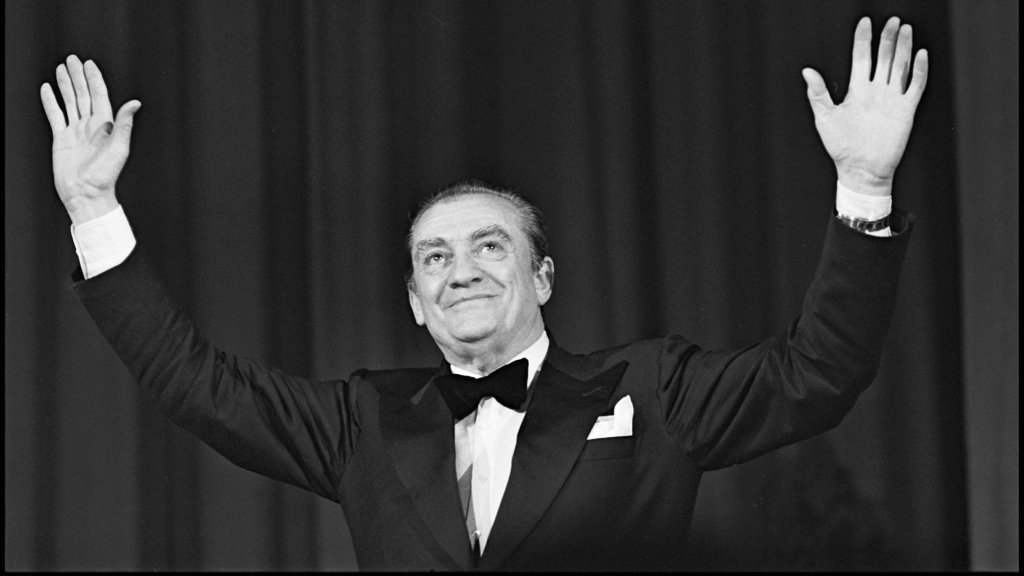
He came from one of Italy’s most respected aristocratic families, became a committed communist and developed into one of the most important directors of post-war European cinema. Luchino Visconti combined social criticism with lavish historical productions, repeatedly exploring power, social decline, beauty and human desire in his films. This week, the Italian filmmaker would have turned 120.
Key facts at a glance
- 120th birthday: Luchino Visconti was born in Milan on 2 November 1906. The Italian director came from a wealthy aristocratic family and died in 1976 at the age of 69.
- A pioneer of neorealism: With his directorial debut “Ossessione” (1943) and the social drama “La terra trema” (1948), Visconti influenced the development of post-war Italian cinema.
- International breakthrough: His historical film “The Leopard” won the Palme d’Or at the Cannes Film Festival in 1963.
- Homosexuality and art: Visconti was gay. His relationship with actor Helmut Berger also shaped his artistic work. Questions of identity, beauty and unfulfilled desire played an important role in his films.
- Lasting influence: Alongside his work as a film director, Visconti also enjoyed success in theatre and opera. His productions had a lasting influence on European auteur cinema.
A master of cinema
Visconti’s body of work comprises just fourteen feature films. Yet he is still regarded as one of the most influential figures in Italian neorealism and European auteur cinema. His films explore social conflicts as well as personal dependencies and sexual identity. His own homosexuality and his relationship with Austrian actor Helmut Berger (German) are also part of his life story. Themes such as same-sex desire, loneliness and the conflict between social expectations and individual needs took on particular significance in his later work.
A childhood among aristocratic palaces
Luchino Visconti was born in Milan on 2 November 1906. His family belonged to one of Italy’s oldest aristocratic dynasties and possessed considerable wealth. His father held the title of Duke of Grazzano. His mother came from a family that had made its fortune through a pharmaceutical company. Visconti spent his childhood in an environment shaped by social privilege, art and aristocratic traditions. Family life included stays in city palaces and summer residences, as well as visits to racecourses. Music also played a central role from an early age. The young Visconti was particularly fascinated by opera. His family had its own box at La Scala in Milan, one of the world’s most important opera houses. “As a child, I heard more operas than fairy tales,” Visconti later recalled. His deep engagement with music, theatre and elaborate stage sets influenced his later style as a film and opera director.
Political convictions
Initially, there was little to suggest that Visconti would one day make film history. In the 1920s, he was mainly occupied with horse breeding. It was not until the mid-1930s that his life took a decisive turn. Visconti went to Paris and became involved in the city’s left-wing artistic scene. Through fashion designer Coco Chanel, he met French film director Jean Renoir. Visconti began working as his assistant, gaining his first practical experience in filmmaking. His encounter with Renoir influenced not only his artistic development but also his political views.
The Italian aristocrat from a privileged family embraced communism. Social inequality, poverty and the living conditions of working people increasingly became the focus of his interest. Working with Renoir also sharpened his eye for depicting human relationships and social power structures. “Renoir showed me how to film people with respect,” Visconti later said.
“Ossessione” changes cinema
In 1943, Visconti released his first feature film, “Ossessione”. Based on the novel “The Postman Always Rings Twice”, the drama tells a story of passion, dependency and crime. Its depiction of poverty, desire and social conflict set it apart from the idealised productions that had characterised Italian cinema under fascist rule. Visconti showed people living in difficult circumstances without presenting a sanitised image of their surroundings. State censors responded to the work. “Ossessione” was initially banned and later shown only in a censored version. Today, the film is regarded as a pivotal starting point for Italian neorealism.
Social inequality
After the Second World War, Visconti continued to explore social conflicts. In 1948, he made “La terra trema”, a film about the life and economic difficulties of a fishing family in Sicily. Filming took place in a Sicilian fishing village. Visconti worked with non-professional actors and adopted a documentary-like approach to depicting everyday life. The film centres on poverty, exploitation and the fishermen’s dependence on economic power structures. Despite his realist approach, Visconti placed great emphasis on visual composition.
In the 1950s, Visconti developed his distinctive artistic style further. While his early films were strongly shaped by neorealism, he increasingly turned to historical subjects and lavishly designed productions. Colour, costumes, architecture and music took on ever greater importance. In 1954, he released “Senso”. This was followed in 1960 by “Rocco e i suoi fratelli” (“Rocco and His Brothers”). The film tells the story of the disintegration of a southern Italian family who move to a big city, where they face social conflicts.
Success in opera
Alongside his film work, Visconti worked as a theatre and opera director for many years. His productions attracted particular attention at La Scala in Milan. Among the artists he worked with was the internationally acclaimed opera singer Maria Callas. Visconti placed great emphasis on historical accuracy, meticulous stage design and the psychological development of his characters. His opera productions were considered pioneering because he combined musical performance with intense dramatic staging. His experiences in theatre and opera also influenced his later films, whose design and visual composition often recalled large-scale stage productions.
Breakthrough with “The Leopard”
Visconti reached a high point in his career in 1963 with the historical film “Il Gattopardo” (“The Leopard”). The work depicts the decline of the Sicilian aristocracy in the 19th century against the backdrop of political and social change in Italy. At its centre is an aristocratic patriarch who recognises that the existing social order is increasingly losing its significance. American actor Burt Lancaster played the leading role. The film became particularly well known for an elaborately staged ballroom sequence, in which Visconti combines the elegance of aristocratic society with an awareness of its impending decline. “The Leopard” won the Palme d’Or at the Cannes International Film Festival in 1963. This success cemented Visconti’s international reputation as one of Europe’s leading film directors.
Homosexuality and desire
In the late 1960s and early 1970s, Visconti increasingly explored the relationship between power, sexuality, social constraints and personal identity. His so-called German trilogy dates from this period. It began in 1969 with “The Damned”. The film depicts the moral and political disintegration of a German industrialist family during the rise of Nazism. It was followed in 1971 by “Death in Venice”, an adaptation of Thomas Mann’s novella of the same name. The film tells the story of an ageing artist who, during a stay in Venice, is drawn to the beauty of a young man (German). Visconti turned it into a powerful exploration of unfulfilled desire, transience and the relationship between beauty and death. Its portrayal of same-sex attraction gave the film particular significance within European film history. Visconti treated homosexual desire not as an isolated social issue, but as part of a broader exploration of human emotions, longings and conflicts.
Helmut Berger as his partner
Austrian actor Helmut Berger (German) played an important role in Visconti’s private life and artistic work. The two had a romantic relationship lasting several years, which was also characterised by close professional collaboration. Berger took on significant roles in Visconti’s films and became one of the best-known actors in his later work. Their relationship was regarded as intense and fraught with conflict. At the same time, it influenced both men’s artistic development. “Ludwig”, the third part of the German trilogy, was made in 1973. The film focuses on the gay Bavarian king Ludwig II (German), who increasingly withdraws from political reality and seeks refuge in art, music and personal longings. Visconti portrayed a ruler whose vision for his life comes into conflict with the expectations of his social position.
The director’s legacy
In 1972, Visconti suffered a stroke. Despite its effects on his health, he continued to work as a director. In 1974, he released “Conversation Piece”, a drama focusing more closely on personal relationships and conflicts within a confined social milieu. His final film was “L’Innocente”, from 1976. The director died in Rome on 17 March 1976 at the age of 69. Although Visconti directed only around a dozen feature films during his career, he influenced several generations of filmmakers. The combination of apparent opposites remained a hallmark of his work. His films combined social criticism with a pronounced aesthetic sensibility, exploring personal longings as well as historical upheavals.
Visconti also holds particular significance in the history of gay artists. His homosexuality was part of his life story, without being the sole defining feature of his films. Instead, he explored same-sex desire, social expectations and personal conflicts within broader historical and cultural contexts. “Death in Venice” and “Ludwig” in particular show how closely questions of sexual identity can be linked to themes of loneliness, power and social exclusion. In doing so, Visconti created cinematic portrayals of homosexual experiences that went far beyond simplistic stereotypes. On the 120th anniversary of his birth, the film world remembers a director whose artistic signature remains recognisable to this day.








