With just under a week to go before the state election in Mecklenburg-Vorpommern, both the parties’ LGBTQ+ policy positions and the CDU are in the spotlight. LSVD+ Mecklenburg-Vorpommern has surveyed the parties standing in the election on 20 September 2026 using nine LGBTQ+ policy questions. At the same time, concern is growing within the state CDU that the party could fail to return to the state parliament.
Key points at a glance
- LSVD+ Mecklenburg-Vorpommern has surveyed the parties standing in the state election on 20 September 2026 on nine LGBTQ+ policy issues.
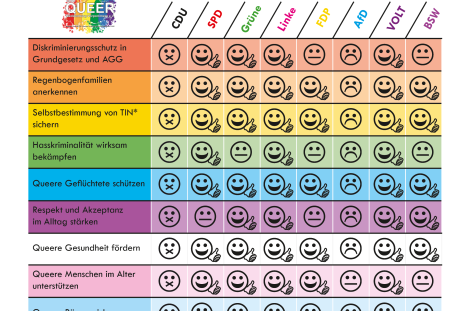
- Die Linke and Volt received positive ratings in all nine areas assessed.
- The SPD and Bündnis 90/Die Grünen received predominantly positive ratings.
- The FDP and BSW received positive ratings in several areas, but LSVD+ found that some of their responses lacked precision.
- The AfD received negative ratings in eight policy areas, while its position in one area was rated as imprecise.
- According to LSVD+, the CDU provided no responses on the issues surveyed that could be assessed.
- A week before the election, CDU politicians fear that their party could fail to clear the five per cent threshold.
- CDU politicians blame the difficult situation partly on federal politics and the election campaign run by Minister-President Manuela Schwesig (SPD).
LGBTQ+ policy and the election campaign
With its election questionnaire, LSVD+ Mecklenburg-Vorpommern aims to give voters factual guidance ahead of the election. The organisation explicitly stresses that its assessment does not constitute a voting recommendation. “The LGBTQ+ policy questionnaire shows very clearly that the state election on 20 September is about concrete political support for the safety and self-determination of queer people in Mecklenburg-Vorpommern. Particularly in light of growing hostility towards queer people, we expect reliable political answers from all parties on how they intend to protect and strengthen queer life in Mecklenburg-Vorpommern in future,” explains Sebastian Witt, a board member of LSVD+ Mecklenburg-Vorpommern.
Assessing the parties
Die Linke and Volt fare particularly well in the assessment. Their positions received positive ratings in all nine policy areas examined. According to LSVD+, the SPD and Bündnis 90/Die Grünen also take clearly supportive positions in the vast majority of areas. The verdict on the FDP and BSW is more mixed. Both parties receive positive ratings in several policy areas. At the same time, the organisation finds that their responses lack precision in several areas. The assessment of the AfD is considerably more critical. Its responses were rated negatively in eight of the nine policy areas. In the remaining area, LSVD+ rated its position as imprecise. By contrast, the organisation says it found no responses from the CDU on the issues surveyed that could be assessed.
Will the CDU lose its place in the state parliament?
While LSVD+ compares the parties’ policy positions, nervousness is growing within the CDU in Mecklenburg-Vorpommern. According to the latest polls before the election, the party is now polling at only around seven per cent. Although this puts it above the five per cent threshold, it leaves only a comparatively narrow margin above this crucial mark. A week before the election, CDU politicians are therefore increasingly concerned about what might happen if the party slips further in the polls. In the worst-case scenario, it could lose its place in the state parliament. “There is concern about failing to clear the five per cent threshold,” Marc Reinhardt, deputy leader of the CDU parliamentary group in the state parliament in Schwerin, told Tagesspiegel. Eckhardt Rehberg, a former leader of both the state CDU and its parliamentary group, also sees a danger of the Christian Democrats losing their place in parliament. Given the current polling figures, he said, there was “a danger that the CDU will drop out of the Mecklenburg-Vorpommern state parliament”.
AfD leads in the polls
Mecklenburg-Vorpommern will elect a new state parliament on 20 September. The AfD is currently ahead of the SPD in the polls. The CDU has recently fallen to around seven per cent; it performed considerably better in the previous state election in September 2021. Back then, it won 13.3 per cent of the vote. For Reinhardt, the current situation is correspondingly difficult. Among the reasons he cited were the public mood and a lack of support from federal politics: “Many people are dissatisfied; the federal government is not giving us any momentum.” The state CDU is also regularly confronted with federal politics on the campaign trail. CDU campaigners are frequently asked about Federal Chancellor Friedrich Merz.
Attack on Schwesig
However, Reinhardt does not see federal politics alone as the central problem. In his view, Minister-President Manuela Schwesig (SPD) is running a “populist election campaign devoid of substance”. He says: “She polarises and thinks only of herself. The CDU ends up caught between the far right and the left.” He also believes the minister-president is running an “AfD-or-me election campaign” that “draws votes away from all the other parties”. At the same time, he says, the state CDU faces another problem: it is suffering “from the federal government’s dismal reputation”.








