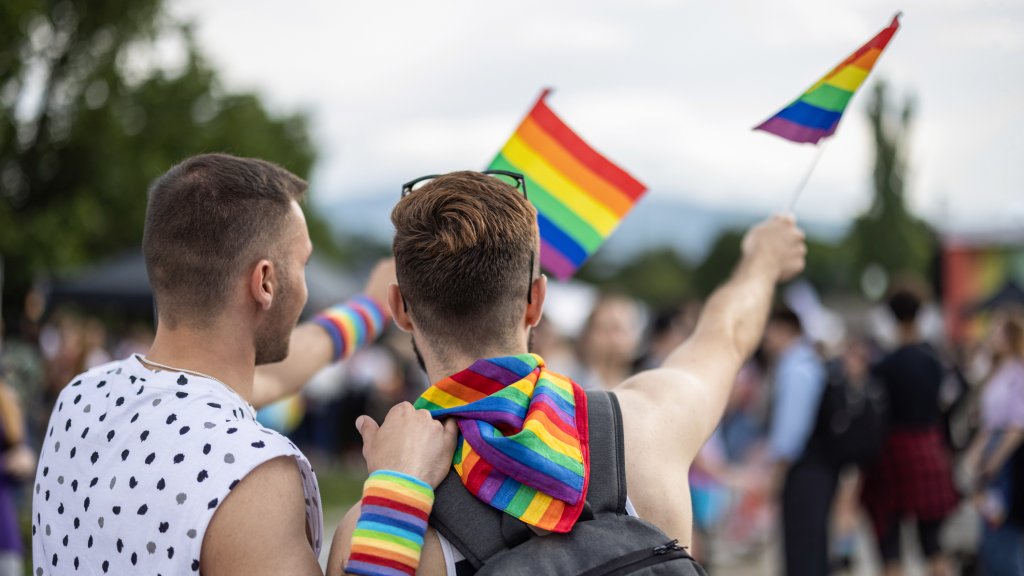
A counter-demonstration is planned for this Saturday's Christopher Street Day (CSD) Pride event in Bernau, in the German state of Brandenburg. According to police, a second gathering has been registered in the town in the Barnim district alongside the CSD. It is directed against the LGBTQ+ community's event.
Key points at a glance
- A Christopher Street Day event will take place this Saturday in Bernau, in Brandenburg's Barnim district.
- Police have also received a registration for a second gathering, directed against the CSD.
- The neo-Nazi group “Deutsche Patrioten voran” (DPV) is promoting the counter-protest on social media.
- The group had already called for a counter-demonstration at the CSD in Rathenow. According to police, “fewer than 40” people took part there.
- Brandenburg's 2025 domestic intelligence report classifies the group as part of “violence-oriented subcultural neo-Nazism”.
“Deutsche Patrioten” plan to protest
The neo-Nazi group “Deutsche Patrioten voran” (DPV) is mobilising support for the counter-protest on social media. In an Instagram post, the group writes that it wants to protest “for child protection”. This is not the first time DPV has mobilised against a CSD in Brandenburg. Only a few weeks ago, the group organised a counter-protest on the sidelines of Christopher Street Day in Rathenow. The turnout was low, however. According to police, “fewer than 40 people” took part in the event. The group also appears in Brandenburg's 2025 domestic intelligence report, which classifies its members as part of “violence-oriented subcultural neo-Nazism”.
Far-right attacks at CSD events
CSD events have increasingly been targeted by Germany's far-right scene for some time. Since mid-2024, the domestic intelligence service has recorded repeated far-right extremist disruptions or related mobilisation attempts across the country, highlighting incidents in Bautzen, Leipzig, Magdeburg and Zwickau, among others. The trend continued in 2025: according to an analysis by the Amadeu Antonio Stiftung (German), 66 per cent of the CSD events examined in eastern German states were affected by attacks or disruptions, compared with around 38 per cent in the west. The documented incidents included far-right counter-demonstrations, attempts to prevent events from taking place, hatred and incitement, as well as property damage and physical violence.








