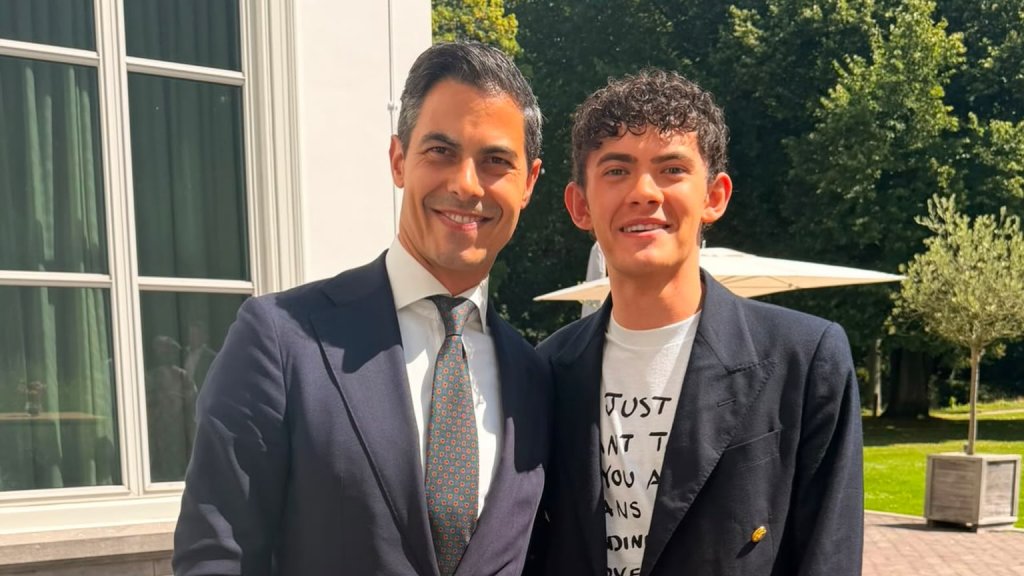
Gay Dutch Prime Minister Rob Jetten (39) has made a statement in support of LGBTQ+ visibility and safety at World Pride 2026 in Amsterdam. Alongside a meeting with gay Heartstopper actor Joe Locke (22) (German), the prime minister announced a new funding programme worth millions and warned of the growing spread of hate and disinformation.
Key points at a glance
- Rob Jetten met actor Joe Locke at World Pride 2026 in Amsterdam.
- The prime minister recognised the importance of “Heartstopper Forever” for visibility and acceptance.
- The Dutch government is providing €7.5 million a year for three years to protect LGBTQ+ people.
- Jetten warned of increasing hate speech and disinformation online.
- The prime minister commemorated the victims of the Berlin Pride attack
Feeling understood through Heartstopper
On his social media channels, Jetten reported on his meeting with British actor Joe Locke, who rose to international fame through the series Heartstopper (German). “It was wonderful to spend time with Joe Locke during World Pride 2026,” Jetten writes. The gay Dutch prime minister continued: “Heartstopper Forever is more than just a film. It shows us that kindness matters, that love should be celebrated and that hope can be found even in difficult times. Art, books and films like this help people around the world feel seen and understood, and a little less alone. That is why representation is so important.”
Addressing Locke directly, the 39-year-old prime minister added: “Thank you, Joe, for using your talent and your voice to inspire so many people. Let us keep building a world where everyone can be free to be exactly who he or she is – with hope, courage and joy.” Heartstopper tells the coming-of-age story of gay schoolboy Charlie, played by Joe Locke, who falls in love with his classmate Nick. The series is based on Alice Oseman’s webcomic of the same name. It recently concluded with the final film “Heartstopper Forever”.
Greater protection for LGBTQ+ people
At the opening of the World Pride Human Rights Conference in Amsterdam yesterday, Jetten also announced a new package of measures to protect LGBTQ+ people. According to Jetten, the Dutch government will provide €7.5 million in each of the next three years. The money is intended to fund projects, combat discrimination and improve public safety. Efforts to tackle disinformation and misinformation about LGBTQ+ people are also to be stepped up.
In his opening speech, Jetten warned that progress towards equality was once again being called into question in many parts of the world. Hate speech was becoming increasingly socially acceptable. According to Jetten, “toxic, highly organised and well-funded groups hiding behind the façade of freedom of expression” are major contributors to this development. He also accused major social media platforms of failing to do enough to tackle abusive and hateful content. “Hate groups no longer feel held back,” Jetten said. “In my view, the rise of online hate is one of the greatest threats to LGBTQ+ people today. Misinformation – and deliberate disinformation – can be spread in a fraction of a second with a single click of a mouse.” This, he said, allowed it to reach far more people than non-governmental organisations, youth workers or health organisations could. “This is how hate always takes hold: in secret. Out of society’s sight. Underestimated by everyone.”
Nationwide campaigns
In addition to the funding package, the prime minister announced a nationwide information campaign. It aims to counter discrimination, misinformation and disinformation online. According to Jetten, some of the funding will also go towards expanding Purple Friday. The annual initiative encourages schools in the Netherlands to engage with LGBTQ+ inclusion. It has been organised by the LGBTQ+ organisation COC since 2010. Pupils and teachers wear purple as a sign of their support.
In recent years, the day of action has become increasingly controversial. Surveys conducted by Dutch broadcasters NOS and RTL in 2024 found that around three-quarters of participating schools had experienced problems relating to Purple Friday. These included burnt rainbow flags, damaged posters and protests by parents. A study by the Dutch public health service GGD showed (German) that acceptance of homosexuality has fallen dramatically, particularly among young people. Only 43 per cent of the young people surveyed now tolerate homosexuality, compared with 69 per cent two years ago. Some schools have since replaced the event with more general “Be Yourself” days of action.
Hope after Pride attack
In his speech, the prime minister also recalled the attack during Berlin Pride on 25 July (German), in which one person was killed and 31 others injured. The suspected Islamist attacker was later shot dead by police. Jetten said his “heart had been full of hope in the days afterwards” when thousands of people gathered at the Homomonument in Amsterdam to commemorate those affected. This year’s World Pride also marks an anniversary: the Netherlands is celebrating 25 years of equal marriage (German). Shortly after midnight on 1 April 2001, four same-sex couples married at Amsterdam City Hall. Since then, more than 36,000 same-sex couples have tied the knot in the country.








