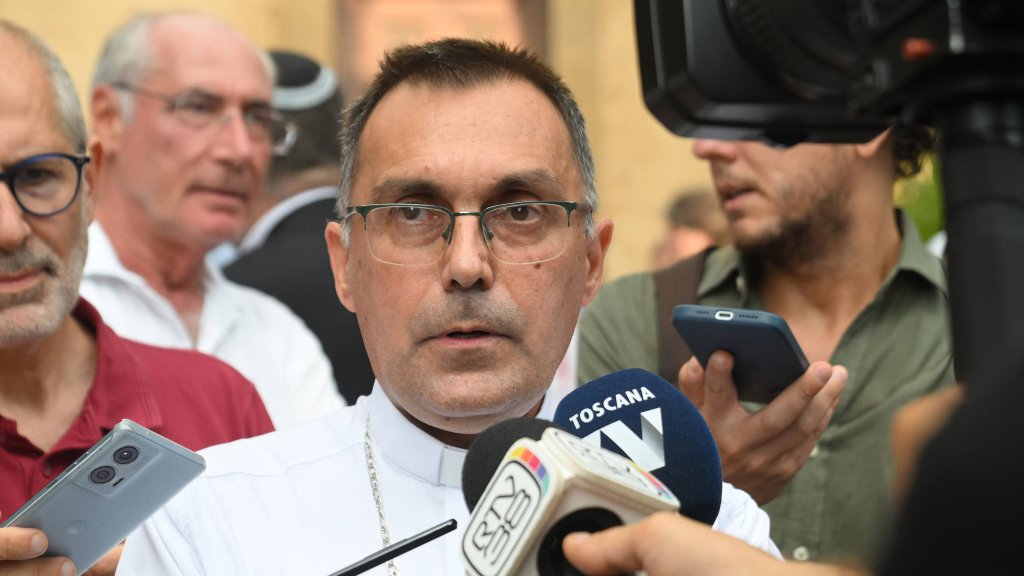
The Archbishop of Florence, Gherardo Gambelli, has called for a different approach to LGBTQ+ people within the Catholic Church. Gay and trans people should not be seen primarily as a problem on which the Church must take a position. Rather, the aim should be to listen to their life stories and thereby better understand what God is doing.
Key points at a glance
- Archbishop Gherardo Gambelli of Florence has called for greater dialogue with LGBTQ+ people within the Catholic Church.
- He sees their personal experiences as an important part of the Church's decision-making processes.
- Gambelli warns against prejudice and a fundamentalist or one-sided interpretation of the Bible.
- In his speech, he referred to the experience of a female couple, highlighting their care for others and their commitment to the Gospel.
- Families of gay and trans children must also receive support and opportunities for dialogue, he said.
- However, Gambelli is not fundamentally questioning Catholic teaching on homosexuality.
- The archbishop thus joins a movement within the Church that also has supporters in Germany.
Questioning one's worldview
Gambelli spoke at the first national meeting for pastoral workers, entitled “Good Practices in Pastoral Care with Homoaffective and Transgender People”. The event took place in Rome at the General Curia of the Society of Jesus. Gambelli began his address with an account from the Acts of the Apostles. It centres on the Apostle Peter's encounter with Gentiles in the house of Cornelius, a centurion. Peter is initially criticised for having “entered the house of uncircumcised men” and eaten with them. After describing what he experienced, he asks: “If, then, God gave them the same gift that he gave us because they believed in the Lord Jesus Christ, who was I to stand in God's way?”
The passage recalls the well-known phrase “Who am I to judge?”, which Pope Francis used in 2013 in response to a question about gay priests. Gambelli does not, however, explicitly mention the former pope's words. The parallel lies above all in the perspective: rather than excluding people or judging them hastily, encounters with them should prompt people to question their own ideas.
LGBTQ+ people's experiences
Experiences in his own diocese of Florence are another starting point for Gambelli's reflections. The diocese is home to Kairòs, a group of LGBTQ+ Christians. A diocesan coordinating body for inclusive pastoral care has also been established. According to Gambelli, the services for gay and trans people did not emerge as separate, independent projects. Rather, they are connected to the diocese's synodal journey: “Many of the good practices with homoaffective and transgender people in our diocese of Florence are closely linked to the synodal journey; they are a fruit of the communal discernment that we have learnt and rediscovered in recent years.”
Members of the Kairòs group therefore took part in the listening phase of the synodal process. They shared their own experiences with the Catholic community. For Gambelli, this exchange had tangible consequences: “Little by little, this broke down many prejudices, many fears, many reservations, many stereotypes.” The archbishop is thus describing a shift in perspective. LGBTQ+ people should not be solely recipients of the Church's pastoral care. Instead, their personal experiences should feed directly into the community's dialogue.
The victims' perspective
Gambelli referred to five criteria for communal discernment developed by the theologian Vito Mignozzi on the basis of the Acts of the Apostles. The first criterion is to start from reality and seek “real solutions to real problems that burden the life of the Church”. The second concerns the sharing of personal experiences. In doing so, it is necessary to “adopt the victims' perspective”. According to this approach, pastoral care with LGBTQ+ people also means recognising the tangible consequences of exclusion, moral judgements and discrimination within Catholic communities. For a long time, homosexuality was discussed within the Church primarily through doctrinal documents and moral prescriptions. Those affected were not always given a direct opportunity to speak. By contrast, Gambelli's approach places greater emphasis on their experiences and the tangible consequences of welcome and exclusion.
Warning against a one-sided interpretation of the Bible
The third criterion concerns the interpretation of Holy Scripture. Gambelli referred to the Synod's final document and stressed that discernment within the Church requires: “An appropriate exegesis of biblical texts that helps to interpret and understand them while avoiding one-sided or fundamentalist approaches.” This is particularly significant in relation to homosexuality. Individual biblical passages have repeatedly been used to justify moral condemnation, so-called conversion therapies or the exclusion of people. However, Gambelli did not set out a fundamentally new interpretation of the biblical passages traditionally cited against homosexuality in his speech. Instead, he calls for the texts not to be read selectively or exclusively literally, and for the experiences of those directly affected to be taken into account.
Gambelli describes the fourth criterion as a search for what is essential. This also means overcoming the “exclusionary logic of inside and outside”. Gambelli names the experience of joy as the fifth criterion. The success of such a process of discernment should not be judged solely by abstract or measurable results. Its effects on people's actual lives are also crucial.
Helping families overcome their fears
The experiences cited by Gambelli include meetings in the diocese of Florence attended by LGBTQ+ people, relatives, priests, deacons, seminarians, nuns and members of male religious orders. Specialists supported the events, at which questions and uncertainties were discussed. The families of LGBTQ+ people play a particular role here. Gambelli describes the meetings' effect as follows: “Parents who attend the meetings with other couples who have homoaffective or transgender children feel relieved when they realise that they are not the parents of excommunicated people or heretics.”
The statement points to continuing uncertainty in some Catholic families in Italy. A son or daughter coming out can be accompanied by fears that this will lead to a break with the faith or the Church community. The diocese of Florence is trying to create spaces for dialogue and support. This includes the diocesan coordinating body for inclusive pastoral care. In his address, Gambelli particularly highlighted the story of a lesbian couple. He did not explicitly pass judgement on their relationship. Instead, he focused on their treatment of others and their Christian practice. “I have in mind one female couple in particular who show extraordinary care for their neighbours, a faithful commitment to the Gospel that inspires wonder in those who see them.” Gambelli then says: “Christianity, good practices, grow through attraction.”
A movement in Germany too
Gambelli's speech thus echoes calls that have also been raised repeatedly in Germany in recent years as part of the Synodal Path. In an exclusive interview with SCHWULISSIMO, the German Bishops' Conference (DBK) representative for queer people, Auxiliary Bishop Ludger Schepers of Essen, reaffirmed, among other things: “As a Church, we must finally stop constantly peering into people's bedrooms. That is not our job. People in our society – and therefore also in the Church – are concerned today with very different, far more existential questions (…) For me, reaching out to queer people and recognising their dignity and their partnerships is not a matter of following the modern zeitgeist, but a fundamental consequence of God's love for every single person. For me, this position is non-negotiable.”








