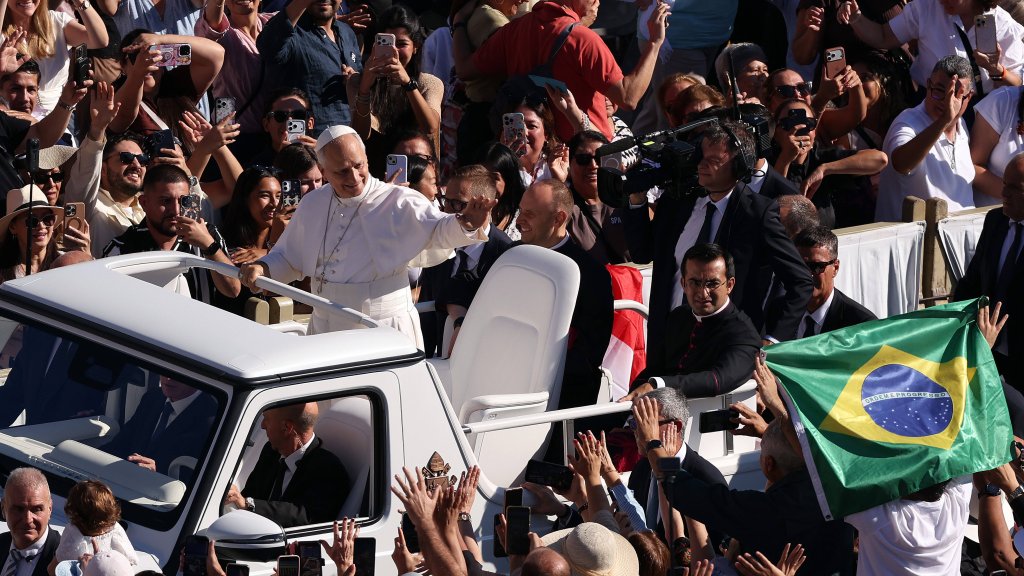
In Buenos Aires, a ban on public events around the forthcoming visit by Pope Leo XIV is prompting protests from LGBTQ+ organisations. The city authorities have announced that they will not authorise any “events, performances or gatherings in public spaces” from 6 to 13 November. This would also affect Pride, scheduled for 7 November.
Key points at a glance
- The Buenos Aires city authorities intend not to authorise any events or gatherings in public spaces from 6 to 13 November.
- The reason is the visit by Pope Leo XIV, who is expected in Argentina on 8 November.
- The 35th edition of Buenos Aires Pride is due to take place on 7 November.
- Pride organisers have criticised the ban and announced that they will take to the streets anyway.
- Around two million people took part in Buenos Aires Pride last year.
- The organisers also point to the political situation under President Javier Milei and documented anti-LGBTQ+ incidents.
- The Nationale Observatorium für LGBTIQ+-Hassverbrechen recorded a total of 227 such crimes in 2025.
Community defies ban
The queer organisers have criticised the decision as incomprehensible. Pope Leo XIV is not due to arrive in Buenos Aires until 8 November – the day after Pride. Argentina’s LGBTQ+ community has therefore announced that it will defy the ban. “We understand the institutional significance of a visit by a head of state and the highest authority in the Catholic Church. What we do not understand is how this can be cited as sufficient grounds to demand the suspension of one of the city’s most important, longest-established and best-attended public events – particularly given that the Pope will not arrive in our country until the following day,” the organisers said. Buenos Aires Pride is one of the largest events of its kind worldwide. According to the organisers, around two million people took part last year.
City stresses security measures
Pope Leo XIV will begin a four-day trip through Argentina on 8 November. It is part of his first visit to Latin America, which is also due to take him to Uruguay and Peru. The last pope to visit Argentina was John Paul II in April 1987. Pope Francis, who was born Jorge Mario Bergoglio in Buenos Aires, did not visit his home country during his twelve-year pontificate. In a newly published decision, the Buenos Aires city authorities justified the restrictions by citing the particular significance of the papal visit. It “constitutes an event of exceptional institutional, religious and social significance and exceptional scope”, the decision stated. Accordingly, “precautionary measures are necessary to ensure the safety of the high-ranking visitor, participants and the public”.
Plans include “a special traffic management plan – including road closures, temporary restrictions and diversions”. The police and other authorities are also to deploy an “exceptionally” large amount of personnel and material resources. According to the city authorities, other events in public spaces during the same period would be “incompatible with the conditions of security, public order and mobility that the city authorities must guarantee for the public”. They could also compromise “the orderly and safe conduct of the Holy Father’s visit”.
Organisers announce march
The Pride organisers responded immediately. On social media, they offered a reminder: “Pride is also shaped on the streets.” They continued: “The government is trying to prevent the Pride parade by restricting events in public spaces. But there is one thing they must understand: our rights cannot be suspended by decree. The Mothers of the Plaza de Mayo took to the streets when doing so meant standing up to those in power. They did not ask permission to demand truth, remembrance and justice. If they did not ask, neither will we. Because to march is to exist. To march is to become visible. To march is to defend what has been achieved and demand what is still missing. On 7 November, Pride returns to the streets.”
Criticism of President Milei
The dispute comes at a politically tense time for Argentina’s LGBTQ+ community. The organisers also point to President Javier Milei’s policies and accuse his government of re-establishing homophobia and transphobia at an institutional level. Just last week, young gay LGBTQ+ activist Agustín Romero was attacked in Buenos Aires. Earlier, in January 2025, Milei had attacked feminism, so-called “gender ideology” and progressive political approaches at the World Economic Forum in Davos. His remarks sparked protests across the country. In its World Report 2026 coverage of Argentina, Human Rights Watch also highlighted derogatory remarks by Milei about same-sex marriage, gender identity and inclusive sexuality education.
227 hate crimes in 2025
The Nationale Observatorium für LGBTIQ+-Hassverbrechen, supported by LGBT-Defensoría, Argentina’s LGBT-Föderation and the Defensoría del Pueblo de la Nación, recorded a total of 227 hate crimes in 2025 said to have been motivated by sexual orientation, gender identity or gender expression. Around 90 per cent of attacks go unreported and do not appear in the statistics. Against this backdrop, the Pride organisers intend to stick to their planned date.








