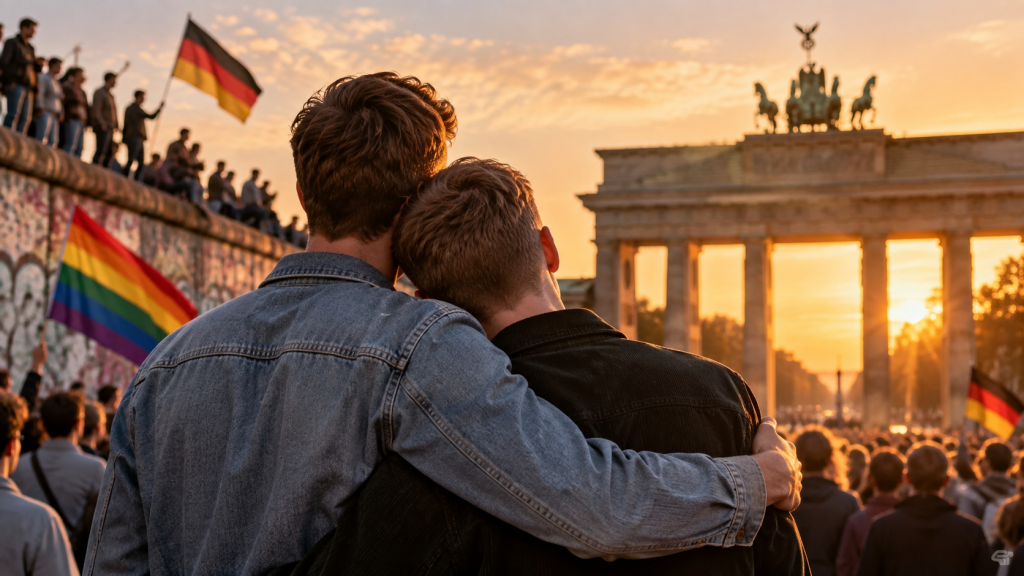
When Germany once again marks German Unity Day on 3 October, 36 years will have passed since reunification. For the history of lesbians, gay men and queer people, this date carries a particular ambivalence: German reunification brought freedom, new opportunities for political action and, in the long term, far-reaching progress. Yet in one crucial respect, the East was legally ahead of the West in 1990.
The key points at a glance
- On 3 October 1990, the GDR joined the Federal Republic. For lesbians and gay men, reunification did not simply mean moving from a more repressive to a more liberal legal system – the story was more complicated.
- The GDR had already fully abolished its specific criminal provision against homosexual relationships in 1988. In West Germany, by contrast, Section 175 remained in place until 1994.
- At the same time, lesbians and gay men in the GDR faced social exclusion and state surveillance. Nevertheless, an independent homosexual emancipation movement developed from the 1980s onwards.
- By a remarkable coincidence, 9 November 1989, the evening the Berlin Wall fell, also saw the premiere of the DEFA film “Coming Out” at Berlin’s Kino International – the first GDR feature film with a gay theme.
- The upheaval of 1989/90 opened up new political opportunities for LGBTQ+ groups. East German activists later also played an important role in the final abolition of Section 175.
- Since then, the legal situation has changed fundamentally: registered civil partnerships were introduced in 2001, followed by marriage for same-sex couples in 2017.
An ambivalent history
When the Unification Treaty came into force on 3 October 1990 and the Basic Law began to apply in the eastern German states as well, more than four decades of German division came to an end. This had been preceded by the Peaceful Revolution in the GDR, the fall of the Berlin Wall on 9 November 1989 and months of negotiations over national reunification. For homosexual people, however, this historic turning point came against a backdrop of very different histories in East and West. The widespread image of the Federal Republic as a consistently more liberal West and the GDR as an East that was more repressive in every respect falls short when it comes to the history of homosexuality.
The GDR abolished Section 175, inherited from German criminal law, as early as 1968. It was replaced by Section 151. This continued to criminalise certain same-sex contacts between adults and young people and – unlike Section 175 – also covered female homosexuality. In December 1988, this specific provision was also removed. This meant that, by the time the Wall fell, the GDR no longer had a specific criminal provision against homosexual relationships. The situation in the Federal Republic was different. There, Section 175 had undergone a fundamental reform in 1969, meaning that consensual sex between adult men was no longer generally a criminal offence. A further reform followed in 1973. However, Section 175 did not disappear entirely from the Criminal Code until 1994 – almost four years after German reunification (German).
This created a remarkable situation in 1990: reunification brought two legal systems together, and in the very area of sexual offences law, simply adopting West German law would have represented a step backwards for gay men in the East. Fortunately, that did not happen. As part of the harmonisation of the law, Section 175 was finally removed in its entirety in 1994. The Federal Agency for Civic Education describes this as a legal turning point from a West German perspective, but as safeguarding an already established situation from an East German perspective. East German activists played an important part in this outcome.
Decriminalised did not mean free
Earlier decriminalisation does not, however, mean that homosexual people were able to live freely and as equals in the GDR. Marriage and the traditional family were the social norm. Homosexuality often remained invisible. Gay men and lesbians were subjected to state surveillance, meeting places and networks were monitored, and activists were watched by the state security service. The Bundesstiftung zur Aufarbeitung der SED-Diktatur points out that homosexual people faced discrimination both from the state security service and through vilification in the media.
Surveys from the period of upheaval in 1990/91 show how distressing the social climate could be. In these, 42 per cent of the lesbians surveyed and 55 per cent of the gay men reported homophobic verbal abuse. Seven per cent of lesbian respondents and 25 per cent of gay male respondents said they had experienced physical violence because of their homosexuality. Discrimination at work was also reported. At the same time, many homosexual people had entered heterosexual marriages and had children – an indication of the considerable social pressure to conform at the time.
Under the church’s roof
Despite these conditions, the situation began to change in the 1980s. The Protestant church played an important role. From the early 1980s, increasing numbers of homosexual working groups formed under its auspices. Church premises offered a degree of protection and enabled networking, discussion and political work. According to the Federal Agency for Civic Education, by the summer of 1989 there were just under 30 lesbian, gay or mixed working groups, alongside groups in state-run youth and cultural centres. In 1987, “Homosexualität” became the first popular science publication on the subject in the GDR. In 1988, the Deutsches Hygiene-Museum Dresden produced the educational film “Die andere Liebe”. In the final years of the GDR, groups also emerged outside church structures. The emancipation movement was therefore already in place when the political order began to falter.
A gay film as the Wall fell
Few events connect homosexual history and modern German history more symbolically than the evening of 9 November 1989. While the Wall was falling in Berlin, just a few kilometres away the DEFA film “Coming Out” was having its premiere at Kino International (German). The film tells the story of a gay teacher and was the first GDR feature film to place homosexuality at its centre. It was intended to promote social tolerance towards homosexual people. Yet even as the premiere was taking place, the country outside was changing. By the time the audience left the cinema, the border had opened. The political reality within which the film had been made began to dissolve within a matter of hours. For German gay history, this coincidence retains extraordinary symbolic power to this day: visibility and freedom broke through in very different ways on the same evening.
New scope for action
The Peaceful Revolution and the fall of the Wall opened up room for action for homosexual groups in the GDR that had not previously existed. Political work could now take place openly, new organisations emerged, and activists sought to feed their demands directly into the restructuring of the state. The Unabhängige Frauenverband emerged from feminist-lesbian networks in December 1989. Representatives of LGBTQ+ interests took part in the Central Round Table. The demands under discussion were strikingly relevant to the present day: protection against discrimination on the grounds of “sexual orientation” was included in the draft of a new GDR constitution, which was ultimately never implemented. Long-term partnerships were also to be protected. Rapid developments towards German reunification overtook this draft constitution politically.
Reunification also meant loss
For precisely this reason, from an LGBTQ+ perspective, 3 October is not solely a story of straightforward progress. With the end of the GDR, structures, experiences and political approaches of the East German lesbian and gay movement also disappeared in a unification process that largely adopted the institutions and legal system of the Federal Republic. At the same time, hostility towards homosexual people, right-wing extremism and racist violence became clearly visible during the social upheavals in eastern Germany. The Federal Agency for Civic Education points to an increase in neo-Nazi violence in the period after 1989/90. The political freedom gained therefore did not automatically mean personal safety.
A period of upheaval in the community
The period of upheaval also gave rise to organisations that would shape homosexual politics in reunified Germany. In 1990, gay activists in the GDR founded the Schwulenverband in Deutschland. It later developed into a nationwide organisation, now known as LSVD+. East German activists also took part in the fight against Section 175 and in demands for legal recognition of same-sex partnerships. “Aktion Standesamt” followed in 1992: same-sex couples publicly demanded access to marriage. There was still a long wait ahead. In 2001, Germany introduced registered civil partnerships. In 2017, marriage was finally opened to same-sex couples. That same year, the Bundestag unanimously approved the rehabilitation and compensation of people convicted after 1945 under the former criminal provisions against homosexual acts. This covered convictions in both the Federal Republic and the GDR.
36 years of history since the turning point
For lesbians and gay men, enormous legal changes therefore separate the Germany of 1990 from that of 2026. At the time of reunification, the West still had a specific criminal provision covering male homosexuality. Today, two men or two women can marry. For precisely this reason, from a homosexual perspective, 3 October tells a story of more than the unification of two states. It also tells of two different histories of homosexual life that came together in 1990. For historical context, it is also worth noting that the fall of the Wall and German reunification gave East German lesbians and gay men a previously unknown freedom to organise politically.
At the same time, they had to defend rights they had already won and bring their experiences into a new system for the whole of Germany. Even 36 years after reunification, the question of equality has not become an entirely historical one – among other things, the struggle continues to add specific protection for “sexual identity” to Article 3 of the Basic Law. And social acceptance has recently declined again (German), too. From an LGBTQ+ perspective, German Unity Day can therefore serve as a reminder of liberation, contradictions and unfinished history all at once. The fall of the Wall removed one border in 1989. For gay men and lesbians, however, that did not mean every other barrier disappeared overnight. Some fell only years later. Some remain the subject of social and political struggles to this day.








