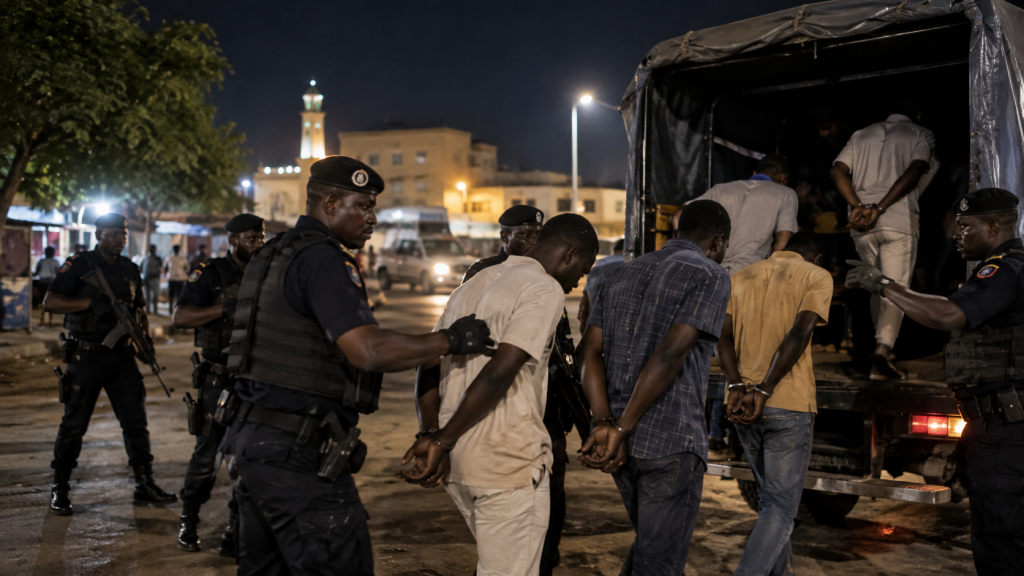
The persecution of people suspected of being homosexual continues in Senegal. Police have now arrested 35 people on suspicion of homosexuality in the eastern Senegalese city of Tambacounda. According to Senegalese media reports, those affected come from various social groups and occupations.
Key points at a glance
- Further arrests: police have arrested 35 people on suspicion of homosexuality in the eastern Senegalese city of Tambacounda.
- Those arrested include school pupils, university students, teachers, healthcare workers and people in other occupations.
- According to investigators, 13 of those arrested tested positive for HIV. Only three of them are currently receiving medical treatment.
- A tougher law against homosexuality has been in force in Senegal since March 2026. Hundreds of people were arrested both before and after it took effect.
- The authorities describe the case as organised crime and are investigating possible contacts. A uniformed officer who was also accused was not arrested.
An organised network?
According to police, those arrested include four pupils of compulsory school age, two university students, two secondary school teachers and four healthcare workers. A businessman, a development worker and a tailor are also among those affected. The group's composition has drawn the attention of the investigating authorities. The news website SeneNews wrote: “This diversity has aroused the curiosity of investigators, who are trying to establish how this network came into being and operated.”
Investigators apparently believe there are connections between those arrested. The idea that homosexual people deliberately involve others in their sexual activities is widespread in Senegalese media and among law enforcement authorities. Citing the investigation, the news website Seneweb described the group as an “organised criminal network specialising in unnatural acts”. This account reflects the authorities' perspective. The available reports do not establish whether a criminal organisation actually existed.
13 people arrested are HIV-positive
As part of the investigation, the authorities are also examining statements by several of those arrested that they had sexual relationships with a uniformed officer. According to police, the officer in question was not arrested. The reports do not explain why no such action was taken against him. Information about the health of those arrested has attracted particular attention. Police apparently had all 35 people tested for HIV.
According to investigators, 13 people tested positive. Of these, only three are currently receiving medical care and antiretroviral therapy. According to the published information, this leaves ten of those arrested who are HIV-positive without appropriate treatment. The reports so far do not establish whether those affected already lacked access to treatment before their arrest or whether their medical care was disrupted by the arrests.
Tracing further contacts
The Senegalese authorities also appear to be linking their investigation to public health arguments. According to the reporting, some sections of the public believe that a rigorous crackdown on gay men could help improve public health. SeneNews reported: “The investigation is continuing intensively under the supervision of the relevant authorities to identify possible accomplices and trace contacts, so that the further spread of the disease can be prevented.” However, linking homosexuality to the spread of HIV is medically misleading. HIV can be transmitted regardless of sexual orientation. By contrast, criminalising same-sex sexual activity can lead those affected to forgo testing and medical help for fear of prosecution.
Hundreds of arrests
The latest arrests in Tambacounda are part of a nationwide wave of arrests targeting gay men. According to the news website Erasing 76 Crimes, hundreds of people have already been arrested on suspicion of homosexuality. The repression began before the latest tightening of the law and continued afterwards. On 31 March this year, a tougher law against homosexuality came into force in Senegal (German). Arrests took place both before and after this legislative change.
As early as June 2026, Erasing 76 Crimes reported hundreds of arrests of homosexual people. In August, news followed that 28 of a total of 99 men arrested over allegations of same-sex sexual acts had been released. The latest developments show that the authorities are continuing their actions against people suspected of being homosexual. People from various occupations, as well as school pupils and university students, are being targeted by investigators. There has also recently been considerable international criticism of Senegal's actions, particularly in view of the forthcoming Youth Olympic Games in the country.








