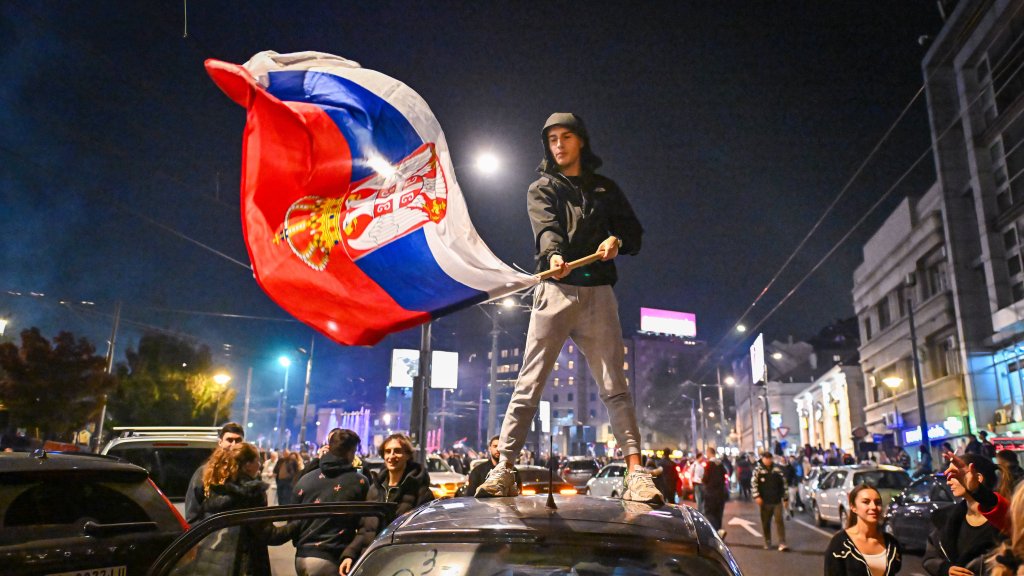
Following the Serbian student movement’s election victory, the country faces a political upheaval. The ruling elite around Aleksandar Vučić must concede defeat. For the LGBTQ+ community, the change of government could open up new opportunities. However, it remains unclear whether the incoming government will actually implement the reforms to secure equality for same-sex couples that have been demanded for years.
Key points at a glance
- Change of power in Serbia: according to provisional results, the student list wins the parliamentary election with around 53 per cent of the vote, securing an absolute majority.
- Vučić concedes defeat: after 14 years in power, the nationalist politician’s political camp loses the election.
- Brnabić in a key role: the openly lesbian interim president must nominate a candidate for prime minister.
- Hope for LGBTQ+ people: activists are calling for legal recognition of same-sex partnerships and a law on gender identity. The student list has so far made no commitments on these issues.
- Foreign policy remains contentious: the student movement rejects sanctions against Russia. A vote on EU membership is to take place only after domestic reforms.
Fall of the government
In last Sunday’s snap parliamentary election, the student list secured 52.71 per cent of the vote, according to provisional figures. Vučić’s “United Serbia” alliance received 39.52 per cent. Figures released by the Serbian electoral commission on Monday evening give the student list 140 of the 250 parliamentary seats. An absolute majority requires 126 seats. Turnout was around 70 per cent, its highest level since 1992. “It is clear that we have lost these elections. The student list has won,” Vučić said on television. Radomir Sajčić, co-founder of the civic association supporting the student movement, responded: “Tonight we celebrate victory; tomorrow we shape the future.” In Belgrade and other Serbian cities, thousands of people took to the streets to celebrate the election result.
Lesbian interim president
A particular role in the forthcoming transfer of power falls to Ana Brnabić. The openly lesbian politician is one of Vučić’s closest confidantes and served as prime minister from 2017 to 2024. She subsequently became speaker of parliament. Since 28 September, following Vučić’s resignation, she has been serving as acting president. In this capacity, she must now consult the parliamentary forces and nominate a candidate for prime minister. A long-standing representative of the former governing camp is thus tasked with initiating the transition to a government formed by its political opponents.
For Serbia’s LGBTQ+ community, Brnabić is a controversial figure. She is openly lesbian and has a son with her partner. Yet her time in government brought neither legal recognition of same-sex partnerships nor comprehensive legal protections for lesbian couples. Internationally, Brnabić was long seen as a sign of Serbia’s growing social openness. LGBTQ+ organisations, by contrast, criticise the fact that her personal visibility has not translated into corresponding legislative progress.
LGBTQ+ activists hope for change
The Serbian LGBTQ+ movement has been making its demands for years. Its priorities are legal recognition of same-sex partnerships, a law on gender identity and more effective protection against discrimination. Back in 2022, Goran Miletić, one of the organisers of Belgrade Pride, reported that a law on same-sex partnerships was “ready, but blocked”. He also highlighted the particularly difficult situation facing trans people. Numerous LGBTQ+ activists also joined the student movement during the mass protests against Vučić.
Dušanka Tomašević of the lesbian organisation Labris said in March 2025 that the social climate had also changed to some extent during the demonstrations. “During these protests, it has become more common for people to step in to stop homophobic insults,” Tomašević said. She also emphasised the connection between the student movement’s demands and campaigning for sexual minorities: “The struggle for our rights is the same struggle as the one for democracy.” Whether this solidarity will lead to concrete political decisions after the election victory remains uncertain, however.
Equal rights and protection from violence
At the Belgrade Pride parade on 5 September, LGBTQ+ activists once again demonstrated for legal equality. Under the slogan “There is room for all of us”, the march passed the seat of government, the president’s office and the National Assembly. Participants called in particular for a law recognising same-sex partnerships, greater protection from homophobic violence and legislation on gender identity. Serbia’s equality commissioner Milan Antonijević described these demands as “justified”. Representatives of the student movement also took part in the event. Two students spoke on stage about the continuing prevalence of violence against LGBTQ+ people.
Andreas von Beckerath, head of the EU Delegation to Serbia, also joined the march. Despite support from sections of the protest movement, the student list has so far made no binding commitments on LGBTQ+ policy. The alliance is focusing primarily on tackling corruption, strengthening the rule of law and reforming state institutions. For LGBTQ+ organisations, this raises the question of whether their concerns will feature in the future government’s programme or have to take a back seat to other political priorities.
Vučić shaped Serbia
The defeat of the former governing party ends a long period of political dominance by Aleksandar Vučić. In the late 1990s, he was information minister under the then Yugoslav president Slobodan Milošević. Milošević later stood trial before the UN war crimes tribunal in The Hague, but died in 2006 before the proceedings concluded. Vučić was Serbian prime minister from 2014 to 2017 and subsequently president until September 2026. Critics accuse him of weakening the independence of the media and democratic institutions during his time in power, and of putting pressure on non-governmental organisations. Moves towards a law on so-called foreign agents modelled on Russian legislation were particularly controversial.
The government’s relationship with the LGBTQ+ community was also marked by conflict. In 2022, Vučić tried to cancel the planned Euro Pride in Belgrade. The event became the focus of an international dispute over freedom of assembly and minority rights in Serbia. The protest movement against his government emerged after the collapse of a railway station canopy in Novi Sad in November 2024, which killed 16 people. Students held corruption and failings by state authorities partly responsible for the disaster. The initial protests developed into a nationwide movement against the political system.
Who will be the new prime minister?
Following its election victory, the student list faces the task of forming a government. The final election results are expected on Thursday, 29 October, subject to any challenges. The new National Assembly must convene within 30 days of the official confirmation of the results. There are then 90 days to elect a government. If this fails, fresh elections will be required. Cardiologist Ilija Srdanović from Novi Sad, who heads the candidate list, is seen as a potential prime minister. His appointment is by no means certain, however. The student movement has so far deliberately avoided having a single central leader. Its candidates were selected through university bodies. How the movement intends to allocate ministerial posts and choose its prime minister remains unclear. Presidential elections are also due by the end of December.
Foreign policy direction remains contentious
In foreign policy, too, the student movement’s election victory does not necessarily mean a fundamental change of direction. European Commission President Ursula von der Leyen and Commissioner for Enlargement Marta Kos congratulated the election winners. Russian state media, by contrast, circulated allegations that Western intelligence services had directed the protest movement. On key foreign policy issues, the student list holds positions that partly overlap with those of the previous government. On 30 September, it declared that Serbia would maintain its position in principle and would not impose sanctions on Russia. On possible EU accession, lead candidate Srdanović proposes first implementing domestic reforms and only then holding a referendum on membership. It therefore remains unclear how closely Serbia will align itself with the European Union under a new government. For Serbia’s LGBTQ+ community, the election outcome is above all a source of expectations.








