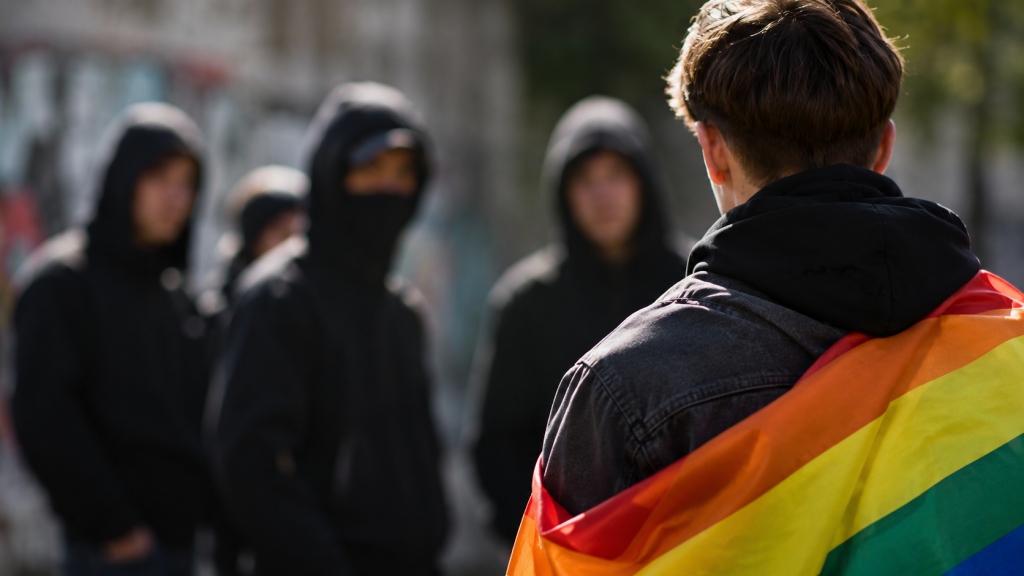
In Baden-Württemberg, security authorities are observing a development within the far-right youth scene: young people of Ukrainian origin are increasingly forming neo-Nazi groups and seeking contact with existing extremist networks. According to the State Office for the Protection of the Constitution (LfV), their pronounced hostility towards gay and queer people is particularly striking.
Key points at a glance
- New far-right networks: Baden-Württemberg's domestic intelligence service is observing growing links between young people of Ukrainian origin, German neo-Nazis and other extremist groups.
- Homophobia as a shared source of hostility: According to security authorities, the groups are united in particular by an “extremely pronounced homophobia”.
- Significant willingness to use violence: The State Office for the Protection of the Constitution classifies the groups as “extremely violent”.
- Brutal attack in Eislingen: In May 2025, two neo-Nazis allegedly pursued a young man and injured his head with knuckledusters.
- Queer facilities affected: Swastikas were repeatedly scrawled and notices for queer events removed at a youth centre in Nürtingen.
Organised groups
The groups are considered particularly willing to use violence. In the state government's response to a major parliamentary interpellation from the SPD parliamentary group in the state parliament, the domestic intelligence service describes them as “extremely violent”. The security agency now sees a “significant pool of far-right young people of Ukrainian origin” across the state. According to its findings, these young people do not act solely as individuals, but organise in groups, use Nazi slogans and maintain contacts beyond their immediate surroundings. Links are forming both with German far-right extremists and with extremists from other migrant communities. The Stuttgarter Zeitung reported on the development following its own investigations.
Hatred of gay people
According to the domestic intelligence service's assessment, a key common feature of the groups is their rejection of LGBTQ+ people, particularly gay people. In its response, the state government points to shared perceived enemies that facilitate cooperation between different far-right circles. Alongside traditional neo-Nazi beliefs, an “extremely pronounced homophobia” is said to play a particular role. The security agency describes this hostility towards LGBTQ+ people as a “bridging narrative” among modern neo-Nazi groups. This means a shared ideological foundation.
Ukrainian sociologist Hanna Hrytsenko of the Zentrum Liberale Moderne sees this as a continuation of long-standing developments. She says that even before the start of Russia's war of aggression, far-right groups in Ukraine had targeted gay and queer people, feminist initiatives and Roma in particular. Such perceptions of enemies could persist after migration to Germany and encourage closer ties with far-right structures there.
Disruption at Pride events
The growing importance of anti-queer hostility is also evident at public LGBTQ+ community events. Far-right youth groups repeatedly attempt to disrupt Christopher Street Day (CSD) Pride events, intimidate participants or assert their presence through targeted provocations. According to the findings of a recently published study, more than half of Pride events in Germany in 2026 were affected by disruption. Alongside far-right extremists, other groups, including Islamists, were also identified as perpetrators. For security authorities, such actions indicate that opposition to sexual and gender diversity is increasingly being used as a shared rallying point within the far-right scene.
Attack with knuckledusters
An incident in May 2025 in Eislingen, in the district of Göppingen, illustrates how dangerous the actions of individual groups can become. According to investigations by the Stuttgarter Zeitung, two men from a four-strong, non-German-speaking neo-Nazi group pursued a young man after he left a train. The attackers allegedly harassed their victim and asked whether he belonged to Antifa. They then struck the young man on the head with knuckledusters. According to the reports, the perpetrators fled shouting “Heil Hitler”. The victim suffered a heavily bleeding laceration and had to be treated in an emergency department. According to the investigations, far-right Ukrainian youths have been increasingly visible in public spaces for some time, particularly in the districts of Göppingen and Esslingen.
Provocations at a youth centre
Alongside attacks in public spaces, facilities explicitly committed to diversity and the protection of queer young people are also being targeted. One example is the Jugendhaus am Bahnhof (JaB) youth centre in Nürtingen, in the district of Esslingen. The centre sees itself as a queer-friendly safe space. According to those in charge, a group of Ukrainian young people with far-right views has been visiting the centre regularly for around nine months. Centre manager Marina Bahnmüller reports repeated incidents involving Nazi symbols and anti-queer behaviour. Staff have observed some young people also expressing their political views through clothing and music. There are also anti-queer remarks, which the centre's management says repeatedly cause problems. Despite the incidents, the youth centre in Nürtingen is continuing its socio-educational work with the young people.








