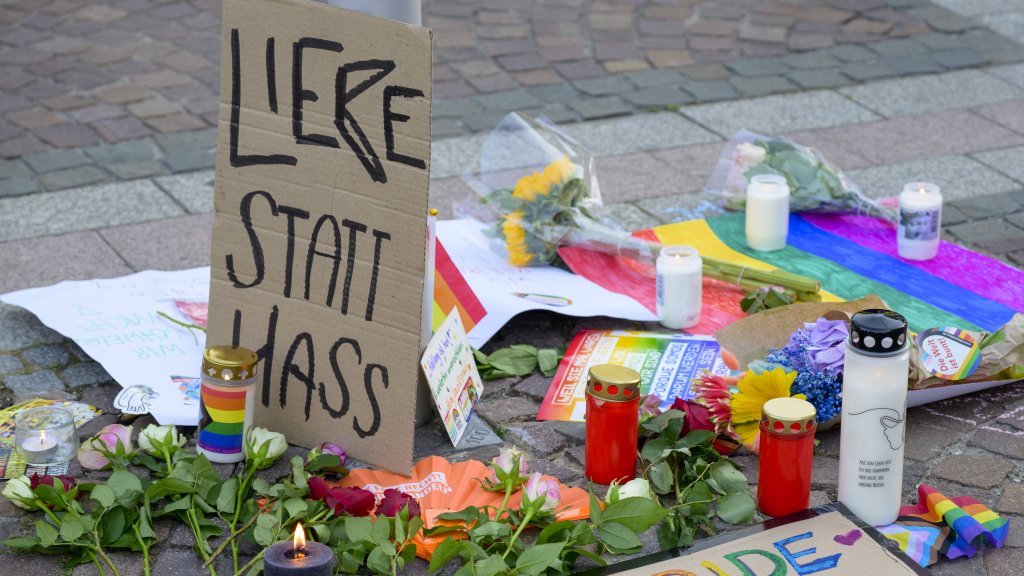
Germany has never hosted as many Christopher Street Day (CSD) Pride events as it did in 2026. At the same time, attacks on and disruptions to these events reached a new high. These are the findings of the latest CSD monitoring report by the Amadeu Antonio Stiftung. According to the report, at least 299 CSD events took place nationwide. The foundation recorded attacks or disruptions at 156 of them. This means that more than half of all events were affected.
Key points at a glance
- Record number of CSD events: at least 299 Christopher Street Day (CSD) events took place in Germany in 2026 – more than ever before.
- More than half of all CSD events affected: the Amadeu Antonio Stiftung documented attacks or disruptions at at least 156 events.
- Physical violence on the rise: the number of recorded physical attacks on participants rose from four in 2025 to at least 19 in 2026.
- Fewer organised counter-protests: far-right counter-demonstrations fell from at least 43 to 27. At the same time, other forms of intimidation and violence increased.
- Western Germany also increasingly affected: the proportion of CSD events disrupted there rose from 38 to more than 47 per cent. In eastern Germany, the figure was 62 per cent.
- Funding increasingly difficult: according to the foundation, higher security costs and the loss of grants threaten smaller CSD events in particular.
Fewer far-right activists, more violence
The foundation considers the increase in physical violence particularly concerning. While four physical attacks on CSD participants were recorded in 2025, there were at least 19 in 2026. The foundation warns that anti-LGBTQ+ attacks are increasingly being seen as an everyday occurrence. Many incidents receive barely any media coverage. The monitoring also reveals a trend in the opposite direction: the number of organised counter-protests by far-right groups has fallen. At least 43 anti-CSD protests were recorded in 2025, compared with 27 in 2026. According to the foundation, these counter-demonstrations also became smaller. However, it says this is no cause for reassurance. The total number of attacks and disruptions has risen again. Attacks are also increasingly being carried out by individuals who are not part of any registered counter-demonstration and cannot necessarily be classified as belonging to the far right.
The foundation cites several incidents as examples: in Kassel, a man barged into participants at a CSD event. One person subsequently hit their head on the ground. In Chemnitz, someone threw eggs at a march from an adjoining residential building. A person in a wheelchair was injured. In Landshut, an individual hit a participant in a CSD demonstration. There are also reports of insults and hostility from passers-by. The foundation sees this as evidence that people are becoming less inhibited about expressing anti-LGBTQ+ attitudes publicly and violently.
Far-right extremists and Islamists
Far-right actors also remain a threat to CSD events, the foundation says. However, they are increasingly acting in a less organised way. Rather than registered counter-demonstrations, spontaneous or unregistered actions on the fringes of events are becoming more common. This makes security planning more difficult. Such situations are harder for organisers and police to anticipate, and potential threats require a faster response.
The foundation cites this year's Islamist attack on Berlin's CSD as a particularly serious example. It says the consequences of such acts extend far beyond those directly affected. They can heighten fear and insecurity throughout the LGBTQ+ community. The foundation stresses that anti-LGBTQ+ violence can stem from both far-right and Islamist ideologies. Both reject an open, pluralistic society and can benefit from social polarisation. Events and places where LGBTQ+ life is publicly visible remain particularly at risk.
In the mainstream of society
The Amadeu Antonio Stiftung describes anti-LGBTQ+ hostility as a so-called bridging ideology. This means that such attitudes can connect different political and social groups. It refers to the 2024 Leipzig Authoritarianism Study. According to that study, anti-feminist and, in particular, anti-trans attitudes play a central role in far-right world views. The 2025 Mitte Study, meanwhile, shows that anti-LGBTQ+ attitudes are not confined to the political far right. The foundation interprets the increase in physical attacks by people outside organised far-right counter-protests as evidence of this prevalence across society. It says the Federal Criminal Police Office's figures on politically motivated crime also point to a longer-term increase in anti-LGBTQ+ hate crime. The high proportion of violent offences is particularly concerning.
Eastern Germany more severely affected
According to the monitoring report, regional differences remain clearly evident. Around 62 per cent of CSD events in Germany's eastern federal states were disrupted in 2026. The proportion therefore remains higher than in western Germany. However, the situation there has also deteriorated. While 38 per cent of CSD events in western Germany were affected by attacks or disruptions in 2025, the proportion rose to more than 47 per cent in 2026. The foundation sees this as a nationwide problem. Anti-LGBTQ+ hostility and attacks have long since ceased to be confined to particular regions, it says. It also criticises the limited public attention many incidents receive. This creates a risk that such attacks will increasingly be accepted as normal.
Higher security costs for CSD events
The worsening security situation also creates financial difficulties for organisers. CSD events that are not recognised as political assemblies, in particular, must cover certain security costs themselves. According to the foundation, attempts were made in 2026 to strip CSD events in Dresden (German) and Görlitz of this status. Such a change could mean that organisers would have to cover the cost of security staff themselves, among other expenses. For smaller CSD events, particularly in rural areas, these additional costs could threaten their survival. The foundation is therefore calling on security authorities to prepare better for potential attacks and other threat scenarios.
Grants withdrawn
Alongside rising costs, declining public support is also worrying organisers. According to the foundation, several CSD events no longer received grants they had reliably counted on in previous years. It cites CSD Rathenow as an example. Unlike previously, it says, the event no longer receives financial support through the federal programme “Demokratie leben!”. The reason given is that the programme must maintain political neutrality. CSD Lünen was also reportedly denied grants on the same grounds. The Amadeu Antonio Stiftung criticises this argument. It sees it as a problematic interpretation of the state's duty of neutrality that makes civic engagement more difficult. At the same time, the record figure of at least 299 CSD events shows that LGBTQ+ activists and organisers are not generally deterred by intimidation. In the foundation's view, this public visibility is an important counterweight to growing anti-LGBTQ+ hostility.








