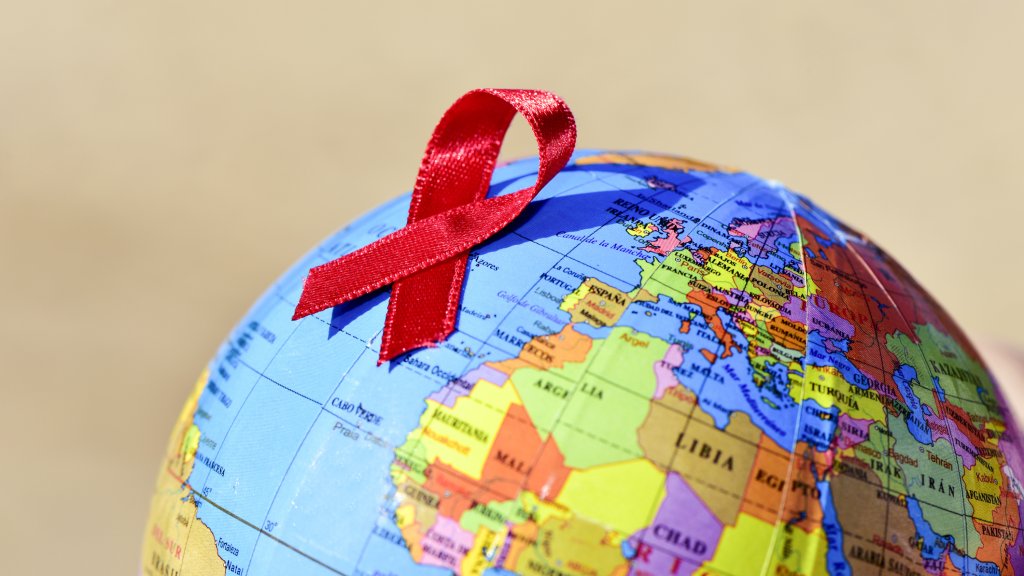
The Joint United Nations Programme on HIV/AIDS (UNAIDS) sees the progress made so far in the global fight against AIDS as being at risk. A lack of funding, growing social inequality and barriers to accessing prevention services, HIV testing and medical care are making further progress more difficult. These are the findings of the annual report “UNAIDS Global AIDS Update 2026”.
Key points at a glance
- An estimated 41 million people worldwide were living with HIV in 2025. Around five million were unaware of their infection.
- Almost nine million people living with HIV were not receiving antiretroviral therapy.
- Around 1.2 million people acquired HIV, and 570,000 died from AIDS-related causes.
- Gay and bisexual men, trans women, sex workers and people who inject drugs have a significantly higher risk of HIV.
- Funding gaps threaten prevention programmes and the goal of ending AIDS as a public health threat by 2030.
Unaware of their HIV status
The number of new HIV infections and AIDS-related deaths has fallen significantly over the long term. However, this positive trend has slowed in recent years. At the same time, funding cuts threaten to worsen care, particularly for population groups at especially high risk of infection. UNAIDS estimates that around 41 million people worldwide were living with HIV in 2025. About five million of them had not received an HIV diagnosis. This represents twelve per cent of the total. The gaps are particularly large among children and young people under 15: of the roughly 1.3 million people worldwide living with HIV in this age group, around a third were unaware of their infection or had not received an HIV diagnosis.
Significant progress has been made in access to medication over the past 15 years. While only 7.6 million people had access to antiretroviral therapy in 2010, the figure had risen to more than 32 million by 2025. Nevertheless, almost nine million people living with HIV remained without such treatment. Here too, the situation is particularly serious among young people. Of the 1.3 million people under 15 living with HIV, almost 570,000 received no HIV medication last year.
One person dies every minute
Put simply: around one person still dies from AIDS every minute. Access to antiretroviral medication is crucial both for the health of those affected and for containing the HIV epidemic. Effective treatment can prevent the infection from progressing and reduce the viral load to a level at which HIV can no longer be transmitted through sex. A lack of treatment options therefore contributes to preventable new infections and deaths. In 2025, an estimated 1.2 million people worldwide acquired HIV. This represents a fall of 65 per cent from the peak recorded in 1994. Compared with 2010, the number of new infections fell by 42 per cent.
The long-term improvement was particularly marked among children. While around 300,000 children acquired HIV in 2010, the figure was about 93,000 in 2025. However, progress here has also stalled for several years. The number of AIDS-related deaths fell to around 570,000 in 2025, reaching its lowest level in more than two decades. This represents a decline of 73 per cent from the peak in 2004. Nevertheless, almost 1,600 people worldwide die from AIDS-related causes every day – statistically, around one person per minute.
Significantly higher HIV risk
The risk of acquiring HIV is distributed very unevenly worldwide. According to UNAIDS, people who are socially excluded or marginalised are particularly at risk. Compared with the general population aged between 15 and 49, gay and bisexual men face an HIV risk 18 times as high. For sex workers and trans women, it is 17 times as high in each case. The risk is particularly pronounced among people who inject drugs: it is 34 times as high as the population average.
Multibillion-dollar gap in the fight against HIV
UNAIDS is concerned about funding trends. In low- and middle-income countries, only US$17.6 billion was available for HIV prevention in 2025. Available funding was therefore around 20 per cent below the estimated annual requirement of US$21.9 billion by 2030. International funding contributions fell by 18 per cent. Although the countries affected increased their own spending slightly, they were unable to make up the resulting shortfalls. Around 60 per cent of available funding now comes from domestic sources. The cuts particularly affect preventive measures and services run by organisations within the respective communities. This puts pressure on precisely those structures that are important for providing care to population groups at particularly high risk.
Fewer people using HIV prevention
The funding shortfalls are already affecting the use of HIV pre-exposure prophylaxis (PrEP). Between 2024 and 2025, the number of people using this medication to protect themselves against HIV infection fell by almost 15 per cent. Programmes for providing condoms and targeted prevention services for young people (German), women and other population groups at particularly high risk were also scaled back in numerous regions. The cuts are particularly far-reaching in sub-Saharan Africa. There, HIV prevention programmes serving a total of 2.3 million girls and young women were discontinued.
UNAIDS stands by its 2030 goal
Despite the growing challenges, UNAIDS still considers the international goal of ending AIDS as a public health threat by 2030 achievable. However, it says this requires reliable funding, effective health systems and consistent respect for human rights. It also says that access to HIV prevention, testing services and medical treatment must be ensured for everyone, regardless of their social standing. In Germany, according to the Robert Koch Institute, around 100,600 people are currently living with HIV, about 8,700 of whom are unaware of their HIV infection.








