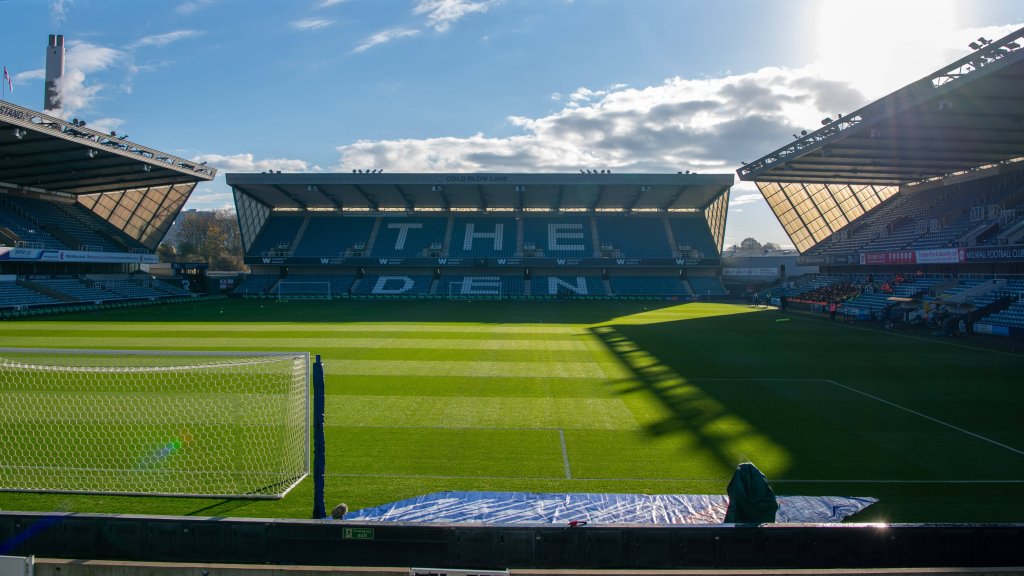
The Football Association (FA), English football’s governing body, has imposed a penalty unprecedented in England on second-tier club Millwall FC over discriminatory chanting by fans. For their home match against Sheffield United on 8 December, the London club must close four sections of the Dockers Stand at The Den. Almost 1,300 seats are affected.
Key points at a glance
- The Football Association is punishing Millwall FC over homophobic and ableist chanting by fans.
- Four sections of the stand must remain closed for the home match against Sheffield United on 8 December.
- The club must also pay a fine of £70,000 plus the costs of the proceedings.
- The number of reported homophobic incidents in English football recently rose by 46 per cent.
- Despite its own anti-discrimination projects, Millwall does not yet have an LGBTQ+ supporters’ group.
Further partial closure possible
The sanction follows repeated homophobic and ableist chanting during the London derby against Charlton Athletic in January 2026. Millwall admitted the charges brought against the club over its failure to adequately control spectator behaviour. Alongside the partial stadium closure, the FA imposed a fine of £70,000 plus the costs of the proceedings and issued a formal warning. An action plan to improve spectator behaviour is also being extended. Any further discriminatory chanting before the end of next season could result in another partial closure.
Discriminatory chanting
The written reasons issued by an FA disciplinary commission reveal that the first ableist insults could be heard as early as the fifth minute of the match. After Millwall took the lead, home fans again directed the offensive chant “South London Spastics” at the opposing supporters. It was the first meeting between the two clubs at The Den since 2019. The ableist chanting was repeated ten minutes into the second half. Shortly afterwards came the homophobic insult “You get fucked up the arse.” According to the disciplinary commission, both chants were repeated “several times”.
Millwall went 2–0 up in the 81st minute and scored twice more in stoppage time to secure a 4–0 victory. Further ableist chanting could be heard during stoppage time. On 24 November, the FA explained its decision by citing breaches of its rules on controlling spectator behaviour: “Millwall FC have been sanctioned for breaches of FA Rules relating to misconduct in controlling spectator behaviour during an EFL Championship match against Charlton Athletic.”
Club management apologises
In a statement, Millwall FC explicitly distanced itself from its supporters’ behaviour. “Both chants are discriminatory and offensive, and the club condemns them in the strongest possible terms.” Chief executive Mark Fairbrother also addressed fans in a letter published on the club’s website. “Incidents like these affect us all,” Fairbrother said, “but no one more than the people directly discriminated against by ableist, homophobic or other unacceptable chants. We apologise to everyone who was affected by these chants, felt offended by them or was otherwise harmed.” Fairbrother announced additional preventive measures. These include clearer warnings about unacceptable behaviour and an increased stewarding presence. The chief executive also reminded supporters that discriminatory incidents can be reported “discreetly”.
Sharp rise in homophobia
The incidents at Millwall come against a backdrop of a marked increase in reported cases of discrimination in English football. Last season, the anti-discrimination organisation “Kick It Out” received a sharply increased number of reports of homophobic mass chanting (German) – as many as in the four previous seasons combined. The total number of reports of homophobic incidents rose by 46 per cent compared with the 2024/25 season. A substantial number of incidents are still believed to go unreported. “Kick It Out”, which receives financial support from football associations and leagues including the English Football League (EFL), welcomed the sanctions against Millwall and called for joint action against discrimination.
“Last season, we received a record number of reports of mass chanting in football, including racist, sexist and misogynistic, homophobic, ableist and religion-related abuse.” The organisation announced further research and campaigns. “That is why we are conducting further research and running campaigns to highlight the impact on the communities affected and ensure more consistent action by clubs and the relevant authorities.” Raising awareness among fans and club officials was particularly important, it said. “Education plays a crucial role here – both for fans, so they understand the impact and consequences of discriminatory chanting, and for clubs, so they can actively help curb its spread. We stand ready to support football in eliminating this problem.”
Delayed investigations
The written reasons for the sanctions reveal that the club’s delayed response limited the opportunities to identify those responsible. “By the time the club finally began taking steps to investigate the incidents, little could be done about the incidents themselves,” the report states. Nevertheless, video footage made it possible to identify one participant. “Analysis of a video found on social media led to the identification of a person who had been involved in one of the incidents. This person admitted their involvement in the incident in question, attended an education session and was banned by the club from attending the stadium for a specified period.” The use of technology could make it easier to identify those responsible, but would involve additional expenditure. Second-tier clubs already invest millions in player wages to remain competitive in the race for promotion to the financially lucrative Premier League. Millwall generated £21.6 million in revenue from player sales in 2025. Nevertheless, the club recorded a pre-tax loss in the financial year in question.
Gay players
Homophobic abuse in the stands is regarded as one of the reasons why gay and bisexual men in professional football rarely speak publicly about their sexual orientation. According to the LGBTQ+ sports website “Outsports”, only a very small number of footballers or referees in the United Kingdom have publicly come out to date. It says there are currently no active, openly gay or bisexual players in European men’s professional football. Fans, too, may find it difficult to openly criticise homophobic remarks. The fan culture at Millwall FC, whose team is also known as the “Lions”, has traditionally been shaped by the motto “No one likes us, we don’t care”.
Despite the latest incidents, the club has been working to combat discrimination for several years. Millwall has its own anti-discrimination campaign and supports Millwall Romans FC, an LGBTQ+-inclusive amateur football team. In summer 2026, the team also took part in a PR agency project supported by the “Football v Homophobia” initiative. This produced the “Pride Playbook”. The guide is intended to help other professional clubs establish their own LGBTQ+-inclusive teams. Unlike most other clubs in the English Championship, however, Millwall does not yet have an organised supporters’ group for LGBTQ+ people and their allies.








