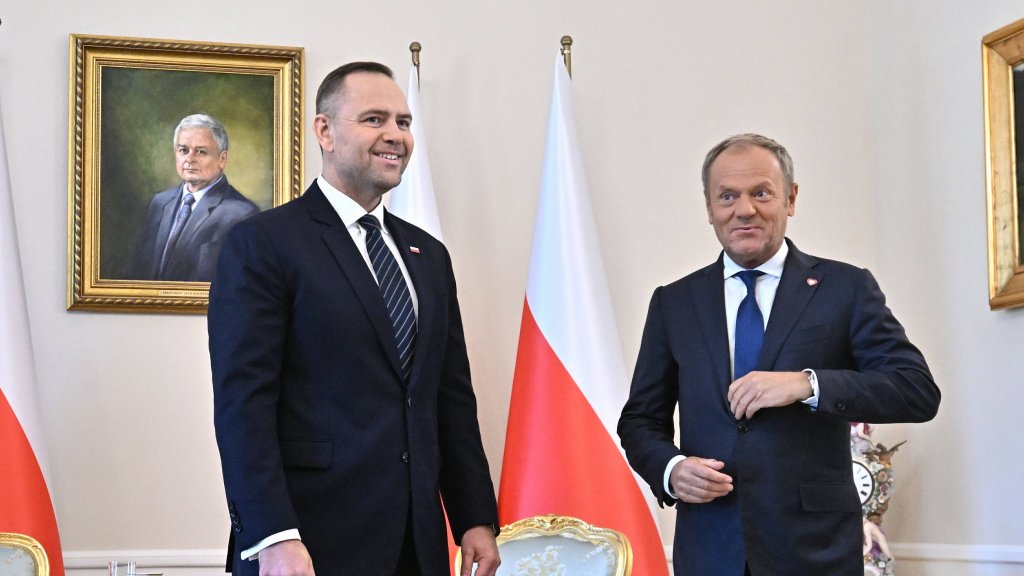
For gay and lesbian couples in Poland, more is at stake in the confrontation between President Karol Nawrocki and Prime Minister Donald Tusk than the composition of the Constitutional Tribunal. The right-wing conservative president opposes the introduction of same-sex marriage and can use his veto to block legislation to that effect. At the same time, the centre-left government is trying to reduce the influence of the former governing party, Law and Justice (PiS), over the judiciary.
The key points at a glance
- Same-sex couples await legal recognition: Poland’s President Karol Nawrocki continues to oppose opening marriage to gay and lesbian couples. His power of veto is a major obstacle to the necessary legislative changes.
- Power struggle over the Constitutional Tribunal: Donald Tusk’s government is trying to restructure the court, which has been politically contentious for years. The president is refusing to swear in several elected judges through the regular procedure.
- Government claims majority: On paper, Tusk’s centre-left coalition now controls eight of the 15 judicial seats. However, several newly elected judges are being prevented from actually participating in the court’s work.
- Rule of law remains contested: While Tusk seeks to depoliticise the judiciary, the president and opposition accuse the government of improper interference.
Political manoeuvring
The dispute therefore also concerns the political and legal conditions under which gay and lesbian couples might secure state recognition of their relationships in future. Poland has not yet passed legislation opening marriage to same-sex couples. Legal protections for same-sex partnerships also remain politically contested. The conflict between the government and the head of state further complicates the search for a legislative solution. It is important here to distinguish between the institutions’ powers: parliament decides on new marriage and partnership laws in the first instance. The president can refuse to sign them. The Constitutional Tribunal, in turn, can rule on whether laws comply with the Polish constitution. Its composition and independence therefore also matter for future disputes over the rights of same-sex couples.
Demonstrators block access
The extent to which the institutional conflict has escalated was evident again yesterday outside the Constitutional Tribunal’s premises in Warsaw. Around 100 supporters of the right-wing conservative opposition had blocked access to the grounds with barriers. One banner carried the appeal “Poland, wake up”. “All patriotic Poles should be here with us,” one participant told the television channel TVN. The protest was directed against the lawyer Maciej Berek taking office. The 54-year-old had been elected a Constitutional Tribunal judge by the centre-left parliamentary majority in early September.
On Wednesday this week, Berek intended to begin work after taking his oath before parliament. However, the demonstrators blocked his path to the court building. The judge was only able to enter the grounds after the police intervened. Officers removed the obstructions, with scuffles breaking out in the process. Gaining access to the building did not, however, mean that Berek could begin his judicial work.
Court president refuses to let judge take office
Inside the Constitutional Tribunal, Berek encountered further resistance. The court’s president, Bogdan Swieczkowski, refused to assign him a workspace or allow him to participate in its judicial work. Swieczkowski is regarded as a close confidant of Zbigniew Ziobro, who headed the justice ministry under the PiS government. In the court president’s view, Berek may only take office once President Nawrocki has confirmed his swearing-in. The conflict also escalated on a personal level. Swieczkowski stood in Berek’s way and prevented him from going to another judge’s office.
Berek subsequently accused the court president of violating his bodily integrity and filed a criminal complaint. Behind the confrontation lies a dispute over the procedure for appointing new Constitutional Tribunal judges that has remained unresolved for months. After his election in September, Berek had asked the presidential chancellery to set a date for his swearing-in. No response came for weeks. The governing coalition therefore decided to have the oath administered before the speaker of parliament, without waiting for the head of state’s involvement.
President opposes swearing-in
The government bases this approach on an opinion from the Venice Commission. The Council of Europe’s advisory body concluded that a Constitutional Tribunal judge elected by parliament can be sworn in even without the president’s “physical presence” if the head of state refuses or delays administering the oath. Nawrocki does not recognise this interpretation as binding. He described the assessment as a “non-binding opinion” and declared that Berek was “certainly not a judge of the Constitutional Tribunal”. At midday on Wednesday, the president then made a pointed visit to court president Swieczkowski. That evening, it emerged that Nawrocki had cancelled a planned trip to Slovenia. His presidential chancellery also made strong accusations. Its head, Zbigniew Bogucki, described the attempt to bring Berek into the Constitutional Tribunal as “brutal pressure”. PiS leader Jaroslaw Kaczynski went further, speaking of a “coup d’état”. The government rejects the accusations and invokes parliament’s right to elect Constitutional Tribunal judges.
No to marriage equality
That Nawrocki’s power of veto has concrete consequences for gay and lesbian people has been demonstrated several times in the past (German), most recently in summer 2026. In mid-July, the president refused to sign two laws that would have allowed unmarried couples to legally register their relationships for the first time. The proposal explicitly included same-sex partnerships. The legislation would have allowed two adults to enter into an agreement before a notary and have it registered at a registry office. It included provisions on joint property arrangements, maintenance obligations, housing rights, access to medical information and funeral arrangements. It did not provide full equality with marriage. Nevertheless, it would have been the first legal means of officially recognising same-sex partnerships in Poland.
Nawrocki justified his veto by citing the special protection afforded to marriage under the Polish constitution. In his view, the proposed legislation would have created an institution akin to marriage. The government criticised the decision. Tusk described the proposal as the absolute minimum on which the coalition had agreed. An attempt to override the veto in parliament also failed in September. In the vote in the Sejm, 232 MPs voted to overturn the veto and 199 voted against. A total of 259 votes would have been required. As a result, same-sex partnerships remain without legal recognition to this day.
A look at the constitution
The current dispute over the composition of the Constitutional Tribunal therefore also has a social policy dimension (German). The Polish constitution places marriage, as a union between a man and a woman, under special state protection. Views differ on which legal arrangements for same-sex partnerships are compatible with this. An independent and functioning Constitutional Tribunal could play an important role in future legislative reforms. Its rulings would be particularly relevant if the president or other authorised bodies sought a review of the constitutionality of such laws. However, even a changed majority among the judges would not automatically make same-sex marriage possible. Political and legislative decisions would still be required. The conflict therefore concerns two interconnected questions: who will decide how the constitution is interpreted in future, and what scope is there for legal recognition of same-sex partnerships?
Restructuring the court
The dispute over the court dates back to 2015. That was when the right-wing conservative PiS took power and began a comprehensive restructuring of the justice system. Under the banner of “judicial reform”, it changed the composition and working methods of several courts. Particularly contentious was the appointment of Constitutional Tribunal judges who were politically close to the then governing party. The measures led to years of conflict with European institutions over the independence of the Polish judiciary. In 2025, the European Court of Justice found that Poland’s Constitutional Tribunal had breached fundamental requirements of EU law and could not be regarded as an independent court. When Tusk’s centre-left government took office, it declared restoring rule-of-law standards to be one of its key goals. Putting this into practice proved difficult, however. Several attempts at reform failed, while numerous judges appointed during the PiS government’s time in power remained in office.
Tusk wants to use majority
A year before the next parliamentary election, Tusk is still trying to overcome the deadlock in the Constitutional Tribunal. Berek has an important role to play in this. Until recently, the lawyer worked with Tusk in government and, under the prime minister’s plans, is intended to help restructure the court. “We are restoring the rule of law in Poland and will not take a single step backwards. (…) We will rebuild the legal and constitutional order using every means available to the state,” the prime minister declared. Whether the majority on paper will be enough to reorganise the leadership of the Constitutional Tribunal remains unclear.
Gay and lesbian couples wait
These developments therefore remain particularly significant for gay and lesbian people in Poland. The failed partnership legislation has shown that even a reform passed by parliament can be defeated by the president’s veto. Meanwhile, a paradoxical situation is emerging: following a ruling by the European Court of Justice (ECJ), more than 500 gay and lesbian couples in Poland have now registered marriages they entered into abroad. As an EU member, Poland is legally obliged to allow this. While same-sex marriages entered into abroad are thus recognised, gay and lesbian people are still denied the option of marrying within the country itself. Unfortunately, given the current disputes, a swift solution is still not in sight. For gay and lesbian couples, the political deadlock means that the legal protections they seek for their relationships remain out of reach.








