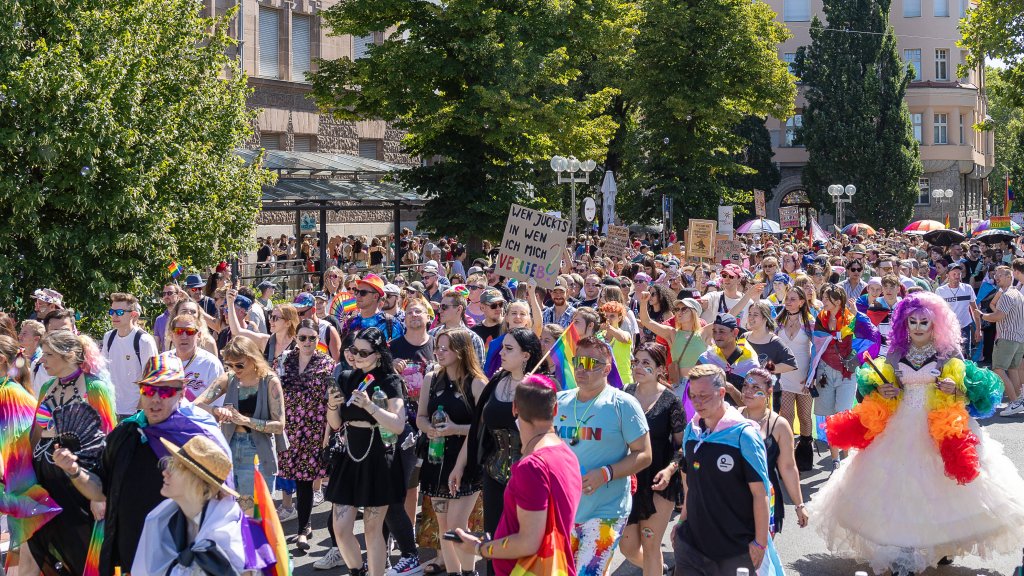
Two weeks on, the attack at Christopher Street Day (CSD) Pride in Berlin (German) continues to resonate at LGBTQ+ demonstrations in other cities. Organisers report significantly higher turnout than in previous years. This applies not only to large events in major cities, but also to smaller Pride events.
The key points at a glance
- In several cities, significantly more people than usual attended Pride demonstrations.
- In Braunschweig, at least 6,000 people took part, according to police.
- Nuremberg reported a record turnout of more than 20,000 participants; in the afternoon, police put the figure even higher, at around 23,000 demonstrators.
- At Ruhr Pride in Essen, at least 3,500 people joined the demonstration march.
- Two weeks after the attack at Berlin Pride, the events placed particular emphasis on solidarity and protecting LGBTQ+ people.
- Pride events in Hamburg and Kempten also attracted unusually high numbers of participants the previous weekend.
- In Prague, participants observed a minute's silence for the victims of the Berlin attack at the start of the Pride demonstration.
- Security measures were tightened in many places following the attack.
More people than usual
In Braunschweig, at least 6,000 people took to the streets for LGBTQ+ rights, according to police. Turnout was therefore significantly higher than in previous years, when officers had counted between 4,500 and 5,000 participants. Björn Waldmann, a member of the Braunschweig Pride organising team, also observed greater participation by people who are not queer themselves. “There are also many non-queer people taking part who want to show their solidarity with the community,” he told the epd news agency. In Waldmann's view, the political character of the event has also changed. Pride had become “more political again than in previous years”. Following the attack in Berlin, he said, there was also a sense of “now more than ever”.
Records in Nuremberg and Essen
Particularly large numbers also gathered in Nuremberg. More than 20,000 participants were counted at Christopher Street Day, setting a new record. Under the slogan “Nuremberg loves”, more than 60 groups marched through the city centre. They wanted to stand up for visibility and equal rights while also taking a stand against anti-LGBTQ+ hostility. Police revised their estimate upwards again during the afternoon, eventually putting the number of demonstrators at around 23,000. According to police, the event was peaceful and passed without incident.
Authorities had also stepped up security measures at Ruhr Pride in Essen following the attack in Berlin. According to police, at least 3,500 people joined the demonstration march in North Rhine-Westphalia. The parade set off from the Grugahalle at midday. During the afternoon, the march proceeded without any notable incidents. Organisers expected around 12,000 people to attend the Pride event as a whole over the course of the day.
High turnout the previous weekend
The strong turnout is not confined to the current weekend. A week earlier, both large and smaller Pride events had already attracted more people. Hamburg hosted the first major Pride event since the Berlin attack. Around 300,000 people gathered there, according to organisers and police – more than ever before. Turnout also exceeded expectations in Kempten in the Allgäu region. Just over 2,500 people took part in Pride there the previous weekend. Following the attack in Berlin, the organisers of several demonstrations had reviewed their security plans and, in some cases, adapted them. The attack has therefore influenced not only the political debate about protecting LGBTQ+ people, but also preparations for the events.
A minute's silence at Prague Pride
The impact of the attack was also felt at a Pride event outside Germany. In Prague, the victims of the Berlin attack were remembered at the start of the Pride demonstration. Participants observed a minute's silence. Afterwards, tens of thousands of people marched through the Czech capital, calling for equal rights for sexual minorities.
The organisers of the Prague festival had also announced additional security measures in response to the attack in Berlin. Hundreds of police officers accompanied the parade, supported by a de-escalation team. Participants also had to follow special rules for banners. They were asked either to carry them by hand or to use plastic poles. Wooden poles and broom handles were not to be used. According to police, the event passed without any notable incidents, despite a small group of counter-demonstrators gathering along the route.








