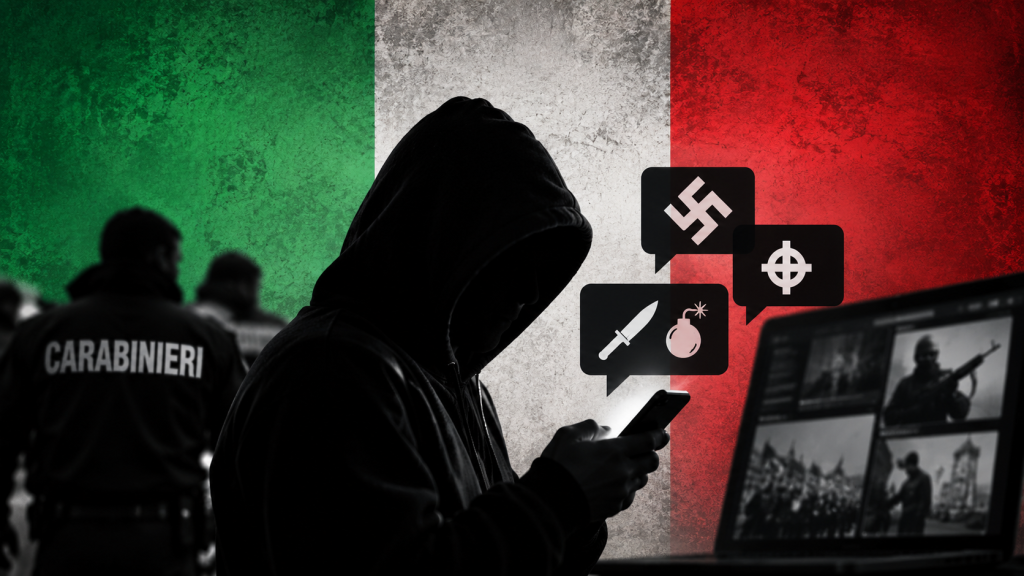
Italian security authorities are investigating 17 young people from neo-Nazi circles. Among the suspects are 14 minors. They are accused of propaganda and incitement to crimes based on racial and religious discrimination, with the aggravating circumstance of terrorism. Gay men and lesbians are said to have been the main intended targets of the planned attacks.
Key points at a glance
- Italian investigators are targeting 17 young people, including 14 minors.
- They are accused of propaganda and incitement to crimes based on racial and religious discrimination – with the aggravating circumstance of terrorism.
- The suspects are alleged to have belonged to two online groups linked to neo-Nazi circles.
- The groups allegedly glorified Hitler, the SS and far-right attackers, and targeted Jews, gay people and Black people.
- According to investigators, detailed instructions were also shared on making homemade explosive devices and using them to maximise their lethal effect.
- Investigators carried out searches in several Italian cities.
Searches in several cities
Officers from the Carabinieri’s ROS special unit and the DIGOS state security department carried out searches in several Italian cities as part of the investigation. The suspects allegedly glorified far-right attackers on social media and exchanged information on making explosive devices, among other activities. According to investigators, some of those accused belonged to the social media group “Chat del Nuovo Ordine Europeo” (“Chat of the New European Order”), while others belonged to “Fronte Fascista Italiano” (“Italian Fascist Front”). Members reportedly targeted Jews, gay people and Black people in their posts.
Attackers and Hitler glorified
Investigators said the ROS and DIGOS investigations began with online monitoring of neo-Nazi circles across various social networks. The suspects were reportedly identified as participants in two groups. Documents and manifestos by prominent attackers of recent years were allegedly shared there. These reportedly described the massacres carried out and the weapons used in detail. According to investigators, members also posted videos of well-known terrorists, including Brenton Tarrant, and glorified their actions “without censorship”.
In 2019, Tarrant carried out far-right terrorist attacks on two mosques in Christchurch, New Zealand, killing dozens of people. The group members had also “stoked hatred” by spreading racist, antisemitic, gender-discriminatory and neo-Nazi ideas, investigators said. They are also alleged to have glorified Adolf Hitler, the SS, fascism and key symbols of the movement. According to investigators, members also took part in online games that virtually re-enacted scenes of violence and the killing of ethnic minorities.
Instructions for making explosive devices
A particularly serious allegation is that the groups also shared specific instructions for potential acts of violence. In some cases, those involved had provided “clear and precise instructions” for making homemade explosive devices, investigators said. These also reportedly included advice on the “correct” use of such devices to “increase their lethal effect”. Instructions on training with, using and handling bladed weapons and firearms were also allegedly shared.
Alongside the ROS special unit, the Carabinieri provincial commands in Rome, Como, Catanzaro, Bologna, Milan, Reggio Emilia, Benevento, Genoa, Udine, Palermo and Trento took part in the nationwide operation. According to the authorities, DIGOS officers from Verona police headquarters and DIGOS units from Naples, Benevento, Bresca and Trento were also involved. The operation was coordinated by the Central Directorate of the Prevention Police.








