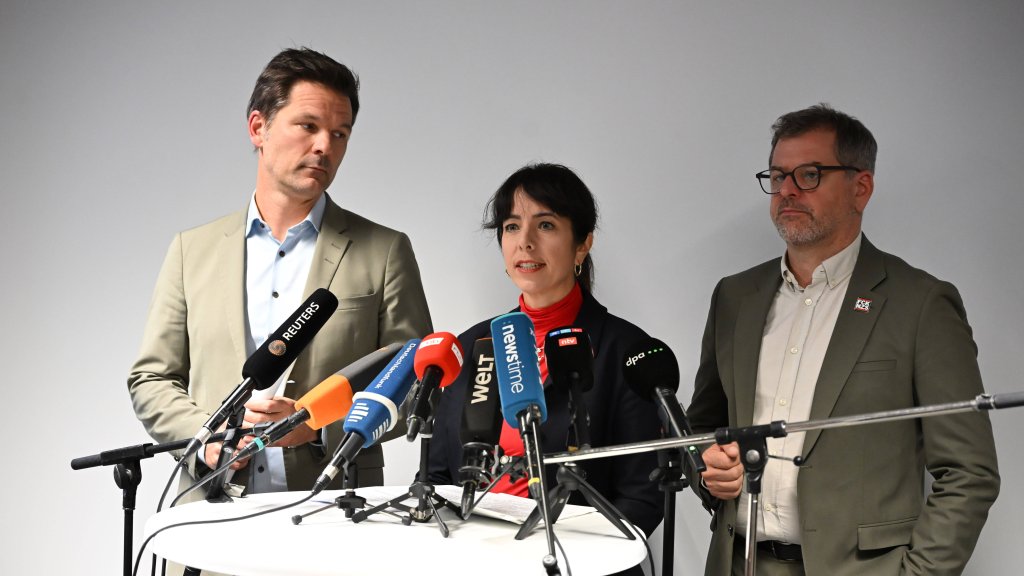
Plans by Die Linke, the Greens and the SPD to form a government in the capital are already causing considerable conflict before possible coalition negotiations have even begun. While the three parties see common political ground following their exploratory talks, criticism of cooperation with Die Linke’s Berlin branch is growing within the SPD at federal level. Meanwhile, the alliance’s working paper also emphasises LGBTQ+ rights.
Key points at a glance
- Opposition within the SPD: according to Spiegel, 20 SPD members of the Bundestag oppose coalition negotiations with Die Linke’s Berlin branch. They cite allegations of antisemitism and contacts in extremist circles in particular.
- Focus on LGBTQ+ policy: Die Linke, the Greens and the SPD want to strengthen Berlin as a rainbow capital, safeguard LGBTQ+ facilities and expand protection against discrimination.
- New legislative measures: plans include an anti-discrimination check for legislation, further development of the state diversity programme and a state law to promote democracy.
- The exploratory paper also envisages changes to housing, migration, tax and education policy.
- Following successful exploratory talks, the parties’ governing bodies must decide on formal negotiations. The Berlin SPD’s executive plans to discuss the matter today.
Revolt within the SPD
According to information obtained by the news magazine Spiegel, twenty Social Democratic members of the Bundestag have signed a joint statement opposing the start of coalition negotiations. The document is reportedly headed “Our moral compass is never negotiable”. Their reservations centre on allegations of antisemitism against individual members of Die Linke’s Berlin branch, as well as disclosed connections to organised crime circles and extremist groups. “The recurring conflicts over antisemitism within Die Linke’s Berlin branch, the disclosed contacts with Remmo associates and figures from extremist circles, and the disputes over how these incidents have been handled give us substantial grounds to doubt the political reliability of this state branch,” the SPD MPs write, according to Spiegel. Former Federal Interior Minister Nancy Faeser is also among the signatories, the report says.
Protecting Jewish life
The Bundestag members make clear that they do not regard the allegations as exclusively a matter of state politics. Rather, they believe fundamental Social Democratic positions are at stake. “Antisemitism is not a marginal problem that can be dealt with through a joint statement,” the document says. Protecting Jewish life is “non-negotiable”. In the signatories’ view, even a well-founded suspicion that people associated with organised crime or terrorist organisations were gaining political influence could damage trust in democratic institutions. “That makes our backing for the police and security authorities all the more important.”
The MPs expressly acknowledge that the decision on participation in government rests with the Berlin SPD branch. At the same time, they point to their “responsibility for the credibility of shared Social Democratic principles”. They draw an unequivocal conclusion from this: “We therefore strongly oppose the start of coalition negotiations with Die Linke’s Berlin branch under the present circumstances”.
Banaszak voices concerns
The debate about how to deal with antisemitic positions is not confined to the SPD. Federal Greens co-leader Felix Banaszak also believes that questions remain to be clarified over a possible governing coalition. His “great concern”, he said, was that not all the problems had been adequately addressed. “If, every few weeks, parts of this coalition invite people somewhere who call for an intifada, then this project will not remain stable for five years. So it needs to be addressed beforehand, so that we can enter this alliance feeling confident,” Banaszak said.
At the same time, he welcomed the possibility in principle of such an alliance. Given the electoral successes of far-right parties, he said it was encouraging that other political majorities could also be formed. Despite the criticism, Die Linke, the Greens and the SPD agreed on the outcome of their exploratory talks on Saturday. Die Linke had emerged as the clear winner of the Berlin House of Representatives election on 20 September. Whether the three parties now actually begin coalition negotiations depends on decisions by their respective governing bodies.
Berlin as a rainbow capital
Equality and LGBTQ+ policy are an important component of the planned cooperation. In the 30-page exploratory paper entitled “More together, more Berlin”, Die Linke, the Greens and the SPD explicitly commit to a diverse urban society and the protection of LGBTQ+ people. Berlin is not only to preserve its existing role as a rainbow capital, but to develop it further. “We also make a clear commitment to our identity as a rainbow capital and will safeguard and further develop queer infrastructure, safe spaces, work to prevent hostility towards queer people and the corresponding action plans,” the agreement states.
With this, the parties aim to secure existing services for lesbian, gay, bisexual, trans, intersex and queer people over the long term. According to the stated plans, these include, in particular, safe spaces, advice and support structures, and measures against anti-LGBTQ+ violence and discrimination. However, the passages reproduced do not contain specific financial commitments for individual facilities or programmes.
Equal rights for all
The three parties describe diversity as a fundamental element of their political vision for the capital. “We want a Berlin in which everyone can live freely and safely, regardless of their background, religion, gender, sexual identity or how long they have lived in Berlin – visibly and with self-determination.” Different gender identities and lived realities are to be explicitly taken into account. The aim, they say, is a city in which people can live with equal rights regardless of “sex, gender identity, sexual identity, disability, chronic illness, neurodivergence”.
The parties link this position to a broader understanding of participation in society. Different ways of life should not be seen as at odds with social cohesion. “The different experiences, political views and ways of life of Berliners are part of our city,” the agreement states. The prospective coalition partners therefore intend to champion democratic conflict resolution, human rights, and freedom of expression, the arts and academic research. They also pledge to counter antisemitism, anti-Roma racism, racism and hostility directed at particular groups, including hostility towards LGBTQ+ people. This policy commitment takes on particular significance against the backdrop of the current allegations of antisemitism against sections of Die Linke’s Berlin branch.
Anti-discrimination check
Beyond safeguarding existing LGBTQ+ services, Die Linke, the Greens and the SPD are planning changes to the legal instruments used to combat discrimination. In future, all laws and regulations are to be reviewed for potential disadvantages. “For us, freedom from discrimination is an essential cross-cutting task across all areas of political and social action,” the parties explain. They add: “To ensure this, we will subject all laws and regulations to an anti-discrimination check and close existing gaps in protection.” Such a review mechanism is intended to ensure that questions of equal treatment are considered when legislation is being drafted. A reform of Berlin’s Landesantidiskriminierungsgesetz (LADG), its state anti-discrimination law, is also planned. The state diversity programme is to be developed further as well. The specific changes to existing anti-discrimination legislation would have to be clarified during any coalition negotiations.
Strengthening civil society work
Another proposal concerns support for democratic and anti-discrimination initiatives. Die Linke, the Greens and the SPD want to introduce a state law to promote democracy, intended, among other things, to strengthen civil society organisations. “At the same time, through a state law to promote democracy, we will strengthen civil society’s anti-discrimination work, empowerment, monitoring and documentation.” For LGBTQ+ organisations, such legislation could be particularly relevant to prevention, documenting anti-LGBTQ+ incidents and supporting those affected. Whether additional funding will be provided, and on what scale, also remains unclear on the basis of the agreements outlined so far.
The three parties also want to address the composition of the Berlin House of Representatives. A parity law is intended to guarantee the “political representation of all genders”. The approach thus goes beyond models that provide exclusively for equal participation by women and men. However, such statutory requirements raise constitutional questions. Comparable parity rules in Brandenburg and Thuringia have already been struck down by courts. The rules there referred to two genders. How Berlin might design a new law while meeting constitutional requirements remains an open question for now.
Expropriating housing companies
Alongside social and equality policy, the exploratory paper contains far-reaching proposals for the housing market. From 2029, property companies with at least 10,000 homes could be subject to expropriation measures. According to the information available, implementation would be subject to a cost ceiling of €16 billion. The parties are thus taking up an issue that has been the subject of controversy in Berlin housing policy for years. Housing policy agreements at federal level create additional tensions. There, the SPD and the CDU/CSU have agreed on the goal of prohibiting the states from expropriating rental housing.
The Berlin parties also want to introduce new rules for allocating existing rental homes. In future, larger housing companies, including private landlords, would have to allocate a certain proportion of their stock to people holding a certificate of eligibility for social housing. A so-called “WBS quota for existing homes” is planned for this purpose. This would mean that the allocation of housing on social grounds would no longer be restricted exclusively to newly built homes or those already receiving public subsidies.
Refugee admission programmes
Another focus of the planned government programme is migration policy. The three parties want Berlin to expand its role as a place that welcomes people seeking protection. “We will establish state admission programmes and reinstate expired admission programmes that enable people in need to enter Berlin safely.” In doing so, the parties also want to restore programmes for Berlin that were halted by the CDU/CSU-SPD federal government in 2025.
Existing legal options for extending residence permits are also to be used to the full. The agreement envisages “making full use” of rights of residence. This could allow more people to remain in Berlin for longer and prevent deportations in certain cases. Another change concerns the payment card for refugees. Die Linke, the Greens and the SPD want to abolish it and replace it with a standard basic bank account. Such an account would give those affected access to ordinary banking services and cash. Critics of abolishing the payment card point to the possibility of paying cash to people smugglers or transferring money abroad.
Voting rights after five years
Political participation by people without German citizenship is also to be expanded. Under the three parties’ proposals, people would be allowed to vote and stand for election at state and local level after five years of residence in Germany. The planned rules would therefore not, in principle, distinguish between different immigration status groups and could also apply to asylum seekers and people whose asylum applications have been rejected. However, the constitutional permissibility of such a proposal is disputed. Augsburg legal scholar Josef Franz Lindner told the newspaper Bild: “The proposal is unconstitutional.” Such a reform would therefore not depend solely on political majorities in Berlin. It would also have to comply with constitutional requirements governing voting rights.
Tax and fee increases
To finance their political plans, Die Linke, the Greens and the SPD intend to raise additional revenue for the state budget. The exploratory paper specifies a minimum annual amount of €400 million. “The coalition agrees to make arrangements to generate additional revenue of at least €400 million a year, particularly through tax and fee increases.” Possible instruments include a packaging tax, whose introduction is to be examined. The three parties also want to campaign at federal level for the introduction of a wealth tax and reform of inheritance tax. They are also seeking changes to the rules on government borrowing. “Our goal is also to abolish the debt brake (…) in its current form.” The financial impact of the individual measures on residents and businesses cannot yet be conclusively determined from the key points outlined so far.
Cohesion between communities
Alongside the individual reform proposals, the parties involved emphasise social cohesion as an overarching goal. Die Linke’s lead candidate Elif Eralp announced her intention to bring different population groups closer together and counter existing social tensions. “For social cohesion, it is crucial that we pursue an inclusive politics and move away from polarisation and division,” she said. “We consider the different communities in our city together. We want to bring people together, and we want to build bridges.” This approach also forms a key reference point for the planned LGBTQ+ policy. The parties want to increase the visibility of different ways of life while promoting peaceful coexistence in a diverse city.
However, it has not yet been decided whether the agreed goals will actually form the basis of a new Berlin state government. Agreement on the exploratory paper is, for now, merely an intermediate step towards a possible governing alliance. Before official coalition negotiations can begin, the relevant party bodies must give their approval. The Berlin SPD’s executive plans to consider this question today.








