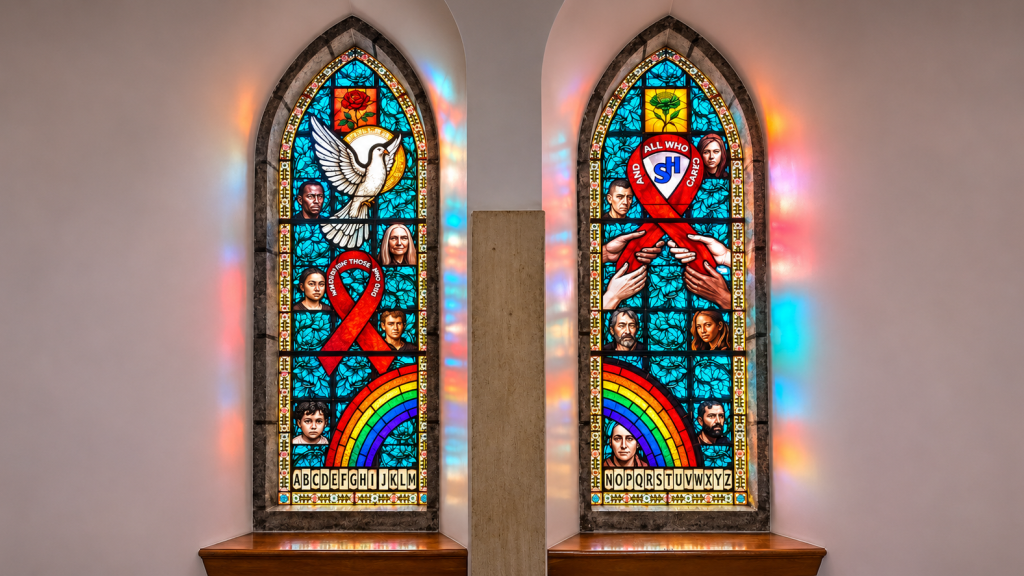
A Catholic parish in the Irish capital, Dublin, is making a special gesture of remembrance for the victims of the AIDS epidemic with two specially commissioned stained-glass windows. The artworks in St. Teresa’s Church on Donore Avenue have now been unveiled, just days before World AIDS Day on 1 December. They are dedicated both to those who died and to the people who supported them during their illness, as the Irish magazine “GCN” reports.
Key points at a glance
- The Catholic parish of St. Teresa in Dublin has unveiled two memorial windows to mark World AIDS Day.
- The stained-glass windows commemorate those who died and honour the dedication of their carers.
- Rainbows, red AIDS ribbons and green carnations symbolise visibility and solidarity.
- Despite repeated hostility, the parish campaigns for acceptance of LGBTQ+ people.
- The memorial also explicitly commemorates people outside the LGBTQ+ community.
Rainbows and red ribbons
The parish had previously created memorials to the victims of the COVID-19 pandemic and their carers. The new stained-glass windows coincide with a special anniversary for the church. “As World AIDS Day 2026 approaches, we are greatly honoured to be able to install these windows in the very year in which our church celebrates its centenary,” the parish explained on social media. Designed and made locally, the stained-glass windows combine Christian motifs with symbols of the LGBTQ+ movement and the worldwide effort to combat HIV and AIDS. The rainbow and the red AIDS ribbon are among the central design elements. “These are the symbols worn by people who championed the cause, activism, funding and research. They stand for visibility,” the parish explained.
Remembering those who died
The first window bears the inscription “In memory of those who are no longer with us” on a ribbon. The second adds: “And all those who cared for them.” Alongside the red rose of Saint Teresa and a depiction of the Holy Spirit, the first window shows people of different ages and ethnic backgrounds. The design is intended to make clear that AIDS affects people regardless of their age or background. While the rainbow represents the values of the LGBTQ+ community, the red ribbons recall the commitment of activists and efforts to promote awareness and fund research. A distinctive feature appears along the bottom of both stained-glass windows: an alphabet has been incorporated, allowing visitors to spell out the names of loved ones who have died.
Remembering Oscar Wilde
The second window continues the rainbow from the first artwork and incorporates the green carnation, a historical symbol of gay people. It commemorates the gay Irish writer Oscar Wilde (German) and the many victims of the AIDS epidemic in the international arts and theatre world. Wilde had discovered green carnations in Paris and brought them to London, claiming to have “invented” them. He asked friends to wear one of these flowers at the premieres of his plays. Even if a play had been rejected by the critics, the unusual gesture would have brought him attention in the gossip and society columns. At the same time, it prompted speculation about the symbol’s meaning.
The arts and theatre sector was hit particularly hard by the AIDS epidemic worldwide. The fate of many artists made the effects of a pandemic publicly visible when they often remained hidden in other parts of society. “It is extremely fitting that the green carnation – Oscar Wilde’s symbol and now the emblem of the International Dublin Gay Theatre Festival, which was founded in the Dublin 8 district – represents that community, with its own identifying code, which was so profoundly affected,” the parish wrote on Facebook. The parish also explicitly invites people from outside its own ranks to join in remembrance. “The parish of St. Teresa wishes to remember the experiences of its own parishioners and of all people worldwide. We invite everyone to visit us, find comfort and perhaps light a candle for those who have left us and for those who cared for them. May you now rest in peace. Your memory lives on.”
Repeated hostility
The Catholic parish’s commitment to the acceptance of LGBTQ+ people does not meet with universal approval. Sam Byrne, the parish’s pastoral leader, told the Irish news website “The Journal” about repeated protests and hostile reactions linked to prayer events during Pride Month. In the weeks when such events take place, the parish regularly faces “a flood of emails and phone calls”. “Sometimes there are protesters outside the church during this time. By now, we have almost become used to it,” Byrne said. There had also been negative reactions online after the memorial windows were installed. Critics had accused the parish of pursuing an initiative that was “not in keeping with the teachings of the Church”.
Byrne, by contrast, described St. Teresa as an “open and inclusive parish” where people were “welcome” and did not have to hide their identity. “You don’t have to hide the fact that you are homosexual. You can freely say that you are married to someone of the same sex. Here, you are respected and feel safe.” The pastoral leader also recalled the Catholic Church’s responsibility during the AIDS epidemic. “Some people are appalled that such an artwork has been installed in a church. On the other hand, this does not undo the failings of the institutional Church during the AIDS epidemic.”
Social change
According to Byrne, it is particularly important to the parish that the stained-glass windows commemorate all sections of the population affected by the AIDS epidemic. In Dublin’s Dublin 8 district in particular, the spread of HIV had also affected many families outside the LGBTQ+ community. “Although many people immediately associate an AIDS memorial window with the LGBTQ+ community, many people here in Dublin 8 have lost loved ones as a result of drug use.” The consequences of intravenous drug use had been particularly severe in the area. There had also been people who contracted HIV through other routes. “This neighbourhood was particularly badly affected by intravenous drug use. There were people who contracted the virus through accidental injuries from infected needles or as a result of blood transfusions.”
The Dublin parish’s commitment comes at a time when the social and legal position of gay people in Ireland, a country traditionally shaped strongly by Catholicism, has changed fundamentally. On 22 May 2015, the Irish public voted in a historic referendum to open marriage to same-sex couples. The following year, so-called stepchild adoption was also made possible. Adoption rights for same-sex couples followed in 2017.








