The CDU/CSU parliamentary group wants to tighten the rules on expelling foreign offenders. People who commit crimes in Germany that the CDU/CSU considers to be directed against fundamental social values should in future be able to lose their right of residence more easily.
Key points at a glance
- The CDU/CSU is calling for an extension of so-called presumptive expulsion for certain foreign offenders.
- In future, crimes motivated by hostility towards women, queer people or Christians could also result in the loss of the right of residence.
- The proposal comes partly in response to the Islamist attack on Christopher Street Day in Berlin on 25 July.
- The CDU/CSU parliamentary group's spokesperson on domestic affairs, Alexander Throm (CDU), supports such an extension.
- A similar provision for crimes with an antisemitic motive had already been proposed following the Hamas terrorist attack on Israel on 7 October 2023.
- Experts point out that EU law and human rights law would still require an assessment of each individual case.
- The Federal Criminal Police Office recorded a total of 2,377 crimes against LGBTQ+ people in 2025. Around a fifth of suspects did not hold a German passport.
- The SPD also wants to take stronger action against violence and exclusion, but is focusing primarily on prevention, prosecution and the enforcement of sentences.
Responding to the CSD attack
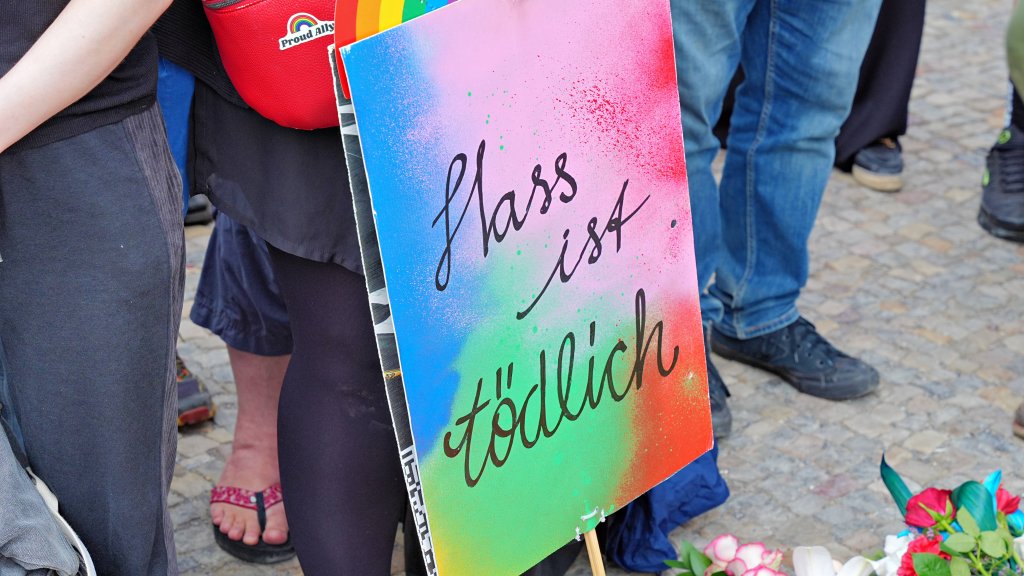
The proposal focuses in particular on offences motivated by hostility towards women, queer people or Christians. The call comes partly in response to the attack on Christopher Street Day (CSD) in Berlin (German) in late July. On the evening of 25 July, 21-year-old Islamist Abdul Ballout drove a van into a group of people on the fringes of CSD. According to investigators' findings, he had previously scouted out so-called “rainbow neighbourhoods” in Berlin.
The CDU/CSU parliamentary group's spokesperson on domestic affairs, Alexander Throm (CDU), sees this as an attack on Germany's free way of life. “The horrific attack on Christopher Street Day in Berlin has shown it once again: fanatical Islamists do not merely reject our way of life, they fight it with hatred and violence,” Throm told Welt am Sonntag. “This time, that hatred was directed at the queer community.” The CDU wants to extend a provision already planned for antisemitically motivated crimes. Foreign nationals who commit such offences could then, as a rule, face expulsion.
Extending the existing proposal
Following the Hamas terrorist attack on Israel on 7 October 2023, Throm had already called for so-called presumptive expulsion for foreign offenders whose crimes were antisemitically motivated. Those affected would have to leave Germany in such cases. The idea was subsequently included in the coalition agreement between the CDU/CSU and the SPD. However, a corresponding amendment to the law has not yet been passed. According to the Interior Ministry, discussions within the federal government are continuing.
The CDU now wants the proposal to be broadened considerably. “We should think further about presumptive expulsion,” says Throm. “What applies to crimes with an antisemitic motive should then also apply to crimes committed out of hostility towards women, queer people or Christians.” In the CDU politician's view, this concerns central principles of living together in Germany. Equality between men and women, acceptance of queer life, the unequivocal rejection of antisemitism, but also freedom of religion and Christian culture are “fundamental values of our country”, Throm said. His conclusion: “Anyone who not only rejects these values but actively fights them has no place in our country.”
Crimes against LGBTQ+ people
In 2025, a total of 2,377 anti-LGBTQ+ hate crimes were recorded in Germany, an increase of 12.8 per cent within a year. Police and experts repeatedly stress that only around ten per cent of all attacks are actually reported and therefore documented. According to the Federal Criminal Police Office, around 20 per cent of suspects did not hold a German passport. Foreign offenders can already lose their residence status under current law, but expulsion is subject to high legal hurdles. This is because courts have repeatedly made clear that the circumstances of each individual case must be taken into account. The state's interest in expulsion is weighed against the individual's personal interest in remaining in Germany.
Thomas Oberhäuser, chair of the migration law working group at the Deutscher Anwaltverein, points to the requirements of European law. “The current rules derive from EU law and the case law of the European Court of Human Rights (ECtHR),” Oberhäuser said. “The ECtHR has set out minimum standards under which expulsions can take place: in every individual case, the interests in expulsion must be weighed against the interests in remaining.” In his assessment, a statutory presumption of expulsion for certain crimes would therefore not automatically lead to significantly more deportations. Daniel Thym, an asylum law expert based in Konstanz, takes a different view of the possibilities. He considers a statutory presumption of expulsion feasible in principle. The crucial point, he says, is that exceptions must remain possible.
The CDU/CSU sees another problem in the actual enforcement of deportations. These apparently often fail because the necessary documents are missing or because those concerned evade the authorities by going into hiding. Throm is therefore also calling for so-called departure detention for serious offenders and people deemed to pose a security threat. They should be detained until they “voluntarily” leave for their home country.
SPD focuses on prevention
The SPD said it also wanted to take stronger action against violence and exclusion directed at queer people. However, its parliamentary group did not comment directly on the CDU/CSU's proposals for stricter expulsion rules. Instead, the SPD pointed to a broader approach. The aim was to do more “to protect queer life from violence and exclusion”, said SPD parliamentary group deputy leader Sonja Eichwede. This depended “in particular on preventive action so that crimes do not happen in the first place, as well as consistent prosecution and enforcement of sentences for all offenders, regardless of their origin”, Eichwede said. In the SPD's view, comprehensive protection can only be guaranteed through this combination of prevention, prosecution and the enforcement of sentences.








