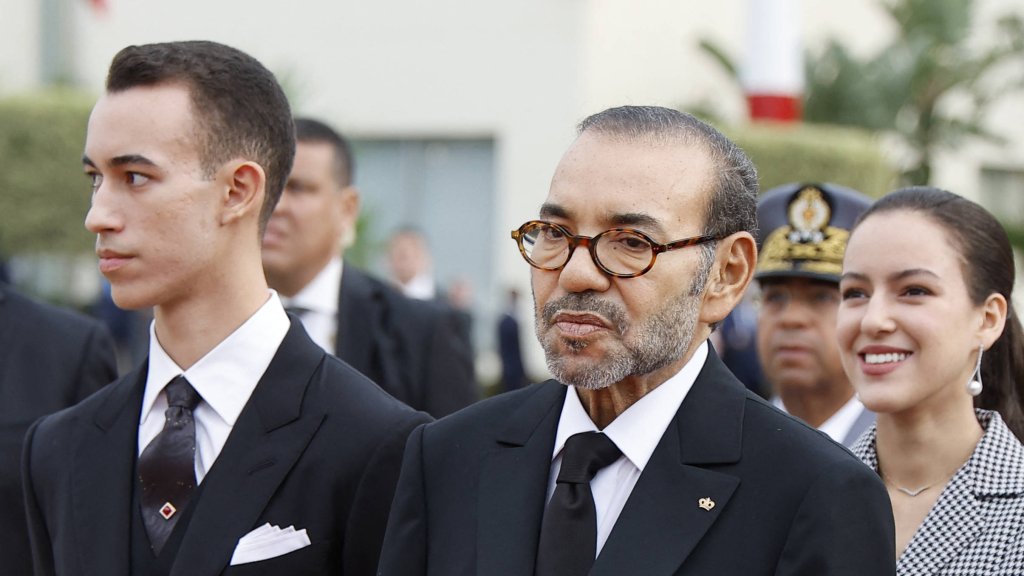
King Mohammed VI.'s absence from public life has repeatedly attracted attention in Morocco and beyond in recent months. When a serious migration crisis recently unfolded in Ceuta, the monarch was not there either. Yet he was only around 42 kilometres away in the Moroccan city of Tétouan. Meanwhile, a rumour that could pose a threat to the monarch is spreading increasingly widely in the country.
The key points at a glance
- King Mohammed VI. was not present during the recent migration crisis in Ceuta.
- Observers have criticised the monarch's frequent absence from public life for years.
- Former UFC fighter Abubakr “Abu” Azaitar is central to his private life.
- The king and Azaitar are said to have shared a close friendship for around seven years – or is there more to it?
- There is so far no official evidence of a romantic relationship between the two men.
- Homosexuality is punishable by up to three years in prison in the country.
Mohammed VI. stays away
During the crisis at the border, Mohammed VI. presided over a military ceremony at which young army officers received their diplomas. The king was already in Morocco at the time for his summer holiday. His children were due to join him after a stay on Capri. The appearance in Tétouan was therefore an official engagement during the royal holiday. At the same time, Spanish Prime Minister Pedro Sánchez travelled to Ceuta in person to address the emergency there. Mohammed VI. had also made no public appearance when a gay cruise ship docked in Tangier. The cruise had prompted considerable criticism on social media.
A close friendship with a combat sports athlete
The monarch's absence during important events is not a new phenomenon. For years, international media and observers have described a king who is increasingly withdrawing from public duties and placing greater emphasis on his private life. One name keeps coming up in this context: Abubakr “Abu” Azaitar. The former UFC fighter, who comes from Morocco and grew up in Germany, has for years been regarded as a close confidant of the king. As an MMA fighter, Azaitar competed in organisations including WSOF and ACB. He was also the first Moroccan to secure a UFC contract. He fought there once in 2021 and once in 2023, losing both bouts.
His past is also well known. Before his career as a kickboxer, Azaitar was imprisoned several times in Germany. The allegations included the theft of luxury vehicles, extortion and violence against a former partner. Despite this past, Azaitar remains part of the Moroccan king's circle. In May 2026, he posted a photograph of Mohammed VI. and his son Moulay El Hassan on his Instagram account, which has around two million followers. According to some reports, however, the crown prince is not particularly fond of the fighter.
Speculation about the two men
According to the magazine Africa Confidential, Mohammed VI. and Azaitar's association dates back approximately seven years. Azaitar regularly posts pictures of himself with the king on social media. This has prompted speculation both in foreign media and, more recently, in Moroccan media. In an interview with CSIS, political scientist Nicolas Pelham described how the close connection might have developed. According to various sources, it began in 2018 – shortly after the king's divorce from Princess Lalla Salma, which was never officially announced.
The princess has since largely disappeared from public life. An important qualification is necessary here: there is no evidence of a romantic relationship between Mohammed VI. and Azaitar. Rather, the rumours are based on speculation about the two men's conspicuous closeness, the timing in relation to the king's separation from his wife, and social conditions in Morocco. Homosexuality is a criminal offence in Morocco under Article 489 of the Criminal Code and can be punished by up to three years in prison. In addition, attitudes towards gay people and attacks against them have recently become more extreme in the country (German).
The monarch's extensive powers
Morocco's 2011 constitution gives the king a considerably stronger role than, for example, the constitutions of European monarchies such as Spain or Britain. Mohammed VI. is head of state, commander-in-chief of the armed forces and chair of the Council of Ministers. He also holds the title “Commander of the Faithful” and is thus regarded as the country's highest religious leader. Critics therefore see the monarch's absence as more than a matter of public perception. They also fear a shift in political decision-making towards the royal court and its advisers.
According to observers, Mohammed VI.'s prolonged absences can also affect the work of the government. The 2023 earthquake is cited as an example. At the time, they say, no minister could have their photograph taken with the affected population before the king had done so himself. When the monarch does not appear in public, decision-making and representative duties may consequently pass to people in his immediate circle. These advisers are not elected but appointed by the king. The debate about the king's absence therefore concerns not only his private life and his friendship with Abu Azaitar. It also raises fundamental questions about the distribution of power and Morocco's political system.








