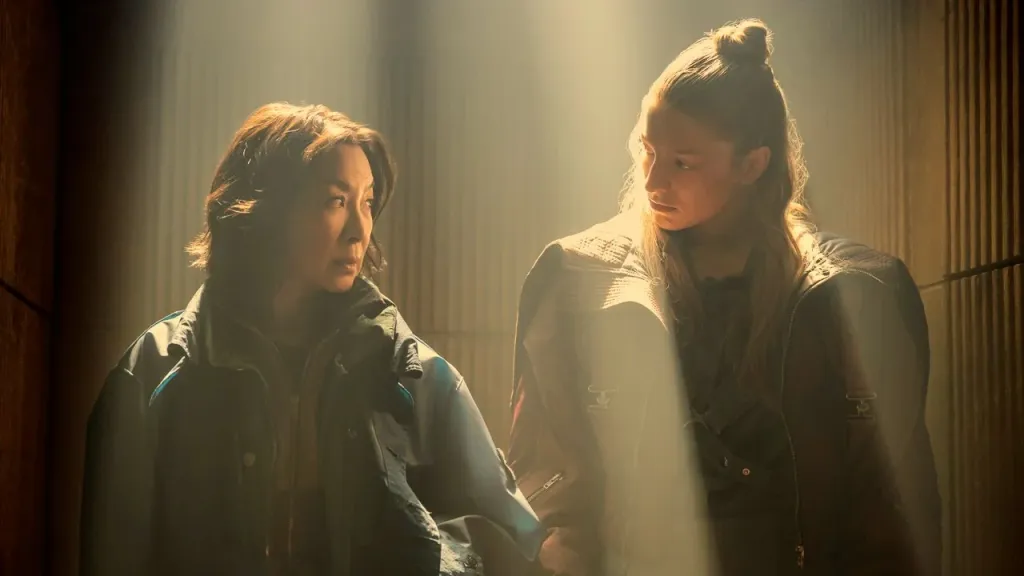
From “Euphoria” to a dystopian future: trans actress Hunter Schafer takes on one of the two lead roles in the new science-fiction series “Blade Runner 2099”. Alongside Oscar winner Michelle Yeoh, the 27-year-old continues the universe of the two feature films “Blade Runner” and “Blade Runner 2049”. The miniseries, co-produced by director Ridley Scott, has been available on streaming service Amazon Prime Video since yesterday.
The key points at a glance
- Amazon Prime Video continues the cult films “Blade Runner” and “Blade Runner 2049” with an eight-part miniseries.
- “Euphoria” star Hunter Schafer plays a human woman who poses as a replicant in a world ruled by artificial humans.
- Oscar winner Michelle Yeoh plays a replicant nearing the end of her lifespan.
- The series reportedly cost around US$150 million to produce.
- While the elaborate visual design impresses, the plot and the development of Schafer’s lead character have drawn criticism.
A career leap for Schafer
For Schafer, who became internationally known primarily through her role as Jules Vaughn in the HBO series “Euphoria” and was recently also tipped as a possible new Bond girl, the casting marks another lead role in an ambitious international production. This time, the openly trans actress is at the centre of a story about power relations in society, identity and the question of what makes us human. All eight episodes of the first live-action series in the “Blade Runner” universe are available to stream at once. The miniseries tells a self-contained story. There are currently no plans for a second series.
A world of artificial humans
The story begins 50 years after the events of “Blade Runner 2049”. Following a devastating war, the balance of power between humans and the so-called replicants has fundamentally changed. While these artificially created humans were once exploited by society for menial work and other services, the physically superior replicants have now seized power. Humans are oppressed and reduced to second-class citizens. Anyone who resists the new order is persecuted.
For their enforcement officers, the replicants have adopted the very name once reserved for the hunters sent after them: Blade Runner. Schafer plays Cora, a human who must pose as a replicant. She is trying to obtain an object that is supposed to offer her and her sick brother a new life. In the process, she joins forces with the experienced replicant and Blade Runner Olwen, played by Michelle Yeoh. Olwen’s artificially limited lifespan will end in just a few days. Together, the two women uncover a conspiracy.
In the 64-year-old Michelle Yeoh, Schafer has an internationally renowned actress at her side. At the 95th Academy Awards in 2023, Yeoh won the Oscar for Best Actress for her role in “Everything Everywhere All at Once”. For Amazon Prime Video, “Blade Runner 2099” is one of its major series launches shortly before the end of the year. In November, the streaming service had already put its weight behind the third series of “The Lord of the Rings: The Rings of Power”. The continuation of the “Blade Runner” universe is now intended to attract viewers with another internationally recognised franchise.
Continuing a sci-fi cult classic
With “Blade Runner” in 1982, British director Ridley Scott created one of the most influential science-fiction films in cinema history. The adaptation of a work by US author Philip K. Dick left a lasting mark on the genre with its bleak vision of the future. Harrison Ford played police officer and replicant hunter Rick Deckard. Thirty-five years later, Canadian director Denis Villeneuve continued the story with “Blade Runner 2049”. Although the film received widespread critical acclaim, its commercial success fell short of expectations. With production costs of between US$150 million and US$185 million, the sequel took around US$287 million worldwide. As a result, another cinematic sequel did not initially materialise. In 2021, the animated series “Blade Runner: Black Lotus” was released, with a story set between the two feature films. Production of the newly released live-action series was delayed several times, partly as a result of the two Hollywood strikes in 2023.
Production of “Blade Runner 2099” reportedly cost around US$150 million in total. That equates to expenditure of just under US$19 million per episode. Producer Silka Luisa (“Shining Girls”), who is responsible for the series, and director Jonathan van Tulleken (“Shōgun”) draw on the films’ distinctive visual language while also introducing visual touches of their own. Unlike the predominantly dark feature films, characterised by nocturnal cityscapes, many scenes in the series take place in daylight. The creative team describe this stylistic approach as “Sunshine Noir”. Elaborately designed retrofuturistic technology and a score inspired by Greek composer Vangelis’s famous soundtrack are intended to evoke the atmosphere of the original.
Criticism of character development
While the series’ visual execution impresses, assessments of the plot and the development of its main characters are less positive. Writing for “Filmstarts”, film critic Markus Trutt praises the atmospheric return to the familiar science-fiction universe, but takes particular issue with the way the screenplay portrays Cora, played by Hunter Schafer. He finds that the criminal case involving a stolen artefact is constructed with enough suspense to sustain interest in the mystery’s resolution. However, Cora remains a comparatively underdeveloped character. He also considers some of her conspicuous behaviour implausible, as it ought to reveal her true identity to the replicants.
In his assessment, the existential questions about humanity and human identity central to the “Blade Runner” universe are also explored less deeply than in the two feature films. The idea that humanity itself is responsible for its downfall, however, remains interesting. His verdict on Michelle Yeoh is more positive. Through nuances in her acting, the Oscar winner succeeds in lending additional depth to her initially cool-seeming replicant. Overall, he finds that “Blade Runner 2099” does not match the quality of the two feature films, but is an audiovisually impressive addition to the science-fiction universe. Whether the franchise continues with further series will now probably also depend on the miniseries’ success.








