The Islamist terrorist attack at Christopher Street Day (CSD) in Berlin (German) has changed many people's sense of safety. In a recent poll, 38 per cent of respondents said their personal sense of safety had definitely or somewhat decreased since the attack, according to the findings of a recent survey by Der Spiegel.
Key points at a glance
- Around one in four respondents says their personal sense of safety has deteriorated since the attack.
- The majority say their own safety is unchanged.
- SPD parliamentary group leader Matthias Miersch is calling for visible support from political leaders.
- Victims of the attack can apply for immediate financial assistance.
An unsafe country in the eyes of the majority
Around half of participants (54 per cent) said their own assessment had not changed. Seven per cent said their sense of safety had definitely or somewhat improved. One per cent did not answer. The survey also addressed general perceptions of the security situation in Germany. Asked whether Germany was “a stable and safe country”, 51 per cent of respondents answered “definitely not” or “not really”. Meanwhile, 37 per cent “somewhat” or “definitely” agreed with the statement. Twelve per cent were undecided.
Speaking to Funke Mediengruppe, gay SPD parliamentary group leader Matthias Miersch (German) addressed Chancellor Friedrich Merz (CDU), stressing: “It would send a very positive signal if the Chancellor attended a CSD event.” It was important, he said, “that we, as political leaders, show our colours in the current situation”. He added: “Many CSD participants are suffering greatly after the attack, even if they were not directly affected. I am part of this community that was attacked, and I can understand very well how many people are feeling emotionally.”
Queer organisations demand better protection
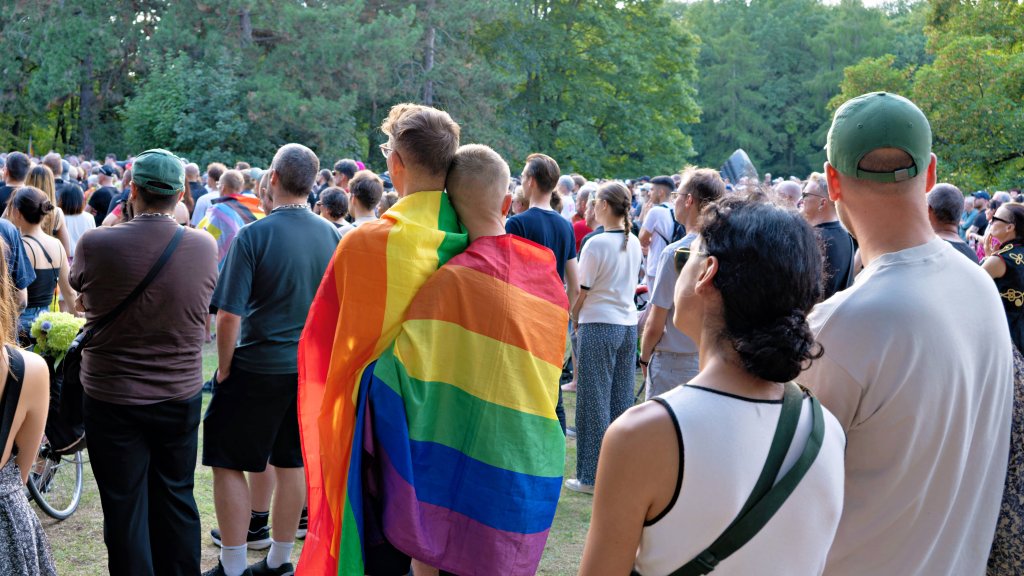
The victims of the Islamist attack were commemorated in Berlin's Tiergarten last Saturday evening. During the rampage on the Saturday a week earlier, 21-year-old Abdul Ballout drove a car into several passers-by before injuring more people with a machete. A Polish mother who had accompanied her daughter to CSD (German) died, and 31 other people were injured, seven of them seriously. The young Islamist (German) was shot dead by police on Sunday evening after officers cornered him at an allotment site in Spandau. According to police, 650 people attended the memorial event, including numerous representatives from state politics. The event was jointly organised by Verband Queere Vielfalt Berlin-Brandenburg and LSVD Bundesverband. Representatives of the organisations used the memorial event to renew their call for greater protection for queer people (German).
Rapid financial assistance for victims
Meanwhile, the German government's Commissioner for Victims, Roland Weber, has offered those affected by the Berlin CSD attack the prospect of rapid financial support. Alongside medical and psychological assistance, victims could also receive material support. “Victims of terrorism are entitled to immediate financial assistance,” Weber told the German Press Agency. According to Weber, these so-called hardship payments are paid out by the Federal Office of Justice, which also accepts applications. The amount depends on the severity of the injuries. Under this tiered system, injured people initially receive €3,000 to €5,000. Those bereaved by the deaths of victims can receive up to €30,000.
“This is an initial payment to help cover certain costs. It can be paid out very quickly,” Weber said. His office also helps those affected complete the necessary applications if needed. Depending on individual circumstances, further benefits may be available in the medium and long term. These include compensation payments, funded retraining, pensions or insurance benefits. Weber also offers support with these. He is also focusing on people who witnessed the attack or were nearby. “There are eyewitnesses, people who were near an attack, and they often run away,” he said. “Some soon feel well again; they put it behind them and cope with it. Others do not. This group is the hardest to reach.” Those affected by the attack, including bereaved people, injured people, relatives, eyewitnesses or people who spontaneously provided first aid, can contact the Commissioner for Victims' free hotline on 0800-0009546.








