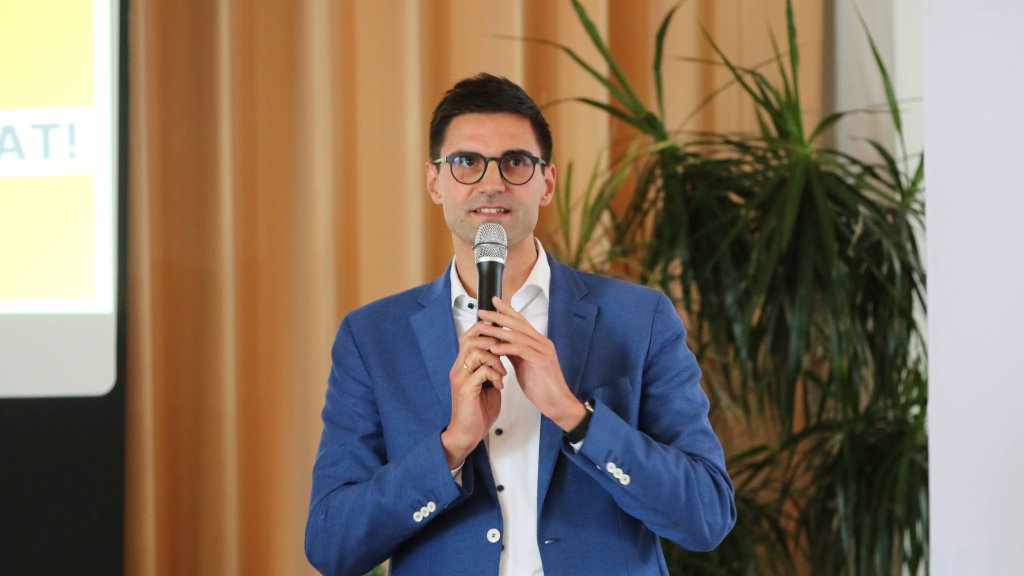
A power struggle over the party’s future direction is emerging within the CDU in Saxony-Anhalt. Bundestag member and deputy CDU/CSU parliamentary group leader Sepp Müller wants to become the party’s new state leader. The gay 37-year-old confirmed his candidacy after a meeting of the CDU state executive in Magdeburg. “I am standing for state leader,” Müller said.
The key points at a glance
- Gay CDU Bundestag member and deputy parliamentary group leader Sepp Müller wants to become the new leader of the CDU in Saxony-Anhalt.
- Following the state election, he believes the mandate to form a government lies with the AfD’s lead candidate, Ulrich Siegmund.
- Müller rules out CDU participation in a government. His party will go into opposition.
- Müller also rejects a non-partisan state premier as a possible solution.
- Federal Chancellor Friedrich Merz had previously criticised Müller in unusually sharp terms.
- Müller defends his pre-election statements, saying: “But the CDU needs credibility.”
- Müller has been a member of the Bundestag since 2017 and is deputy leader of the CDU/CSU parliamentary group.
- In early 2023, Müller made his relationship with CSU Bundestag member Wolfgang Stefinger public. The two politicians married in June this year.
A new direction for the CDU
The chair of the Saxony-Anhalt group of CDU members in the Bundestag is linking his candidacy to a call for a fundamental fresh start. If elected state leader, he intends to reorganise the state party. “We need to get our state party back on its feet instead of standing on its head. Everything needs to change. We need to regain credibility.”
At the same time, Müller believes the AfD could form the next government in Saxony-Anhalt. Speaking on ntv’s “Frühstart” programme, however, the deputy CDU/CSU parliamentary group leader ruled out his party’s participation in a government. Müller believes the mandate to form a government lies with election winner Ulrich Siegmund and his AfD. “They need to cobble together a majority; we are not available for that.” The CDU will go into opposition, Müller added. He also rejected suggestions of electing a non-partisan state premier. “We have experienced the worst election result in the history of the CDU in Saxony-Anhalt. It would be out of the question to contemplate any governing arrangements.”
Sharp criticism from Merz
Müller’s positions had already caused tensions within the CDU/CSU before the election. At a press conference on Monday, Federal Chancellor Friedrich Merz criticised the Bundestag member in unusually sharp terms. According to Merz, Müller had stabbed the CDU’s lead candidate, Sven Schulze, in the back during the election campaign. The criticism followed remarks Müller made on the Friday before the state election. At the time, Müller had publicly declared that a strong election result would give the AfD a mandate to govern. He also said the CDU should not stay in power with support from the Left Party.
Müller has now defended his remarks after the election as well. He said it had been right to state the CDU’s principles and fundamental positions openly. “Voters also need to know what we will do after the election.” For Müller, cooperation with the political extremes was ruled out. “Neither with the right nor with the left.”
Müller rejects Merz’s criticism
By his own account, Müller was unfazed by the Federal Chancellor’s public criticism. He stressed, however, that he was generally open to criticism. “I don’t just accept criticism; I am very open to criticism.” At the same time, he stood by his call for greater credibility for the CDU. In his view, the party must once again do more to ensure that its announcements and political decisions are consistent.
In the debate over the consequences of the poor election result, Müller also opposed a demand from the SPD. The CDU politician rejects a government-imposed fuel price cap. He pointed to Hungary as an example, saying that, in his view, such a cap had not worked there. Müller also took a position against the Social Democrats on the planned pension reform. For him, political credibility depends above all on whether agreements are subsequently implemented.
From banker to deputy parliamentary group leader
Müller has been a member of the German Bundestag since 2017. Originally from Lutherstadt Wittenberg, the trained banker with a diploma in banking management previously worked as a corporate client adviser at Deutsche Kreditbank, among other roles. He has been active in the CDU and local politics since his youth. Within the CDU/CSU parliamentary group, Müller became deputy leader with responsibility for economic affairs and energy, small and medium-sized businesses, tourism and the eastern German states. He also chairs the Saxony-Anhalt group in the Bundestag.
Müller has also attracted attention in his private life. In early 2023, he publicly revealed that he was in a relationship with CSU Bundestag member Wolfgang Stefinger. The announcement also marked both politicians’ coming out. The couple married in June this year (German). Müller and Stefinger are thus the first same-sex married couple in the German Bundestag in which both spouses are Bundestag members.








