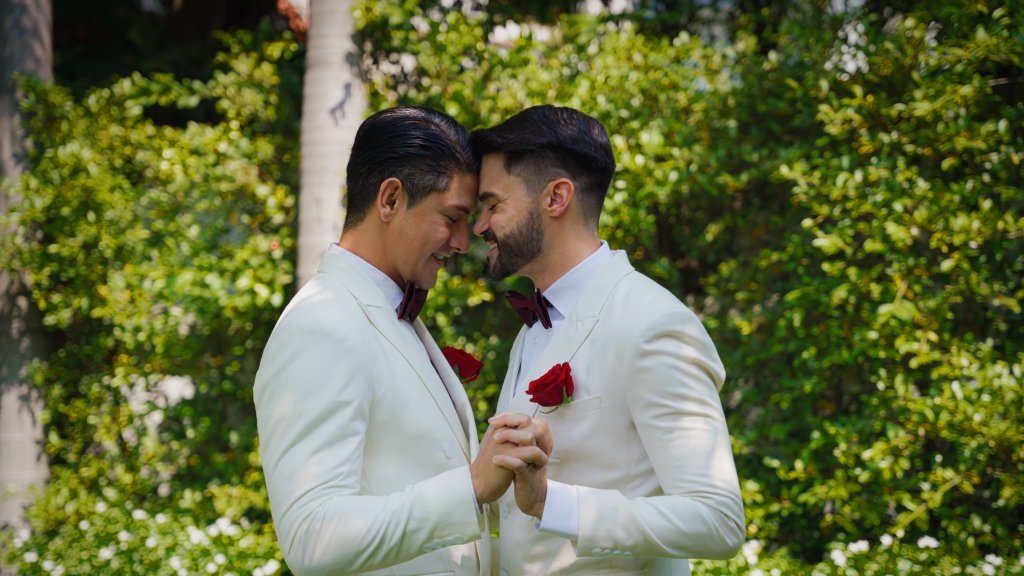
The election of Brazil’s openly homophobic president Jair Bolsonaro appears to have influenced same-sex couples’ decisions to marry. This is the finding of a new study by researchers at the universities of Tübingen and Valencia and EBS Universität für Wirtschaft und Recht in Oestrich-Winkel. The study was published in the Journal of Population Economics.
Key points at a glance
- A study examined the influence of Jair Bolsonaro’s election on marriages between same-sex couples in Brazil.
- In municipalities where Bolsonaro received a higher share of the vote, the number of same-sex marriages rose significantly after his election in 2018.
- The increase was particularly pronounced immediately before he took office in January 2019.
- The effect was stronger among lesbian couples than among gay male couples.
- The researchers suggest that the main reasons were concern about a possible loss of rights and a desire for legal and financial security.
Couples at the altar
The researchers compared trends in same-sex marriages across Brazilian municipalities with differing levels of support for Bolsonaro in the 2018 presidential election. A clear association emerged: the higher Bolsonaro’s share of the vote, the greater the rise in same-sex marriages after his election. The effect was particularly pronounced immediately before the start of his term. A ten-percentage-point higher level of support for Bolsonaro was associated with an increase of around 85 per cent in the number of same-sex marriages in January 2019 compared with September 2018. The effect was statistically significant for both gay male and lesbian couples. Over the entire year following the election, a ten-percentage-point higher vote share for Bolsonaro corresponded to an average increase of around twelve per cent in same-sex marriages.
Particularly strong effect among lesbian couples
The increase was driven primarily by marriages between lesbian couples. The response was particularly strong among people aged 25 to 39. Among younger couples aged 18 to 24, the effect was smaller but still statistically detectable. A moderate effect was observed among people aged 40 to 59. Among people aged 60 and over, however, the researchers found no corresponding response. In the authors’ assessment, there is considerable evidence that couples brought their weddings forward or decided to marry in the first place because they feared a possible loss of their rights. After Bolsonaro took office, the effect disappeared: the number of marriages did not fall below its previous level but returned to its long-term trend. In the researchers’ view, this suggests that the increase was not simply a matter of bringing forward weddings that had already been planned.
Legal security as a motive
Same-sex marriages have been legal in Brazil since 2011. Since a resolution issued by the National Justice Council in May 2013, notaries and registry offices have no longer been allowed to refuse to conduct marriages between same-sex couples. This gave couples rights relating to inheritance, social benefits, health insurance and tax relief, among other things. In 2022, same-sex marriages accounted for around 1.3 per cent of all marriages in Brazil.
According to the researchers, however, Bolsonaro had no immediate legal means of abolishing the right to same-sex marriage. The president did not have the authority to do so, and other political avenues for such a change were also severely limited. Nevertheless, the political situation may have created a perception of threat among those affected. The authors argued that even a relatively low perceived likelihood of losing rights can be enough to make marriage seem attractive as a precaution.
Bolsonaro’s explicit remarks
Even before his election, Bolsonaro had repeatedly made openly homophobic remarks. In June 2011, he said: “If a gay couple moved into my building, my property would lose value. If they held hands and kissed there, it would lose value!” Bolsonaro had also declared that he was “proud to be homophobic” and said he would “rather see his son die in a car accident than be gay”. The researchers cite these statements as examples of particularly pronounced homophobic rhetoric.








