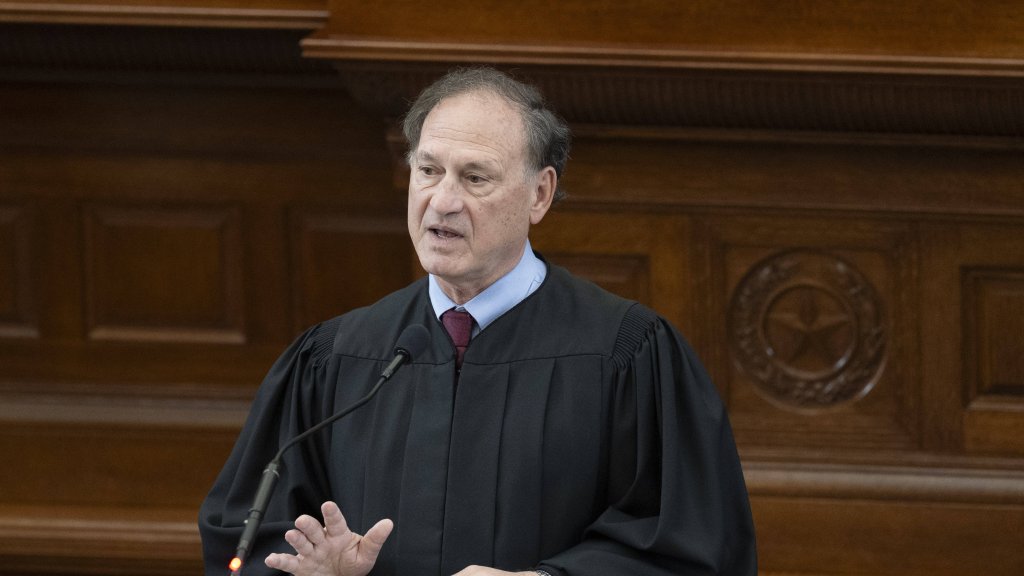
Conservative US Supreme Court Justice Samuel Alito (76) has reaffirmed his criticism of the nationwide legalisation of marriage for same-sex couples in his new book. The Supreme Court’s 2015 decision (German) may have marked “perhaps the decisive point” in America’s turn “against religious freedom”, Alito writes.
Key points at a glance
- Supreme Court Justice Samuel Alito discusses marriage for same-sex couples at length in his new book.
- He describes the landmark 2015 ruling in Obergefell v. Hodges as “perhaps the decisive point” in America’s turn “against religious freedom”.
- In 2015, Alito voted against the decision granting same-sex couples a constitutional right to marry nationwide.
- The ruling remains in force. In 2025, the Supreme Court rejected an attempt to challenge the precedent again.
- The Respect for Marriage Act protects the recognition of same-sex marriages already lawfully entered into, even if the Obergefell ruling is overturned. However, it does not require states to perform such marriages themselves.
- Alito sees conflicts between LGBTQ+ rights and religious exemptions as evidence that support for religious freedom in the US has “collapsed”.
Excluding people of faith
In his book “So Ordered”, the justice focuses in particular on the landmark case Obergefell v. Hodges. By a narrow majority of five votes to four, the Supreme Court ruled at the time that same-sex couples have a constitutional right to marry in all US states. Alito was among the minority of justices who voted against the decision. In his newly published collected statements, he presents the ruling as a turning point in the relationship between LGBTQ+ rights and religious freedom. Early on, Alito expressed concern that religious opposition to same-sex marriage would increasingly be equated with intolerance and that this could drive people of faith out of public life. Four years later, he said that, in his view, his fears had been borne out. “Quite suddenly, religious freedom has become controversial,” said Alito, who also reiterated: “Support for religious freedom has collapsed”.
Obergefell ruling remains in force
Despite the Supreme Court’s increasingly conservative composition, the ruling on marriage for same-sex couples remains in force. In November 2025, the court declined to hear an appeal by former county clerk Kim Davis from Kentucky (German). Following the 2015 ruling, Davis had refused to issue marriage licences to same-sex couples. Her lawyers wanted to use the case to have the Supreme Court overturn the Obergefell ruling. However, the court rejected the attempt.
Additional statutory protection for married same-sex couples has been in place since 2022. The then US President Joe Biden signed the Respect for Marriage Act (German). The federal law requires the recognition of legally valid same-sex marriages. Under the law, states must recognise a same-sex marriage if it was lawfully entered into in another state. The law would also be significant if the Supreme Court were one day to overturn the Obergefell ruling. In that event, however, it would not require individual states to continue issuing marriage licences to same-sex couples themselves.
The statutory protection followed another far-reaching Supreme Court decision. In its Dobbs ruling in 2022, the court overturned the landmark Roe v. Wade ruling, which had constitutionally protected the right to abortion in the US for almost 50 years. The decision fuelled fears that the Supreme Court could also review other constitutional protections based on earlier rulings. These include, in particular, marriage for same-sex couples. Alito and his fellow justice Clarence Thomas (German) remain among the strongest opponents of same-sex marriage.








