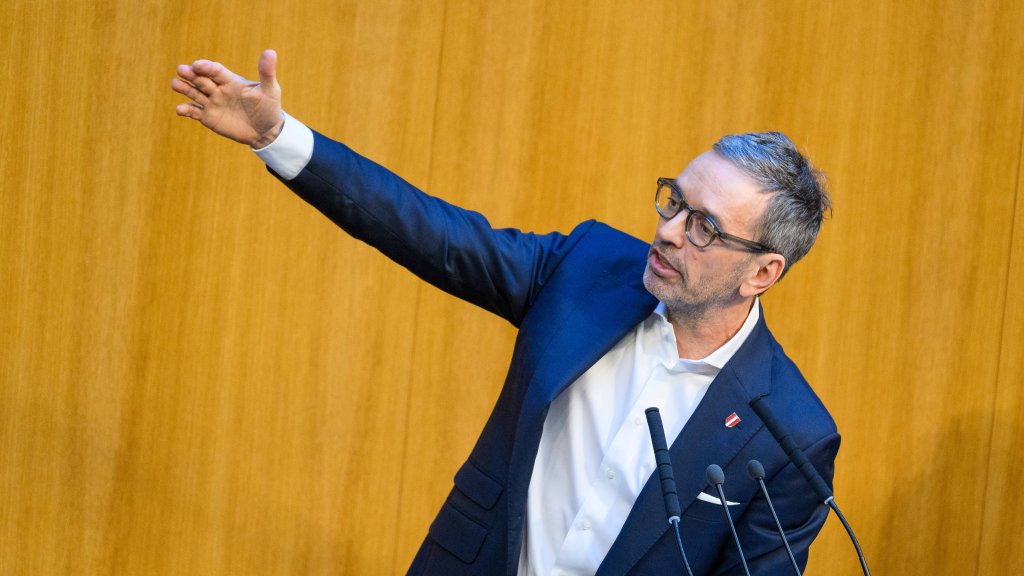
Following his attack on the queer community, FPÖ leader Herbert Kickl will not face a criminal investigation for the time being. Austria’s National Council voted unanimously on Thursday evening against lifting his immunity in this case. The Vienna public prosecutor’s office wanted to investigate him on suspicion of incitement to hatred. The case stems from Kickl’s speech on 1 May at the Urfahranermarkt fair in Linz.
The key points at a glance
- Prosecutors wanted to examine whether Kickl’s statements about queer educational work constituted a criminal offence.
- The National Council refused to authorise an investigation on 15 October.
- Whether Kickl’s remarks constituted a criminal offence therefore remains unresolved.
Queer educational work as a target
As DER STANDARD reports, the request to investigate followed a criminal complaint concerning his appearance in the festival tent. There, Kickl had attacked funding for queer organisations and their work in schools. He spoke of an “LGBT” “lobby” and accused it of spreading a “plague of the mind” among children.
The Vienna public prosecutor’s office subsequently requested authorisation to pursue the case. Its letter reached the National Council on 25 September. The suspected offences concern both incitement to hatred and potentially abusive remarks violating human dignity. Kickl is presumed innocent.
Parliament follows the committee’s recommendation
On Wednesday, the Immunity Committee had already unanimously recommended that an investigation into Kickl should not be authorised. The FPÖ, ÖVP, SPÖ, NEOS and Greens considered the statements in question to be connected to his political activity. The full chamber followed this recommendation on Thursday evening, as Parlamentskorrespondenz confirms.
This means the judicial authorities remain unable to examine the suspicions against Kickl for the time being. Parliament did not decide whether his speech constituted a criminal offence. It could have authorised an investigation even where a connection to political activity existed; in parliamentary practice, however, this happens only in exceptional individual cases.
Austria’s provision on incitement to hatred protects, among others, groups attacked on the grounds of their sexual orientation. Where the material is disseminated to a broad public, it provides for up to three years’ imprisonment. Whether the legal requirements are met in this particular case would have to be determined by the judicial authorities.
Kickl was also protected the previous year
Parliamentary immunity had already prevented an investigation following a May speech by the FPÖ leader in October 2025. On that occasion, Kickl had described SPÖ leader Andreas Babler as a “left-wing tick”. The National Council unanimously refused authorisation in that case too. According to the parliamentary statement issued at the time, Kickl was suspected of insult, whereas the current request concerns incitement to hatred.
The dispute comes amid an ongoing debate about the FPÖ’s attacks on queer visibility. In early October, the National Council considered an initiative by the party against Pride and LGBTQ+ content in tourism advertising. The debate over advertising aimed at queer tourists also drew opposition from other parties.








