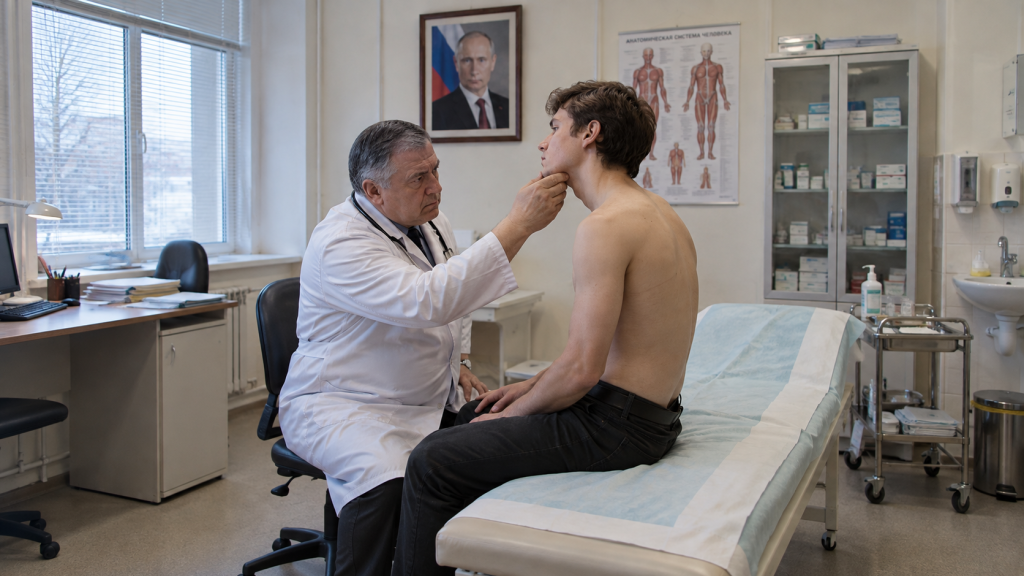
The Russian Health Ministry has now published new clinical guidelines for treating so-called “disorders of sexual preference”. The document, drawn up by the Russische Gesellschaft für Psychiatrie, sets out diagnostic criteria and treatment methods and is intended as a guide for doctors across the country – and could have dramatic consequences for gay and queer people in Russia.
Key points at a glance
- Russia’s Health Ministry has published new clinical guidelines on “disorders of sexual preference”.
- They cover various diagnoses, including fetishism, “fetishistic transvestism”, paedophilia and sadomasochism.
- Sexual orientation is not addressed directly. Depending on how the guidelines are interpreted, LGBTQ+ people could nevertheless be classified as having a disorder.
- The stated treatment goal is to reduce “abnormal sexual desire” and develop “normative models of sexual behaviour”.
- The proposed treatments include cognitive behavioural therapy, medication, “aversion therapy” and “orgasmic reconditioning”.
- Clinical guidelines have been mandatory for doctors in Russia since 2025.
- A professor of psychiatry warns of increased monitoring of patients by law enforcement agencies.
Homosexuality as an illness
The new guidelines cover various diagnoses, including fetishism, “fetishistic transvestism”, exhibitionism, voyeurism, paedophilia, sadomasochism, as well as multiple, other and unspecified “disorders of sexual preference”. Various BDSM practices are also covered. Although the guidelines themselves make no direct reference to sexual orientation, they apparently target gay and queer people quite explicitly. Doctors are instructed to assess patients against five criteria: arousal, activity, consent, distress and potential harm to health. Psychological tests and rating scales may also be used in unclear cases. In principle, this creates the possibility of defining homosexuality or queer life as an illness, depending on the interpretation and the individual case.
“Abnormal sexual desire”
The Health Ministry accordingly describes the treatment goal as a “reduction in abnormal sexual desire and its manifestations, with a transition towards developing normative models of sexual behaviour”. According to the ministry, this is intended to reduce the risk of sexual offences and support patients’ ability to function in society. Cognitive behavioural therapy and antidepressants are listed as treatment options. For psychotherapists using a behavioural approach, the ministry also recommends methods such as “aversion therapy” and “orgasmic reconditioning” – also known as conversion therapies, which most often aim to “cure homosexuality”. The United Nations has clearly classified these ineffective and often brutal methods as torture. In certain cases, hormone blockers and “chemical castration” will also be permitted in future.
Masculinity and femininity as a yardstick
The guidelines also establish the adoption of “normative models of sexual behaviour” as the standard. One of the methods proposed for assessing patients is “Masculinity and Femininity”. This is intended to examine how strongly a person perceives themselves as “masculine” or “feminine” and how this perception corresponds to the sex recorded in their passport. The assessment covers seven traits classified as masculine – bold, hot-tempered, agile, robust, courageous, pushy and determined – and seven traits described as feminine: submissive, tidy, weak, amiable, affectionate, shy and friendly. There are also eight gender-neutral traits.
Guidelines are mandatory
Since 2025, clinical guidelines in Russia have been mandatory for all doctors, including those in private practice. Previously, doctors could also follow international standards such as those of the World Health Organization. If a diagnosis in the area concerned is made, the new requirements now form the binding standard of treatment. Roman Suleimanov, an associate professor in the Department of Psychiatry at RUDN University, described the guidelines to the newspaper Kommersant as a “long-overdue bridge” between medicine and law. At the same time, he warned that patients would be “subject to greater scrutiny by law enforcement agencies”.
He pointed to the security authorities’ access to medical data: “Under the law, law enforcement agencies have direct access to regional medical information systems (EMIAS) and can request lists of people receiving treatment in order to create databases of ‘risk groups’. As a result, attempting to seek treatment voluntarily automatically makes the patient a target of operational interest, which completely undermines the idea of primary prevention of sexual violence in society.” The new guidelines come against a backdrop of international criticism of Russia’s treatment of LGBTQ+ people. In recent days, Mariana Katzarova, the UN Special Rapporteur on the situation of human rights in Russia, had denounced Russia’s transnational repression at the United Nations.








