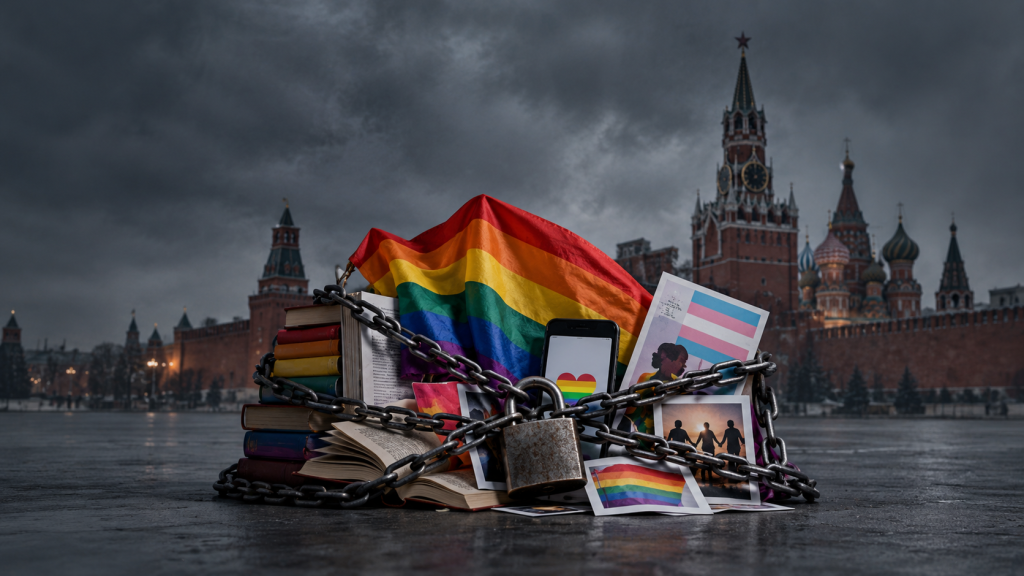
The legal definition of extremism in Russia could be expanded significantly once again. MP Nikolaj Burljajew has introduced a bill in the State Duma targeting ideologies, doctrines, sects and movements that, under the proposed definition, are incompatible with “traditional Russian spiritual and moral values” and the country’s traditional religions. Since 2023, the LGBTQ+ movement has already been classified as an extremist group (German), with far-reaching consequences for community organisations and clubs (German) as well as for gay and queer individuals.
Key points at a glance
- Russian MP Nikolaj Burljajew has introduced a bill to expand the definition of extremism.
- It would cover “ideologies, doctrines, sects and movements” that oppose “traditional Russian spiritual and moral values” or traditional religions.
- Their public justification, dissemination and promotion, as well as the use of certain symbols, would also fall under the legislation.
- One of Burljajew’s arguments for his proposal is that groups could continue operating under different names after being banned.
- Fears are growing within the LGBTQ+ community that gay and queer people could face even greater repression.
- The definition of “extremist materials” would also be expanded significantly.
Expanding the laws
To achieve this, Burljajew wants to amend Russia’s law on combating extremist activities. Under the draft, activities including the public justification, promotion and dissemination of such ideologies would be classified as extremist. Their symbols could also fall under the provisions. The politician belonged to the party “Gerechtes Russland – Für die Wahrheit” and is also known as a former actor and director. Burljajew holds strongly patriotic and traditionalist views and has close ties to the Russian Orthodox Church. He supported the Kremlin’s position on Russia’s invasion of Ukraine. In 2022, the US and the UK, among others, imposed sanctions on him over his political activities and his support for government policy.
A direct attack on LGBTQ+ people?
The MP justifies his proposal by pointing to what he sees as gaps in the legislation. He says Russia does not yet have a sufficiently clear ban on all “destructive” ideologies that oppose traditional spiritual and moral values and religions. Without such a ban, he argues, their continued spread could pose a serious, even “existential”, threat to Russia. In the explanatory notes to his proposal, Burljajew also refers to “heinous crimes”, including the “desecration of churches and cemeteries”. The country’s LGBTQ+ community fears that tougher laws could be used to attack gay men, lesbians and queer people even more severely. “It is necessary to ban every destructive ideology, doctrine, sect or movement that opposes traditional Russian spiritual and moral values and Russia’s traditional religions, regardless of the new names under which they may appear,” Burljajew said.
Banning symbols
The Russian MP also wants to ban all symbols that run counter to his aims and oppose “traditional Russian spiritual and moral values”. He says there must be a comprehensive ban on anything that “contributes to the destruction and discrediting of our values, justifies and promotes destructive pseudo-values or opposes Russia’s traditional religions – including the use or public display of their objects or symbols, or of objects or symbols that could be confused with those of the aforementioned ideologies, doctrines, sects and movements.” Burljajew therefore also wants to expand the definition of “extremist materials”.
At present, this category includes certain materials relating to fascism and Nazism, content justifying hate crimes and materials calling for extremist activities. Russia’s Ministry of Justice maintains an official list of extremist materials. Under the new proposal, the category would be defined much more broadly. This explicitly includes texts and images, for example those produced by or about the LGBTQ+ community.








