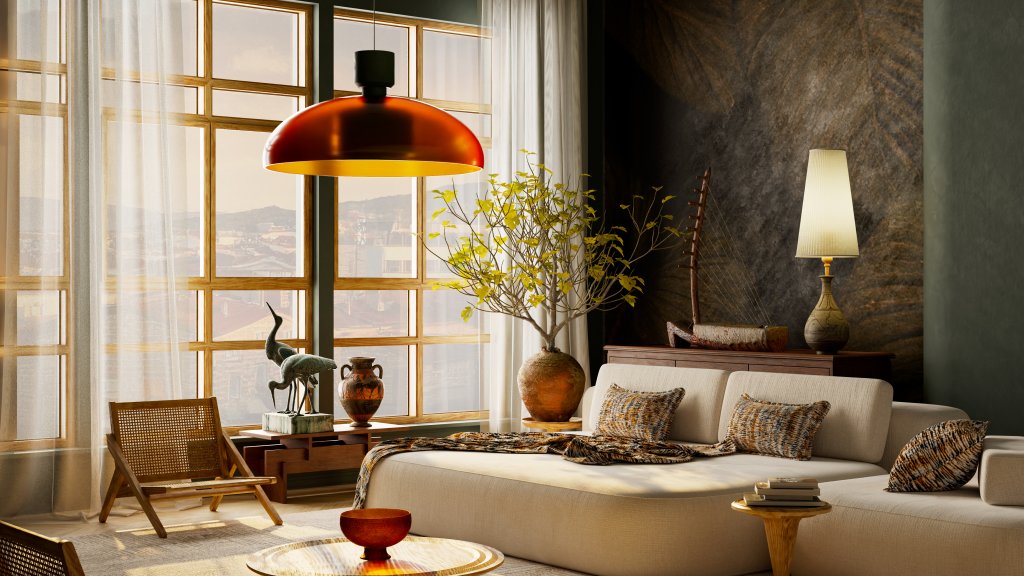
It gets dark earlier outside, our jackets are getting thicker again and suddenly we are spending much more time within our own four walls. This is precisely when we notice whether a home is simply well furnished – or whether it truly feels like home. In autumn 2026, interiors are therefore less about the next fleeting trend than about atmosphere, personality and rooms we want to spend time in. Warm colours, wood, soft fabrics and good lighting all play an important part. Above all, though, the perfectly styled home is losing its appeal. It is allowed to look lived-in again.
Just a few years ago, white, grey, smooth surfaces and pared-back furnishings dominated many interiors. Everything had its place, with as little as possible left lying around. The result often looked excellent in photographs – but could quickly feel rather cold in everyday life. Now interiors are moving in a distinctly warmer direction again. Germany's furniture industry associations count natural colours, harmonious tonal schemes and wood among the defining interior themes of 2026. At the same time, more individual rooms are becoming increasingly important internationally: homes should no longer look as though everything in them was ordered from a single catalogue.
No more living in a laboratory
Cosiness certainly does not mean filling your home with cushions, candles and decorations. It is more about balancing clean design with things that create warmth. A minimalist room can be just as inviting as a lavishly furnished period flat – provided the materials, lighting and proportions are right.
Surfaces are a good place to start. Wood brings warmth to a room almost automatically. That might mean a large dining table, a sideboard or simply a small side table. The wood tones certainly do not all have to be identical. A mixture can actually look more interesting. What matters more is that individual shades are echoed elsewhere.
Both light, natural woods and darker varieties have a part to play in 2026. Internationally, walnut and rich brown tones are making a stronger comeback. They make rooms feel more mature and refined, creating an interesting counterpoint to light walls and fabrics.
Beige can stay – but it is getting some company
Beige is not disappearing either. Fortunately, because it makes an excellent base colour. What is new is more about what goes alongside it. Brown, rust, muted green, warm greys or a dark red can give a previously neutral room character surprisingly quickly.
No one needs to repaint every wall straight away. A single armchair, a rug or new curtains can change the effect of a room. Those feeling bolder can give one wall, or even an entire room, a stronger colour.
Tonal combinations look particularly harmonious. They bring together different shades within one colour family: sand, beige, caramel and dark brown, for example. The result feels calm without becoming boring. This kind of colour coordination is also increasingly appearing in furniture, its frames and its details.
A sofa can be a sofa again
Of course, we can talk about design. But ultimately, one crucial question remains: is the thing comfortable?
In the living room especially, the emphasis is shifting more firmly towards comfort again. A sofa is not a display piece, after all. It is somewhere to read, stream, discuss, make phone calls, fall asleep and sometimes eat. Deep seats, softer upholstery and generous shapes are therefore a perfect fit for this new sense of homeliness.
If you do not want to replace your sofa, you can work with textiles. A few high-quality cushions, a large blanket and, above all, a rug can transform the feel of a room. Rugs give larger rooms structure, improve acoustics and visually bring seating arrangements together.
Curtains are often underestimated too. They do more than frame windows: they soften a room both acoustically and visually. Even a very modern interior immediately feels more homely as a result.
Lighting makes all the difference
You can buy the most beautiful furniture and still end up with an uninviting room. Surprisingly often, the lighting is to blame.
A single bright ceiling light lets you see – but rarely creates atmosphere. It is much more pleasant to distribute several light sources around the room. A floor lamp beside the sofa, a small table lamp on the sideboard and indirect lighting behind a piece of furniture create different layers.
Current lighting trends are moving in precisely this direction. For 2026/27, Light + Building describes softly glowing forms, atmospheric lighting effects and lights that become design objects in their own right, among other trends. Adaptable lighting, with adjustable intensity and colour effects, is also gaining importance.
In everyday terms, this means not everywhere has to be brightly lit at once. A living room can have darker areas in the evening. They create depth and really bring the illuminated areas into their own.
And yes, colour temperature makes a difference. Very cool light can be useful in a workspace, but warmer light usually feels more pleasant in the living room.
Personality beats perfection
Perhaps this is the loveliest development in interiors: not every piece has to be new any more.
An old armchair beside a modern sofa, an inherited table, a picture from a flea market or something brought back from a holiday can give a room more character than a completely matching furniture range.
Internationally in particular, designers are describing a stronger shift for autumn 2026 towards individual pieces, patina and interiors that do not look freshly staged for a property sale. Imperfections are allowed to show.
That also means books can be left lying around. Pictures do not all have to come from the same series. A flea-market vase can stand beside an expensive designer lamp. A piece of furniture is allowed to have scratches.
A home usually becomes interesting where it tells you something about the people who live there.
Rooms need a focal point
A common furnishing mistake is to put every piece of furniture against a wall. The sofa on one side, the cupboard on the other, the television opposite – leaving a large empty space in the middle.
Larger rooms in particular benefit from being divided into zones. A rug can define a living area. An armchair can sit at an angle in the room. A console table can fit behind a freestanding sofa. Plants, lamps or a small side table can also form groupings.
One simple question helps here: what is this room for?
In the living room, the focus might be the seating area; in the bedroom, naturally, the bed; and in the dining room, the table. This focal point should carry visual weight. Everything else is arranged around it.
Buy less, choose better
Making a home more inviting does not automatically mean consuming more. Quite the opposite. Furniture in particular is increasingly being seen as a long-term purchase again. Quality, adaptability and a long useful life also play an important part in current design and lighting trends.
So before replacing the entire living room, it is worth taking a close look at what is already there. Perhaps the sofa simply needs a different position. Perhaps a new light will suddenly make the dining table look completely different. An old cupboard can gain a second life with new handles.
Often, it is actually the small things that make the biggest difference: a large mirror instead of several small decorative objects, one generously sized picture instead of a random wall arrangement, or a beautiful lamp rather than yet another collection of accessories.
And what about all the technology?
Televisions, routers, speakers, games consoles, charging cables and smart-home devices are part of modern living – but they are not always particularly decorative.
The answer is not to hide technology completely. Instead, it should be integrated as naturally as possible. Cables disappear into trunking or furniture, charging points are grouped together, and the router does not necessarily have to become the centre of attention on the sideboard.
With the television, too, it is worth considering whether the entire living room really needs to be arranged around it. A darker wall can make the black screen less visually prominent. Models that display pictures when switched off have long been trying to blend more fully into the living space anyway.
A home is not a showroom
Ultimately, though, there is no formula for the perfect home. And that is probably the most important interiors trend of all.
A home does not have to prove that we know every rule of interior design. It has to suit our lives. Someone who invites friends round for dinner every Friday might need a large table. Someone who loves watching series can build their living room around a fantastic sofa. Anyone who loves books does not have to hide their shelves behind doors.
Autumn is the ideal moment to look at your home with fresh eyes. What feels good? What has been annoying you for months? Where is more light needed? Where is colour missing? And which things are only standing around because, at some point, you convinced yourself that they belonged there?
Perhaps you do not need new furnishings. Perhaps a lamp, a repositioned armchair and an evening spent finally hanging the pictures that have been leaning against the wall for months will be enough.
Because a truly good home does not begin with trends. It begins the moment we close the door and think: this is exactly where I want to be right now. (tb)
INFO BOX · 5 quick tricks for a more inviting home
1. Spread the light
Use at least three light sources in the living room rather than just one ceiling light. Table lamps, floor lamps and indirect lighting create different zones.
2. Choose a large rug
Rugs that are too small can quickly leave furniture looking lost. Ideally, at least the front legs of the sofa and armchairs should sit on the rug.
3. Add a warm colour
Brown, rust, olive, dark red or caramel work even as small accents in cushions, curtains, pictures or a single piece of furniture.
4. Show your personality
Books, photographs, art, travel souvenirs or vintage pieces turn an attractive interior into a personal home.
5. Rearrange first, shop later
Move the sofa, turn an armchair, swap a side table, reduce the decorations. Often, a room already looks completely different afterwards – without costing a penny.