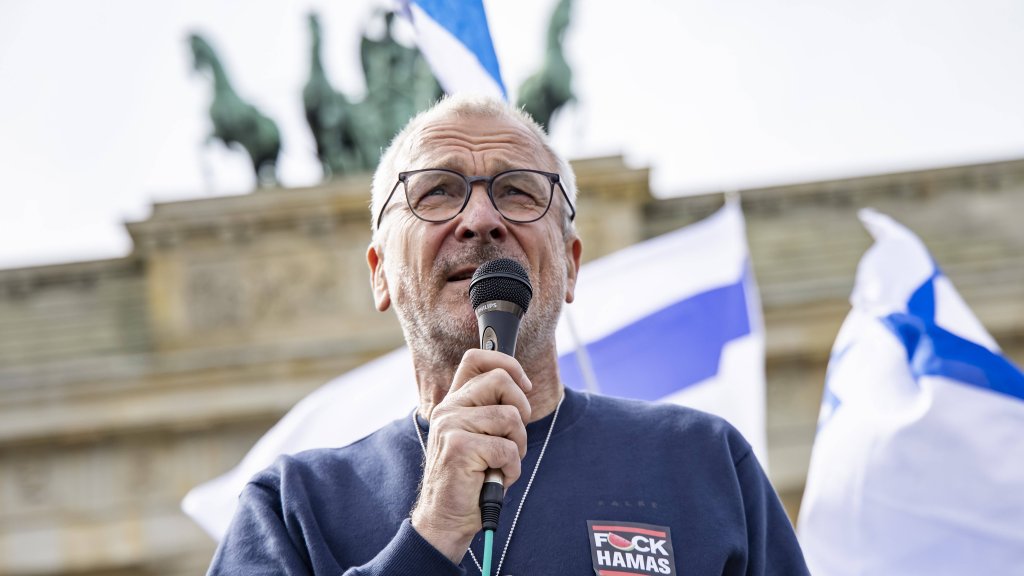
Plans to form a government comprising the Left Party, the Greens and the SPD in the German capital have met with strong opposition from the president of the Deutsch-Israelische Gesellschaft, Volker Beck (65) (German). The former Green member of the Bundestag is particularly critical of how the potential coalition partners are dealing with antisemitic and anti-Zionist positions within Berlin's Left Party.
Key points at a glance
- Criticism of coalition plans: Volker Beck, president of the Deutsch-Israelische Gesellschaft, accuses the SPD and the Greens of disregarding the concerns of the Jewish population with their plans for an alliance with the Left Party.
- Allegations against the Left Party: Beck criticises antisemitic and anti-Zionist currents within Berlin's Left Party and says the party has failed to address them internally.
- Agreement on Israel: In their exploratory talks document, the SPD, the Greens and the Left Party have affirmed Israel's right to exist and agreed on consequences for working with people who reject this position.
- Decision on coalition negotiations: While the SPD and the Greens have already agreed, the Left Party is due to decide on 31 October whether to enter negotiations.
- The federal government's LGBTQ+ commissioner, Sophie Koch (SPD), supports a red-green-red alliance and responds to critics from the SPD and the Greens: “Have you lost your minds?”
Suitability as a coalition partner
Speaking to the Augsburger Allgemeine, Beck has now expressed serious doubts about the Left Party's suitability as a coalition partner. He also levelled serious accusations at the SPD and the Greens, which are seeking talks on forming a joint state government despite the existing controversies. “It is completely incomprehensible that the Greens and the SPD would lend themselves to a coalition with this Berlin Left Party, where antisemitism is not a fringe phenomenon, but rather anti-Zionism is part of the recipe for success,” the former Green politician said. Beck is particularly critical of the consequences he believes such cooperation could have for Jewish citizens' trust in politics. “Two parties of the democratic centre are simply ignoring the concerns of the Jewish population,” Beck said.
Controversy over Emde
A major trigger for the dispute is the political stance of Vanessa Emde, a Left Party member of Berlin's state parliament. Her comments about Israel have sparked debate both within the Left Party and among the SPD and the Greens. During the election campaign, Emde publicly expressed solidarity with the Palestinian movement. Among other things, she argued that states had no right to exist, only people did. This position has further intensified the debate about the Berlin Left Party's relationship with Israel and the possible limits of political cooperation.
The controversial statements could now have consequences for her position within her own parliamentary group. Emde faces expulsion from the Left Party's parliamentary group. Beck sees her comments as reflecting a fundamental political conflict. “Vanessa Emde's statements are appalling; she wants to call Israel's existence into question and delegitimise it,” Beck alleged. In his view, this is not simply the stance of an individual member of parliament. Rather, he regards Emde as a representative of a broader political current within the party. “She is not alone, but represents the anti-Zionist current whose supporters have joined the Left Party in their thousands in recent years.” Beck also accuses Berlin's Left Party of having failed so far to address such attitudes adequately among its members. “There has been no serious examination within Berlin's Left Party of the hatred of Jews and anti-Zionism in its own ranks.”
Exploratory talks document includes commitment
Despite these disputes, the Left Party, the SPD and the Greens have already taken a decisive step forward in their talks on potentially forming a government together. Last weekend, the three parties concluded their exploratory talks. This meant they had agreed on a basis for the intended coalition negotiations around four weeks after the election to Berlin's House of Representatives. In their jointly drafted exploratory talks document, the parties explicitly uphold Israel's right to exist. They also agreed to end cooperation with people who do not support this commitment. Whether this will have any specific consequences for cooperation with individual members of the Left Party, and what those might be, is not clear from the agreements outlined so far.
Left Party to decide at the end of October
While the political bodies of the SPD and the Greens have already approved the start of official coalition negotiations, the Left Party has yet to make a corresponding decision. Berlin's Left Party intends to vote at a party conference on 31 October on whether to enter negotiations with its two potential government partners. The starting point for the talks is the result of the House of Representatives election on 20 September. The Left Party won 25.7 per cent of the vote, becoming the largest political force in Berlin.
Koch backs coalition
Meanwhile, the federal government's LGBTQ+ commissioner, Sophie Koch (SPD) (German), said on Instagram that she supported a possible coalition of the Left Party, the Greens and the SPD. She rejects criticism of this from figures such as former Green politician Beck or from within the SPD. She wrote online: “Since I'm now hearing more and more from my own party, preferably from western Germany, that we should really be aiming for a different government… have you lost your minds?” She went on: “Have you EVER, just ONCE, considered that R2G could be a glimmer of hope for some people, especially in the east? Or that we've been working here with the Left Party AND the CDU for years? R2G is no guaranteed success, but it's hardly the end of the world either.” By R2G, meaning two reds and one green, Koch is referring to the possible three-party red-green-red alliance in Berlin.








