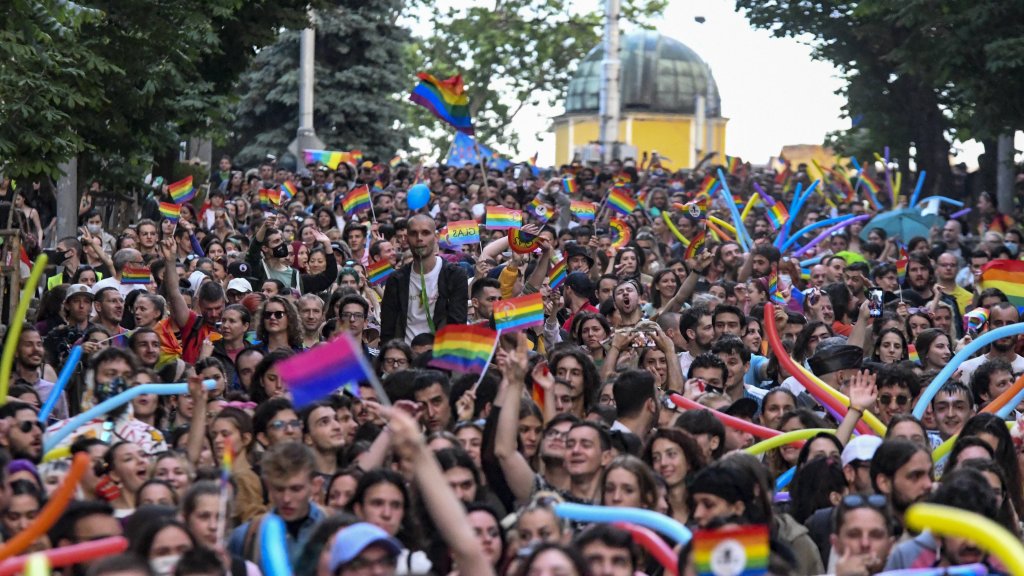
In the face of growing hostility and restrictions on the rights of LGBTQ+ people, the Council of Europe is calling for more decisive action by cities and regions across Europe. Local and regional authorities must effectively guarantee freedom of expression and the right to peaceful assembly, according to a new report by the Congress of Local and Regional Authorities. Shortly beforehand, ILGA Europe had also stressed that community gatherings such as Christopher Street Day demonstrations and Pride parades needed a new strategy for 2027.
Key points at a glance
- Council of Europe adopts report: the Congress of Local and Regional Authorities calls for binding measures to protect LGBTQ+ people's freedom of expression and assembly.
- The proportion of LGBTQ+ respondents in Europe who reported hate-motivated harassment rose from 37 per cent in 2019 to 55 per cent in 2024.
- Protecting Pride events: cities and regions should enable peaceful demonstrations, avoid unnecessary conditions and provide police protection where needed.
- Strengthening organisations: local authorities should provide financial and organisational support to LGBTQ+ organisations and facilities and designate permanent contacts within their administrations.
- Training and data collection: authorities, police and teachers should be better prepared to address discrimination and hate crime.
- Governments' responsibility: in the Council of Europe's view, national laws must not force local authorities to restrict fundamental freedoms.
Action with “no ifs or buts”
The document was adopted during the Congress's 51st session and sets out practical ways in which cities and regions can combat discrimination and strengthen the rights of queer and homosexual people. It focuses in particular on ensuring that public events can take place safely, supporting civil society organisations and addressing hate crime. Helen Belcher from the United Kingdom, who prepared the report jointly with another rapporteur, called on the relevant authorities to take consistent action. “Local and regional authorities must act to guarantee the rights of LGBTQ+ people in law – even in the face of strong opposition. This report clearly shows how they should go about it – with no ifs or buts.”
Hate-motivated harassment
The Council of Europe cites growing hostility towards LGBTQ+ people in Europe as the background to its recommendations. According to the surveys cited in the report, a total of 37 per cent of LGBTQ+ respondents reported hate-motivated harassment in 2019. In 2024, that figure stood at 55 per cent. This represents an increase of 18 percentage points within five years. Alongside verbal abuse and threats, the report points to increasing restrictions on LGBTQ+ people's rights, as well as physical violence. The Congress therefore sees a particular responsibility at local and regional level. It is often there that decisions are made which directly determine whether public events can take place, advice services can remain available and those affected by attacks receive support.
Enabling Pride demonstrations
One central demand concerns the protection of public assemblies. Cities and regions should, as a matter of principle, enable Pride parades and other peaceful events held by LGBTQ+ people and ensure that they can take place safely. Authorities should avoid unnecessary restrictions, lengthy administrative procedures and disproportionate conditions. Where the security situation requires it, adequate police protection must also be guaranteed. The Council of Europe thus makes clear that the relevant authorities must protect freedom of assembly even when events encounter social or political opposition.
Support for the community
Alongside the right to demonstrate, the report addresses the conditions under which LGBTQ+ organisations carry out their work. Local authorities should provide both organisational and financial support to associations, advice centres and meeting spaces. The aim is to secure existing services in the long term and enable these organisations and facilities to continue reaching their target groups. It is particularly important that organisations and meeting places can continue their work without endangering staff, volunteers or visitors.
The Congress also recommends appointing permanent contacts for LGBTQ+ equality within public administrations. They should work regularly with local organisations and respond to complaints or reports of discrimination. Ongoing dialogue could help identify conflicts early and develop solutions before problems escalate.
Police, public administration and schools
The Council of Europe also sees a need for action on initial and further training for staff in public institutions. Teachers, administrative staff and law enforcement personnel should be better prepared to recognise discrimination and respond appropriately to such incidents. This includes training on addressing hate crime and treating LGBTQ+ people respectfully.
According to the Congress's recommendations, public authorities must ensure that those affected are treated with dignity and respect, regardless of their sexual orientation or gender identity. At the same time, the report calls for more systematic documentation of anti-queer and homophobic incidents. Hate speech, threats and acts of violence should be recorded and regularly analysed. The data gathered could help improve assessments of local risks, review existing protective measures and develop new policy strategies.
Progress in Europe
Gudrun Mosler-Törnström from Austria, who co-authored the report as the second rapporteur, pointed to differing developments in European cities and regions. While numerous local authorities had stepped up their efforts towards equality and social inclusion in recent years, there had also been setbacks. “We know that many cities and regions have made great progress in promoting the rights and social inclusion of LGBTQ+ people. But this progress is not evident everywhere,” said the representative of the SOC/G/PD group.
“We are also seeing setbacks and a refusal by some of those in positions of responsibility to respect the rights to which every person is entitled.” The report was therefore intended not only to outline options for local authorities wishing to improve their protective measures. It also set standards against which to assess whether cities and regions were meeting their human rights obligations. “For those seeking guidance, this report can show a clear way forward. And for those who choose to breach their obligations, it sets clear standards against which those failings can be assessed. Human rights apply to everyone,” said Mosler-Törnström.
Ensuring scope for action
To enable the recommendations to be implemented, the Congress is also directing its demands at the governments of the Council of Europe's member states. They must ensure that cities and regions have sufficient legal powers, financial resources and practical scope for action. Local authorities could only fulfil their duties if they were given the necessary resources and responsibilities. At the same time, the Congress calls for national legislation to be framed so that it does not oblige cities and regions to restrict freedom of expression or the right to peaceful assembly. The report thus underlines the shared responsibility of different levels of government for upholding fundamental human rights. Only recently, the Council of Europe also presented its five-year strategy to strengthen equality.








