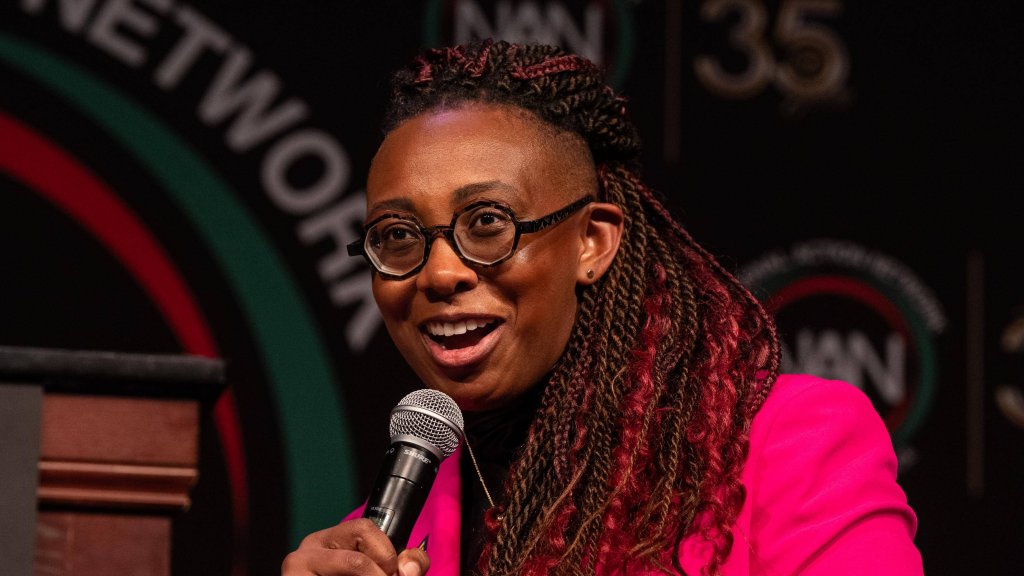
Following the Democrats’ historic victory in this week’s US midterm elections, LGBTQ+ human rights organisation the Human Rights Campaign (HRC) is calling for determined action to uphold LGBTQ+ rights. HRC president Kelley Robinson warned against politically abandoning trans people in particular now that the election campaign is over. The call follows election results in which Democratic candidates achieved major successes while restrictions on trans people were approved at the same time.
Key points at a glance
- Historic election victory: the Democrats take both chambers of the US Congress and win numerous states previously dominated by Republicans.
- Setbacks for trans people: despite the Democrats’ successes, voters in Arizona and Nebraska back restrictions on trans rights.
- Criticism of Democrats: several successful Democratic candidates had spoken out against certain rights for queer people during the campaign.
- HRC demands: president Kelley Robinson calls for binding measures against discrimination, stronger healthcare provision and the passage of the Equality Act.
- Historic LGBTQ+ successes: several openly gay, trans and non-binary politicians win major political offices for the first time.
Democrats must deliver
The Democrats dealt the Republicans a heavy defeat on Tuesday. They won majorities in both chambers of the US Congress and captured numerous political offices in states long considered Republican strongholds. For LGBTQ+ people, the result meant historic progress in political representation and a clear rejection of President Donald Trump’s policies. Yet it also showed that rejecting Republican candidates does not necessarily go hand in hand with supporting trans rights.
In an interview, Robinson welcomed the Democrats’ electoral successes. At the same time, she called on the incoming majorities to protect all LGBTQ+ people — including those whom some successful Democratic candidates had treated as a political liability during the campaign. “The campaign is over; now it is time to govern,” Robinson said. “And if they fail to fulfil their responsibilities, we have four million members who will tell them exactly what they think of that.”
Republican strongholds
The scale of the Republican defeat was extraordinary. Alongside their majorities in the House of Representatives and the Senate, the Democrats won previously Republican-held Senate seats in Texas, Iowa, Ohio, North Carolina, South Carolina, Kansas and Maine. In Indiana, Democratic underdog JD Ford defeated Republican incumbent Victoria Spartz. The home state of former US vice-president Mike Pence is thus sending an openly gay man to Congress for the first time. Kansas elected a Democratic senator for the first time since 1932. In Texas, Gina Hinojosa and James Talarico broke the Republicans’ decades-long dominance. Hinojosa won the governorship, while Talarico won a seat in the US Senate.
The Republicans’ expensive election campaign against trans people could not prevent their defeat. Asked what message voters had sent to Republican candidates over their attacks on trans people, Robinson replied: “They said no. They see through this smokescreen.” Trump himself had also played a decisive role, she said. “I also believe that Donald Trump repeatedly told all voters that this election was about him too. I think people took that seriously and gave Donald Trump a clear rejection.”
Setbacks for trans people
However, election night did not bring only positive results for trans people. In Arizona, voters backed restrictions on trans pupils’ participation in school sports and their use of certain facilities. In Nebraska, corresponding restrictions on sports were even enshrined in the constitution. The result was different in Missouri. There, voters rejected a constitutional amendment that would have combined restrictions on abortion rights with constitutional restrictions on healthcare for trans minors. Existing legal restrictions nevertheless remain in force.
There was progress in other states. Virginia passed protections for equal marriage. Vermont approved a constitutional amendment explicitly extending the principle of equal treatment to sexual orientation, gender identity and gender expression. In Robinson’s view, the differing results show that more work is needed to win over society. People need to see trans people more as an ordinary part of their everyday lives — as neighbours, friends, teachers or fellow pupils. That requires conversations that could change social attitudes and ultimately laws too.
Democrats with restrictive positions
The debate over trans rights is likely to continue within the Democratic Party as well. Several successful candidates had backed restrictions during the campaign. South Carolina’s incoming senator, Annie Andrews, said in an election advert in October: “I do not support biological men taking part in women’s sports.” LGBTQ+ organisations criticised the statement as stigmatising trans women and girls. Andrews also spoke out against gender-affirming surgery for minors.
Positions taken by Democratic politicians in Ohio also drew criticism. Politician Amy Acton said she opposed trans girls’ participation in girls’ sports. As governor, she would enforce the state’s existing restrictions. Congresswoman Marcy Kaptur campaigned on having voted for a bill intended to restrict discussions of gender identity in schools. Both politicians were criticised by LGBTQ+ organisations for these positions. In Texas, Democratic Senate candidate James Talarico supported restrictions on gender-affirming surgery for minors. At the same time, Republicans attacked him over his other political positions.
Elected Democrats under pressure
Robinson announced that the HRC would mobilise its members and supporters, particularly in South Carolina and Iowa. The organisation also intended to lobby elected politicians in Washington directly. “They are accountable to their voters,” Robinson said. In the months before the election, the HRC had already warned against giving up trans rights for electoral advantage. Following the victory, Robinson now expects concrete political commitments. “I think in recent years we have seen how fragile our rights are in this country and that we must protect them,” she said.
The HRC’s key demands include restoring funding for HIV prevention, the provision of medicines, housing support and the government healthcare programme Medicaid. The organisation also wants to push for the passage of the Equality Act. The legislation is intended to create explicit protection against discrimination at federal level. This includes employment, housing, education, lending and access to facilities and services open to the public. Robinson also expects the new Democratic majority in the Senate to block the appointment of judges who hold anti-LGBTQ+ positions. Openly LGBTQ+ members of Congress could also play an important role in scrutinising the administration in future. Re-elected congressman Robert Garcia is considered a possible future chair of the House Oversight Committee. On Tuesday, he issued a brief warning: “Get a lawyer.” Robinson described Garcia as an important ally in efforts to hold the administration to account.
Historic election successes
The midterm elections also brought several historic successes for openly LGBTQ+ candidates. In New Hampshire, Chris Pappas became the first openly gay man to win a seat in the US Senate. In Delaware, Sarah McBride, the first openly transgender member of the US Congress, was re-elected for a second term. Georgia elected an openly trans and non-binary person to its state legislature for the first time in Bentley Hudgins. Robinson sees this as evidence of the growing political importance of LGBTQ+ people in the United States. “We are not a demographic footnote,” she said. “We are a political force, and we deserve to be represented in the highest offices of this country.”
What will matter, however, is whether these electoral successes translate into concrete political improvements. The joy of victory must not obscure the fact that full equality has not yet been achieved. Robinson therefore appealed to the LGBTQ+ community to harness the election’s political momentum over the long term. “We must remember how yesterday felt and turn that feeling into concrete results, day after day, again and again — until full equality is achieved,” she said








