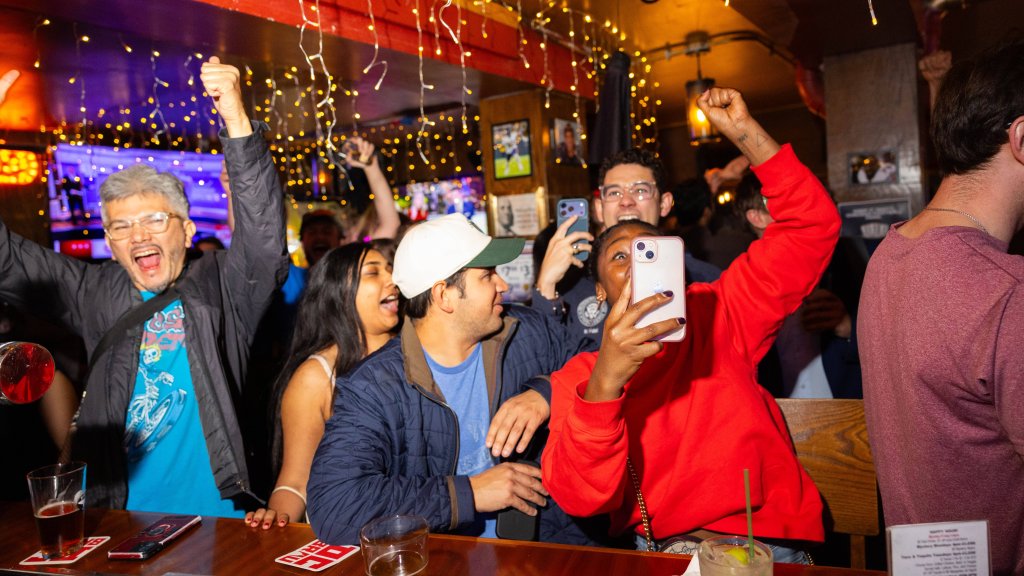
In the US midterm elections, the Democrats have taken the majority in both chambers of Congress from the Republicans. Numerous openly queer and gay candidates contributed to these successes. The Republicans suffered clear defeats, particularly in Texas, despite spending millions on campaign advertising targeting trans people. President Donald Trump announced that he would accept the election result.
Key points at a glance
- Control of Congress changes hands: the Democrats take the majority in the House of Representatives and the Senate from the Republicans. President Donald Trump says he will accept the election result.
- Historic success in Texas: despite millions being spent on campaign advertising targeting trans people, the Democrats win the governorship and a Senate seat.
- Successes for LGBTQ+ candidates: Chris Pappas becomes the first openly gay man elected to the US Senate. Other LGBTQ+ candidates win important seats.
- Sarah McBride re-elected: the first openly trans member of the US Congress retains her seat.
Control changes hands in both chambers
According to the results available so far, the Democrats won a majority in both the House of Representatives and the Senate. This could enable them to block the president’s legislative proposals, have a say in judicial appointments and launch congressional investigations into the administration. The Democrats achieved a particularly remarkable success in Texas. Although the Republicans had invested tens of millions of dollars in television advertising targeting trans people, they lost both the governorship and a seat in the US Senate. Gina Hinojosa defeated incumbent governor Greg Abbott, becoming the first female governor of Latin American heritage in the state’s history. James Talarico defeated Republican attorney general Ken Paxton. The results ended a decades-long series of Democratic defeats in statewide elections in Texas. The Democrats also captured previously Republican Senate seats in South Carolina, Ohio, Iowa and North Carolina.
First openly gay man in the US Senate
Among the historic election successes was Democrat Chris Pappas’s victory in New Hampshire. The sitting congressman defeated former Republican senator John E. Sununu and will enter the US Senate as its first openly gay male member. During the vote count, Pappas held a commanding lead of 60 per cent to 37 per cent. He succeeds retiring Democratic senator Jeanne Shaheen. In Indiana, Democratic state senator JD Ford defeated Republican congresswoman Victoria Spartz. He will become the first openly gay member of Congress from Indiana. In Michigan, Jeremy Moss defeated Republican Ethan Baker and will become his state’s first openly queer representative in the US Congress. JoAnna Mendoza in Arizona and Marni von Wilpert in California also gained seats. Mendoza, a former Marine, defeated Republican congressman Juan Ciscomani. Bisexual local politician von Wilpert defeated Jim Desmond by 59 per cent to 41 per cent in the previously Republican district of retiring congressman Darrell Issa.
Sarah McBride retains her congressional seat
In Delaware, Sarah McBride, the first openly trans member of the US Congress, was re-elected for a second term. The Democrat defeated Republican Joseph Arminio. Even before her first vote in Congress, Republican leaders had attempted to restrict her access to women’s toilets in the Capitol. Lesbian Democrat Sharice Davids also won re-election in Kansas. A member of the Indigenous Ho-Chunk Nation, she defeated Eric Jenkins and secured a fifth term. Davids was one of the first two Indigenous women in the US House of Representatives and the first openly queer member of Congress from Kansas.
In New York, Ritchie Torres, the first openly gay Afro-Latino member of Congress, was re-elected for a fourth term. Mark Pocan of Wisconsin, Eric Sorensen of Illinois, Emily Randall of Washington and California representatives Mark Takano and Robert Garcia also retained their seats. Garcia, who defeated Republican Brian Burley with 62 per cent of the vote, could now chair the powerful House Oversight Committee. On the platform X, he issued a brief warning to his political opponents: “Get a lawyer”. The committee has extensive powers to investigate the administration and other government institutions.
Queer person elected to Georgia’s state legislature
LGBTQ+ candidates also achieved historic successes at state level. In Georgia, Bentley Hudgins defeated Republican Samantha Boston and will enter the state legislature as its first openly trans and non-binary member. During the campaign, Hudgins focused particularly on affordable housing, wages, public transport and the development of neglected neighbourhoods. In Montana, trans legislator Zooey Zephyr was re-elected unopposed. She became nationally known in 2023 after Republican legislators barred her from legislative sessions. In Delaware, non-binary legislator DeShanna Neal and lesbian politician Claire Snyder-Hall also retained their seats. Malcolm Kenyatta was re-elected in Pennsylvania. In 2018, he became the first openly gay Black man elected to the state legislature.
Lesbian governors re-elected
In Massachusetts and Oregon, two of the first openly lesbian governors in the US retained their posts. Maura Healey defeated Republican Mike Minogue in Massachusetts. With 24 per cent of the votes counted, she was leading by 63 per cent to 33 per cent. In Oregon, Tina Kotek again defeated Republican Christine Drazan. With an estimated 51 per cent of the votes counted, Kotek had 54 per cent and her challenger 43 per cent.
Another success for LGBTQ+ rights was reported in Virginia. There, voters supported a constitutional amendment protecting marriage for same-sex couples. This replaces a ban on same-sex marriage adopted 20 years ago that is no longer legally enforceable. The midterm election results also show growing representation of openly queer and gay people in US politics. Through their election victories, numerous LGBTQ+ politicians have contributed to the change in control of Congress and expanded their presence in state legislatures.








