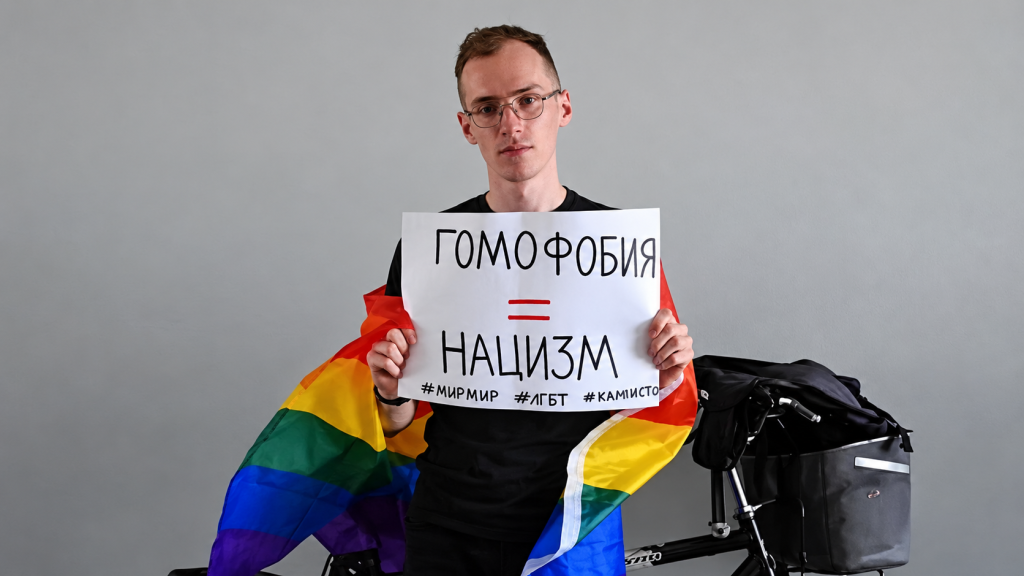
A Russian court has now sentenced LGBTQ+ activist Yaroslav Sirotkin in absentia to four years in a penal colony. The Kirovsky District Court in Yaroslavl found the leader of the “Kallisto” movement guilty of breaching requirements for so-called “foreign agents” and participating in the activities of an organisation designated as “extremist”, meaning the LGBTQ+ community (German).
Key points at a glance
- A court in Yaroslavl has sentenced Russian LGBTQ+ activist Yaroslav Sirotkin in absentia to four years in a penal colony.
- He was accused of breaching requirements for so-called “foreign agents” and participating in an organisation designated as “extremist”.
- A Telegram channel run by Sirotkin from France, featuring posts on LGBTQ+ issues, served as key evidence for investigators.
- Sirotkin now lives in France. He had previously opened a shelter in Armenia for LGBTQ+ people who had fled their countries.
- The verdict comes amid the growing persecution of LGBTQ+ people and alleged “foreign agents” in Russia.
- The UN recently warned that Russia is now also hunting down critics and Russian LGBTQ+ people abroad.
Persecution abroad
In addition to the prison sentence, the court imposed six months of “restriction of freedom” on Sirotkin. He is also banned from running websites for two years. The legal aid organisation Pervy Otdel reported the decision. Sirotkin is from Yaroslavl and had already come to public attention several years ago through his LGBTQ+ activism. In 2020, he was attacked during a solo vigil at which he displayed a rainbow flag on Paratroopers’ Day.
According to Max Olenichev, a lawyer specialising in LGBTQ+ rights, the Russian authorities accuse Sirotkin of having “participated” in the LGBTQ+ movement designated as “extremist” between April 2024 and October 2025. Sirotkin was already living outside Russia during that period. The Russian authorities thus prosecuted him under the Russian Criminal Code for acts he is alleged to have committed abroad.
Telegram channel used as evidence
The Telegram channel “LGBT+ Eshnik”, run by Sirotkin from France, played a central role in the proceedings. According to the report, investigators cited at least 22 posts on LGBTQ+ issues published there as evidence. Sirotkin left Russia after the start of the Russian invasion of Ukraine. He initially went to Armenia, where he opened a shelter for LGBTQ+ people who had fled Russia, Ukraine and Belarus. He later moved to France.
The Russian authorities had already added Sirotkin to the register of so-called “foreign agents” in April 2022. The first criminal proceedings against him were opened in December 2023. The investigations covered a total of two suspected breaches of the legal provisions for “foreign agents” and one case relating to so-called “LGBTQ+ extremism”. In April 2026, the Yaroslavl Regional Court also designated the “Kallisto” movement led by Sirotkin as “extremist”. Its activities in Russia were thereby banned.
Criticism of legislation
According to lawyer Max Olenichev, whose comments were reported by the media outlet Parni+, several activities played a role in the designation of “Kallisto”. These included criticism of a bill to ban gender transition, events opposing discrimination against LGBTQ+ people and support for other LGBTQ+ initiatives. The proceedings also cited experts who had examined Sirotkin’s Telegram channel. They reportedly interpreted his use of terms such as “persecution”, “censorship” and “unprecedented pressure” in his posts as evidence of “extremist activities”.
Russia’s rules for so-called “foreign agents” have faced international criticism for years. According to Amnesty International, the Kremlin uses the legal designation to label and take action against dissidents, non-governmental organisations, journalists and intellectuals, among others. The provisions were introduced in 2012 and tightened several times in subsequent years. Amnesty International says they can now be used against people who criticise the Russian authorities, regardless of whether they actually receive financial support from abroad. According to the report, more than 1,200 individuals and organisations have been officially added to the register. The European Union also criticises the practice. Around 247 media companies or individual journalists have reportedly been designated as “foreign agents” since 2022. Russia is said to be among the countries with a particularly high number of imprisoned media workers.
LGBTQ+ is “extremist”
At the same time, Russia has tightened its so-called anti-extremism provisions. These are now used against political opponents, religious minorities, human rights organisations and LGBTQ+ communities. Russia’s Supreme Court designated the so-called “international LGBT movement” as “extremist” back in 2023 (German). For people accused of involvement or support, this can result in criminal penalties and the freezing of bank accounts. Russia is currently also working on a further tightening of its extremism laws, intended to ban anything that runs counter to the country’s “traditional values”. The proceedings against Yaroslav Sirotkin are another case in which Russian authorities are applying existing provisions against an LGBTQ+ activist. Sirotkin’s safety in France apparently exists only on the surface: just last week, the United Nations warned that Russia is also hunting down critics and Russian LGBTQ+ people living in exile abroad.








