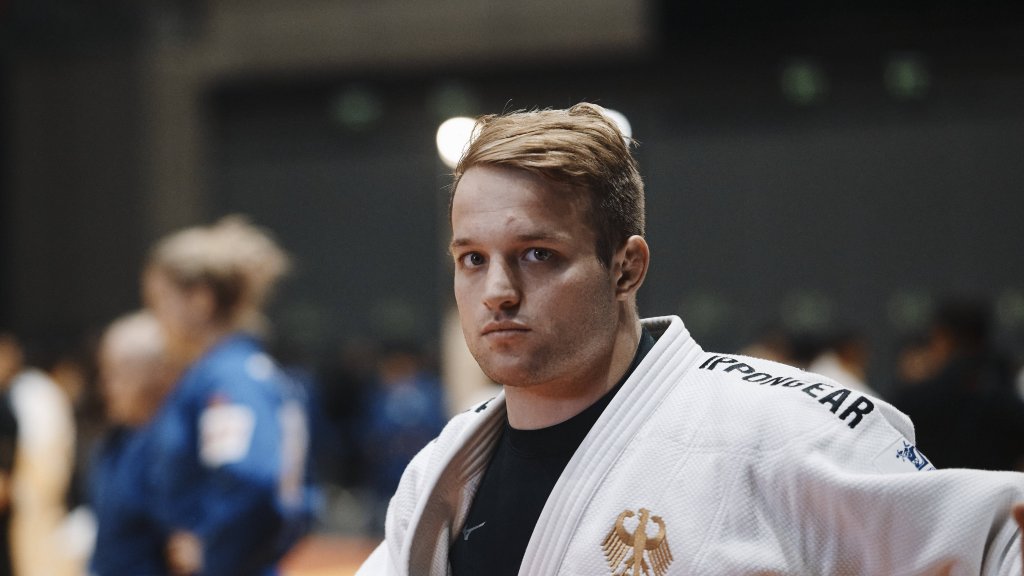
A week and a half after the attack, Timo Cavelius is still shaken. The gay German judoka was attacked by Georgian judoka Akaki Japaridze on 5 September after a Bundesliga bout in Leipzig. Cavelius suffered a double jaw fracture and had two teeth knocked out.
The key points at a glance
- German judoka Timo Cavelius was attacked by Georgian judoka Akaki Japaridze in early September after a Bundesliga bout in Leipzig.
- Cavelius suffered a double jaw fracture and lost two teeth.
- The incident is being investigated by the police and the relevant sports federations.
- In 2024, Cavelius became the first openly gay man to compete in judo at the Olympic Games.
- He does not want to speculate on whether his sexual orientation might have played a role in the attack.
- Japaridze said he had felt provoked by a gesture and an alleged verbal provocation by Cavelius.
- Cavelius says he was merely celebrating his victory towards his own team.
- Following surgery, his jaw has been stabilised with three plates. He must refrain from sport for six to eight weeks.
- Because of the injury, he will miss the Grand Slam in Budapest and the World Championships in Baku. His Olympic qualification is also at risk.
- Cavelius has taken legal action and wants an objective investigation into the incident. Japaridze has not yet apologised to Cavelius.
- Despite the attack, Cavelius continues to stress the importance of respect, fairness and mutual consideration in judo.
Shock in the judo community
The incident has shaken the sport of judo and is being investigated by the police and the relevant sports federations. Cavelius is recovering after surgery. Because of the injury, he will miss next month's World Championships. His chances of competing at the 2028 Olympic Games in Los Angeles are also at risk. In recent days, Japaridze had said he had reacted to a gesture and an alleged verbal provocation by Cavelius. The Georgian has not yet apologised directly to Cavelius.
“I am still shocked by what happened. After the bout was over, I was happy about my victory and celebrated towards my team and my teammates. The bout was close and evenly matched, so naturally I was very relieved and happy to have won.” He had not expected such an escalation immediately afterwards. “I would never have expected the situation to escalate in this way immediately afterwards. I still find it difficult to understand how a sporting contest could lead to a situation like this.” Without warning, the Georgian had knocked the gay 29-year-old to the ground and continued beating him.
An attack motivated by homophobia?
His recovery is going to plan, Cavelius reports. During surgery, his jaw was stabilised with a total of three plates. “The operation went well, and my jaw was stabilised with a total of three plates.” The judoka must now refrain from sport for six to eight weeks. Until the fourth week, he can consume only puréed or liquid food. The plates will have to be removed after about eight months. “My recovery is my priority now. I am glad that everything has gone to plan so far, and I want to give my body the time it needs to heal fully.”
In 2024, Cavelius made sporting history: he was the first openly gay judoka to compete at the Olympic Games. Fortunately, he says, a person's sexual orientation is not a major issue in Germany. In countries such as Georgia, the situation may be different. However, Cavelius does not want to judge whether his sexual orientation played a role in the attack. “I cannot and do not want to judge whether Japaridze attacked me because of my sexuality. Ultimately, his statement leaves room for interpretation in that respect. Only he can say what he was thinking at that moment. As long as Japaridze's statements do not explicitly refer to my sexual orientation, I do not want to speculate about it. It is important to me to stick to the facts and not attribute a motive to anyone that cannot be substantiated.”
Victory celebration as a possible provocation
The elite athlete went on to tell Outsports that he could only describe his own perspective: “Ultimately, only Akaki Japaridze himself can answer that. I can only describe how I perceived what happened. There were neither verbal insults nor physical attacks on my part. My behaviour consisted of celebrating my victory, and that celebration was directed towards my own team. I can understand that Japaridze might have perceived my celebration as a provocation. I can accept that as his perception without that having been my intention.”
According to Japaridze, he felt provoked by a gesture from Cavelius and believed that his behaviour had offended his honour as a man. Cavelius explains that his celebration may have come across to his opponent differently from how he intended. “It was not my intention to humiliate or insult him personally. For me, however, it is crucial to distinguish between a gesture and physical violence. A gesture can be perceived as provocative or inappropriate. That is something one can reflect on critically afterwards. Physical violence, however, is an entirely different matter. Even if Japaridze perceived my celebration as an affront or a provocation, that can neither explain nor justify the subsequent physical attack. That is why I do not want to conflate these two things. I am willing to reflect on how my celebration might have come across to Japaridze. But that does not change the fact that everyone remains responsible for their own physical reaction.”
He will keep celebrating victories
As a matter of principle, Cavelius does not want to give up his way of celebrating victories. “I will continue to celebrate when I win a bout. At the same time, I have of course reflected on how a gesture can be perceived by an opponent. If I were in the same situation again today, I would probably pay more conscious attention to how I express my celebration. For me, that is a matter of mutual respect. Reflecting on my own behaviour does not mean that I take responsibility for someone else's reaction. Everyone remains responsible for controlling their own reaction.”
The attack represents a significant setback for his sporting career. Cavelius will miss important international competitions, including the Grand Slam. “I will miss important international competitions, including the Grand Slam in Budapest and the World Championships in Baku. My Olympic qualification is also at risk as a result. That is particularly painful because I had only just worked my way back into international competition after a long injury lay-off. Nevertheless, I am trying to look ahead. Once I am healthy again, I want to continue pursuing my sporting goals step by step.”
Legal action and consequences
Cavelius has taken legal action. “It is important to me that the incident is investigated objectively and on the basis of what actually happened.” Assessing the incident under criminal law is a matter for the relevant authorities, he says. He does not want to pre-empt the proceedings or express expectations of a particular decision. “The consequences under sporting regulations are also a matter for the respective governing bodies. That is why I consider it inappropriate to make demands. The federations have been informed of the incident and will examine it. I am confident that the relevant bodies will assess the incident within their remit and in the interests of the sport.” Cavelius says one thing is certain for him: “As far as I know, nothing like this has ever happened in judo before. And nothing like this must ever happen again.”
No conversation with Japaridze
As Japaridze has not yet apologised, Cavelius currently sees no basis for a conversation with him. “Japaridze has not apologised to me so far. I would also first like to allow the ongoing criminal and sporting proceedings to reach their conclusion and focus on my recovery.” He does not want to pre-empt what might happen once the proceedings are over. “From my point of view, a conversation with Japaridze would first require an appropriate basis and, above all, a willingness to address what happened honestly and respectfully.”
Cavelius is also following the discussions on social media. “Of course, I am aware that there is a great deal of discussion and debate about what happened. I am very grateful for the enormous support I have received. At the same time, there is also speculation and a lot of very emotional commentary. I try not to let that influence me too much. I do not want to get involved in public disputes or comment on every statement. What matters to me is that the incident is investigated objectively and that the actual sequence of events remains the focus.”
Respect remains a core value
He says the attack has not changed his fundamental view of judo. “Precisely because respect, fairness and mutual consideration are core values of our sport for me, the incident has affected me particularly deeply. Judo is a sport of great physical and emotional intensity. But that also means controlling your emotions and respecting your opponent's physical integrity. The contest ends with its result. After that, there must be a clear boundary.” Cavelius therefore hopes that the incident will be investigated objectively and that the judo community will draw the right conclusions from it.
For now, the judoka must observe the prescribed break from sport. After that, he can slowly start training again. “When I can compete again will depend on how my recovery progresses. I do not want to rush anything. A full recovery is my priority. As soon as my body is ready again, I will gradually return to training and then see when I can compete again.”








