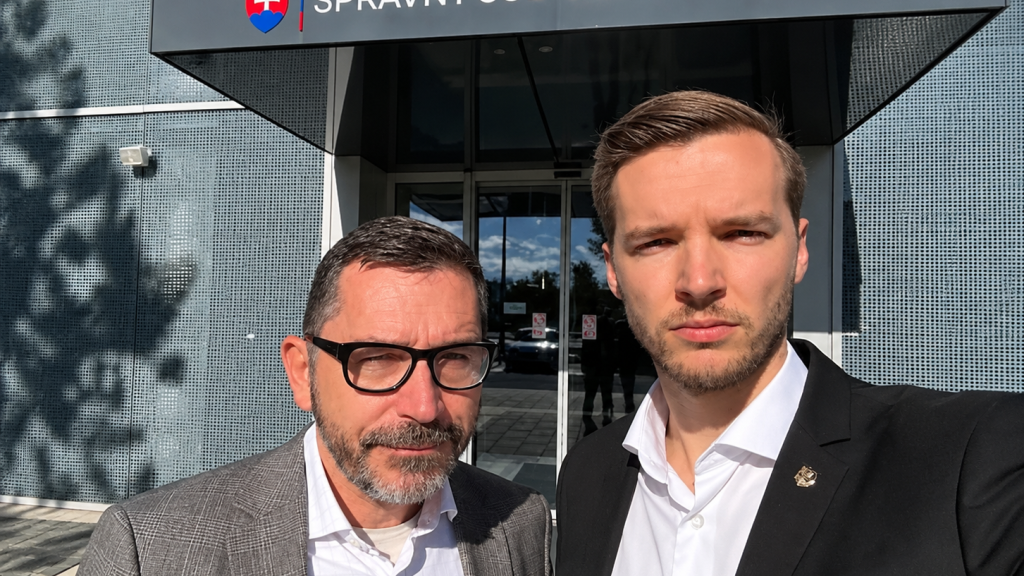
They have been married for six years, yet in their home country they are not officially regarded as spouses. Slovak nationals Ivan Novotný (31) and Metod Špaček (51) married in Austria in 2020. Now they are suing the Slovak authorities for refusing to recognise and officially register their marriage. The two lawyers and former diplomats are relying on a ruling by the European Court of Justice (ECJ).
The key points at a glance
- Dispute over marriage recognition: Two men are suing the Slovak authorities because their marriage, concluded in Austria in 2020, is not being registered in Slovakia.
- EU ruling as the basis: In November 2025, the European Court of Justice ruled that member states must recognise same-sex marriages from other EU countries under certain conditions.
- Constitution as an obstacle: The Slovak government points to the national constitution, which defines marriage as a union between a man and a woman.
- Political climate: Under Prime Minister Robert Fico, Slovakia has further restricted the rights of LGBTQ+ people.
The rule of law called into question
In predominantly Catholic and socially conservative Slovakia, same-sex marriage is not permitted. Nor is there any form of registered civil partnership. However, Novotný and Špaček are not seeking to force a change in national marriage law. Their aim is to secure recognition of their marriage, which was already legally concluded in another EU member state. The legal dispute highlights the clash between obligations under EU law and national rules. It also raises questions about legal protections for same-sex couples under the populist-nationalist government of Prime Minister Robert Fico, who remains firmly opposed to recognising same-sex couples.
According to the couple, they do not feel directly disadvantaged in everyday life. “I have said this publicly several times, and LGBTQ+ activists in Slovakia have criticised me for it: Metod and I are not discriminated against here. We have a wonderful life here in Bratislava, in Slovakia,” Novotný told the British newspaper the Guardian. “So we do not really need recognition of our marriage for our everyday lives.” Nevertheless, the coronavirus pandemic showed how the lack of legal recognition could become a problem. At the time, Špaček needed hospital treatment. A doctor recognised Novotný as a family member and gave him medical information. “She entered me in the medical report as ‘husband’ and gave me all the medical information about my husband,” Novotný said. “The only problem is that she did it because she was nice, not because she was obliged to. If someone wanted to make things difficult for us, they could.” His conclusion: “That is not how the rule of law should work.”
ECJ ruling strengthens couples’ position
The couple hope to find legal support in a European Court of Justice ruling from November 2025. The case arose from a legal challenge by two Polish men, Jakub Cupriak-Trojan and Mateusz Trojan, who had married in Berlin (German). They had challenged the refusal of the responsible voivode, or regional governor, in Poland’s Mazovia region to recognise their marriage concluded in Germany. The ECJ ruled that EU member states must recognise same-sex marriages from other member states if the couples have exercised their right to freedom of movement and established or strengthened a family life in another EU country. However, the judges did not thereby oblige member states to allow same-sex marriages to take place within their own borders. Novotný and Špaček see the ruling as a legal basis for their demand. The Slovak authorities take a different view.
Interior Ministry stresses the constitution
The authorities explained their rejection of the couple’s application in a letter signed by Interior Minister Matúš Šutaj Eštok. “The letter says they lack the legal basis to formally recognise the marriage certificate because the Slovak constitution defines marriage as a union between a man and a woman. That is essentially all,” said Špaček, who previously served as chief of staff to the liberal former president Zuzana Čaputová. In response to an enquiry from the Guardian, the Interior Ministry said it was bound by the constitutional and legal provisions in force. A marriage legally concluded abroad did not change that. Although the ministry acknowledged the primacy of EU law, it said that recognising a marriage to guarantee European freedom of movement did not necessarily mean it also had to be officially registered as a marriage. The administration could “not substitute for decisions by the legislature or the constitutional legislature”, the ministry said.
Another claimant fights on
Radio presenter Marián Žáry Kukelka, 44, is also taking legal action against the Slovak authorities. He married his partner Ondrej in 2023 in Hainburg an der Donau, Austria. The town can be seen from the terrace of his house in Bratislava, which his grandparents built on a hill overlooking the Danube. Žáry Kukelka works for the public broadcaster STVR. There, with his colleagues’ support, he uses his full married name. Žáry is his partner’s surname. In his official documents, however, the presenter is still listed as Marián Kukelka. “It is a court case brought out of love,” he told the Guardian. “I do not need this surname to live my life. But for me, being able to bear his surname too is a kind of tribute to my partner.” For him, it is therefore not just about a formal change to his documents, but also about legal recognition of his relationship.
Homophobic attack
Žáry Kukelka lives behind Bratislava Castle, not far from Zámocká Street. In 2022, two people were shot dead there in a homophobic attack outside the LGBTQ+ bar Tepláreň. In his view, the anti-LGBTQ+ rhetoric of numerous Slovak politicians, particularly those from the governing parties, contributes to an increasingly hostile social climate. Last year, Prime Minister Fico’s government supported constitutional amendments recognising only two genders and tightening restrictions on adoption.
On Monday, the fourth anniversary of the deadly attack on the Tepláreň bar, Fico attacked opposition MP Lucia Plaváková for having married her partner abroad. He described the marriage as a “blatant provocation” and accused her of violating the Slovak constitution. Plaváková’s party, the liberal opposition party Progressive Slowakei, rejected the accusation. It said the MP had violated neither the law in force nor the constitution. Žáry Kukelka himself said he had so far experienced little hostility as a gay man. Nevertheless, depending on whom he is talking to, he thinks carefully about whether to refer to “my husband”. He illustrated how differently he perceives society’s treatment of same-sex couples by describing a trip to Switzerland. “Two weeks ago, we were in Switzerland. There, for the first time in a long while, we held hands in public again,” he said. “We felt that it was different there.”








