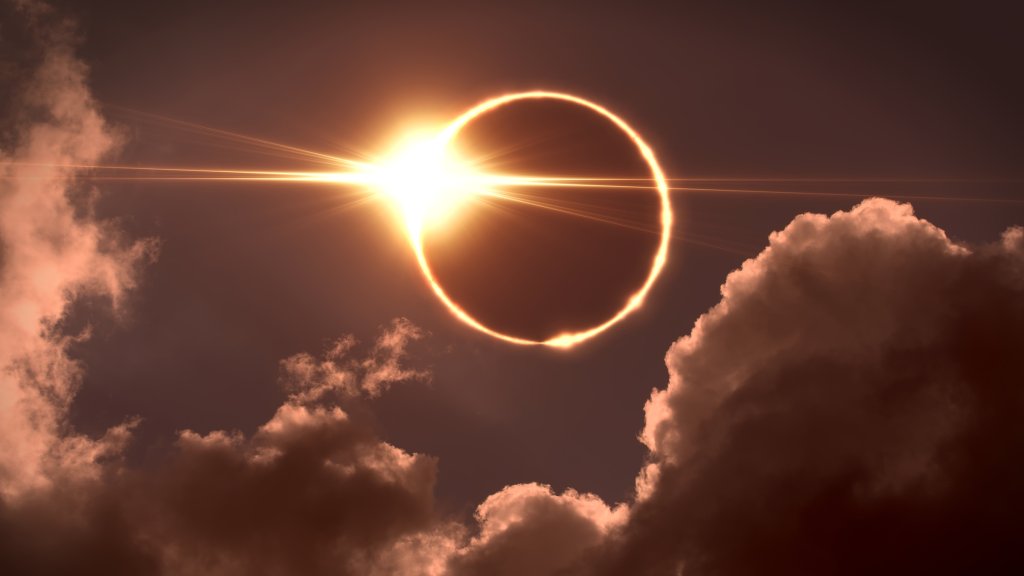
This evening, Europe will witness a rare celestial spectacle. A total solar eclipse will sweep across parts of the continent. While the sun will be completely obscured by the moon for a short time in Spain and Iceland, observers in Germany will experience a deep partial eclipse. For astronomers, the event is a predictable interplay of celestial bodies. For many people, however, a solar eclipse is far more than an astronomical phenomenon. It touches on age-old ideas of change, uncertainty, transcendence and identity. Few other natural events have occupied the human imagination so intensely over millennia.
Astronomy and religion
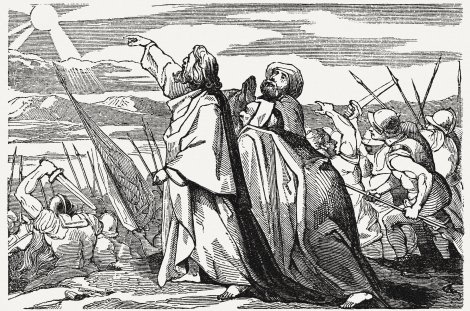
The history of solar eclipses is therefore not just a history of astronomy. It is also a history of religion, power, fear and hope. And it touches in a particular way on questions that remain important to many queer people today: the search for belonging, the experience of social exclusion and a fascination with alternative forms of spirituality. Even in the earliest civilisations, solar eclipses were interpreted as signs. In China, Mesopotamia, Egypt and the ancient Mediterranean world, they were often seen as harbingers of political upheaval or divine messages. The sudden onset of darkness in the middle of the day contradicted people's everyday understanding of the world. What can now be explained scientifically once appeared to be a disruption of the cosmic order.
Powerful symbolism for the community too
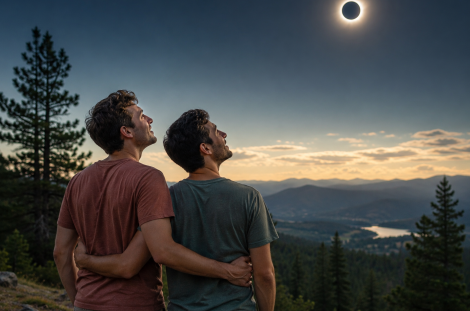
Precisely because solar eclipses are rare and striking, they have repeatedly been associated with transitions: changes of rulers, the beginning of new eras or the closeness of the visible and invisible worlds. This symbolism has survived to the present day. Even today, many people describe a solar eclipse as a moment of reflection or transformation, even if they understand the science behind the event. For queer people, the idea of transitions and in-between states often has a particular resonance. Historians and cultural scholars have long pointed out that queer identities were perceived as “outside the norm” in many societies.
Those who did not fit into prescribed categories of gender, sexuality or social role occupied a kind of social space in between. Solar eclipses symbolically embody just such a state: they are neither day nor night, neither complete order nor complete chaos. For many people, this creates a powerful emotional and cultural appeal. It would, however, be wrong to claim that queer people historically had a special or even exclusive connection to solar eclipses. There is no robust evidence for this. What can be documented, however, is a striking affinity between many queer communities and alternative spiritual movements – particularly since the 20th century. The reasons for this lie less in the supernatural itself than in Europe's social history.
Rejection by the Church
For centuries, homosexual relationships were rejected by the major Christian churches. The Catholic Church, as well as numerous Protestant traditions, regarded same-sex sexual acts as sinful. This attitude shaped not only religious doctrine but also the legislation of many European states. A historical distinction that is often overlooked today is crucial here. The churches did not automatically associate homosexuality with occultism. Rather, from their perspective, the two belonged to different categories of “deviation”. Same-sex sexuality was considered a violation of the divine order of sexuality; magic, divination and belief in spirits were seen as rivals to the Christian faith.
Both were condemned, but for different theological reasons. Nevertheless, they were often lumped together in public perception. Anyone who departed from religious norms could easily fall under suspicion. In the Middle Ages and the early modern period, people regarded as heretics, witches, magicians or moral outsiders were often portrayed collectively as a threat to order. The categories became blurred in the public imagination. This did not mean that every accused witch was homosexual, or vice versa. Yet the mechanisms of exclusion were strikingly similar.
A need for spirituality
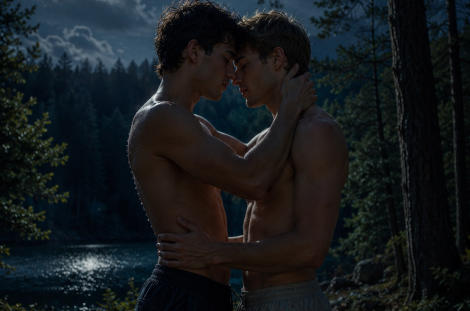
For many queer people, this created a paradoxical situation over the centuries. The dominant religious culture told them that they did not fully belong. At the same time, the need for spirituality remained. Where traditional institutions seemed closed to them, alternative paths became attractive. This was particularly evident in the 19th and 20th centuries. As Europe became increasingly secular, spiritualism, theosophy, astrology and later neopagan movements attracted large followings. In some of these movements, homosexual men and women found freedoms denied to them elsewhere. Alternative spiritual circles were by no means automatically tolerant either. Nevertheless, they often offered more scope for self-definition than the established churches. This trend intensified from the 1960s and 1970s onwards. New forms of queer spirituality emerged alongside the modern LGBTQ+ movement. Some people turned to Buddhism, others to neopaganism, witchcraft-based spirituality or various esoteric traditions. Others remained within Christian churches and fought for recognition there. This development was by no means uniform.
A special appeal
But why do subjects such as astrology, witchcraft and occultism still hold a special appeal for some members of the queer community? Sociologists and scholars of religion offer several explanations. Firstly, many of these traditions allow greater freedom in shaping personal identity. Secondly, they often place greater emphasis on individual experience than on rigid dogma. Thirdly, symbols of change, transformation and crossing boundaries play a central role – themes that also feature in many queer life stories. There is another aspect, too: alternative spirituality often concerns itself with the invisible and the hidden. Historically, many homosexual people also had to live their lives in secret. This gave rise to a distinctive symbolic language in literature, art and culture that used secrets, codes and hidden meanings.
The fascination with mystical subjects can also be understood partly against this backdrop. A solar eclipse brings many of these themes together in a single event. It can be fully explained by science and yet seems almost unreal. It reminds us that even familiar patterns can suddenly look different. For a few minutes, the world visibly changes without suffering lasting damage. Darkness and light enter into an extraordinary dialogue. Perhaps this is precisely where the phenomenon's enduring power lies. Not just for queer people, but for humanity as a whole. Solar eclipses make clear that nature needs no magic to inspire awe. When the sun darkens over Europe on 12 August, millions of people will look up. Some will primarily marvel at the astronomy. Others will think of ancient legends. Others still will find personal meaning in this rare moment. History teaches us that solar eclipses have always been screens onto which people project their hopes, fears and longings. That is precisely why, ultimately, they tell us less about the sun and moon than about ourselves.