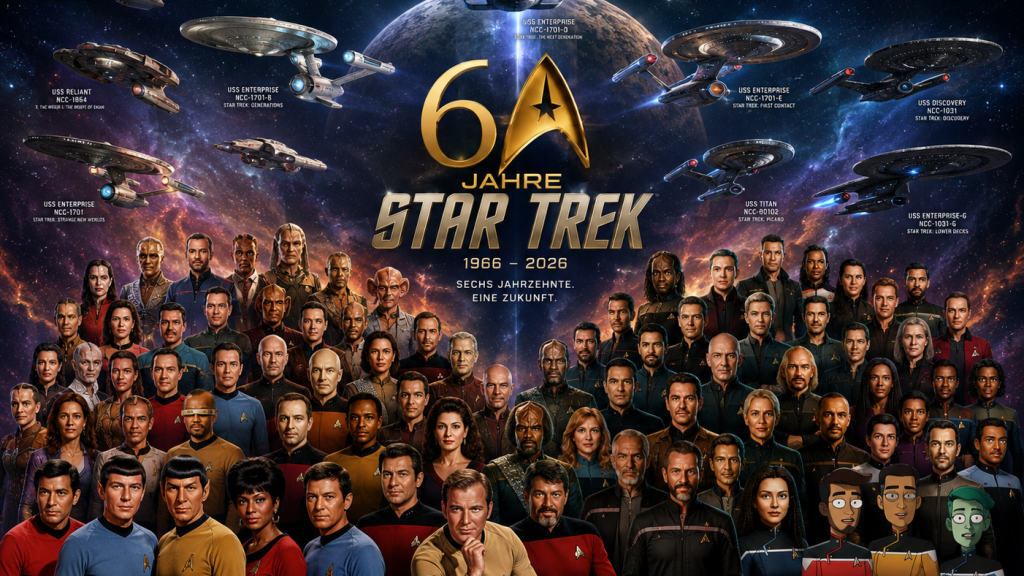
When the first episode of Star Trek aired on 8 September 1966, the world was a different place. The USA was in the midst of social upheaval, civil rights movements were shaping the era, and many minorities were still fighting for recognition and equal rights. A science-fiction series about a spaceship in the 23rd century dared to imagine something unusual: a future in which people from different backgrounds work together, overcome conflicts and no longer see differences as obstacles. From the outset, it was precisely this vision that made Star Trek far more than just casual television entertainment for many LGBTQ+ people.
Infinite diversity
The world of the Federation, developed by creator Gene Roddenberry, was based on a simple idea: humanity can evolve. Not through enforced uniformity, but through recognising diversity. The central concept of “IDIC” – “Infinite Diversity in Infinite Combinations” – was introduced by Roddenberry himself in 1968 and became one of the franchise’s most important guiding principles. It expresses the conviction that different perspectives and identities are not a weakness, but an enrichment. For many gay and queer fans, this message had a particular significance from the very beginning. At a time when homosexuality was often rendered invisible or criminalised, Star Trek showed a future in which people are not judged for their identity.
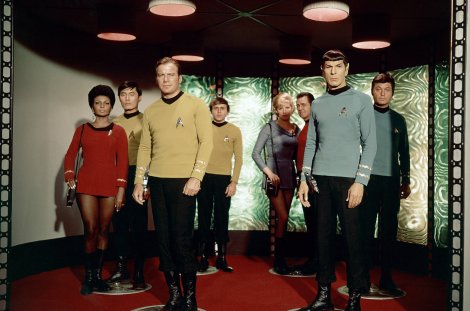
The series did not explicitly say, “LGBTQ+ people belong”, but it conveyed something more fundamental: everyone belongs. Even the original series broke new ground. The international crew of the Enterprise was extraordinary for 1960s television: the character Uhura, played by Black actress Nichelle Nichols, served as an officer on the bridge as a matter of course. Japanese-American actor George Takei played Sulu – at a time when Asian Americans still faced prejudice in many areas of life. For many LGBTQ+ people, this made the series a mental refuge: a place where they could imagine a future in which exclusion had been overcome.
Identity and freedoms
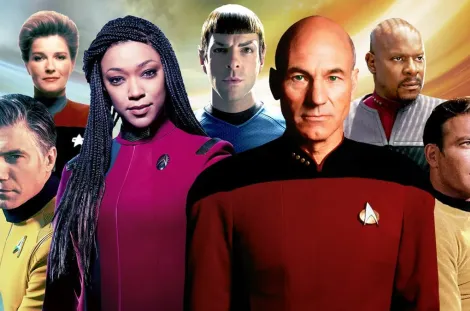
Star Trek continued to evolve over the decades. Its various series increasingly addressed themes such as identity, gender, social norms and personal freedom. With characters such as Seven of Nine, who explored questions of individuality and self-determination, and later openly gay and queer characters, the idea of a diverse future became ever more tangible. The first established, openly gay married couple in the main cast of a Star Trek series were Paul Stamets and Dr Hugh Culber from “Star Trek: Discovery”. The two characters are played by actors Anthony Rapp and Wilson Cruz. However, other important gay characters and queer portrayals had already appeared in the Star Trek universe.
The 2016 film “Star Trek Beyond” showed that the long-established character Hikaru Sulu now had a male partner and a daughter together with him. The portrayal was also a tribute to the original gay Sulu actor, George Takei. Older series such as “Star Trek: Deep Space Nine” also featured subtle queer dynamics, for instance between Garak and Dr Bashir. Minor queer characters also appeared in the novels of the so-called Beta canon. Yet openly gay main characters remained absent from television for a long time. The development of LGBTQ+ characters in the Star Trek universe is a decades-long story, ranging from early studio restrictions to a pioneering role in the modern streaming age. Although series creator Gene Roddenberry stood for a diverse future from the outset, it took more than 50 years for openly gay and queer main characters to appear regularly in the franchise’s television series.
Hidden LGBTQ+ characters
In the original “Star Trek” series and its successors “Star Trek: The Next Generation” (TNG), “Deep Space Nine” and “Voyager”, there were no explicitly gay characters in the main cast. The reticence of the time was particularly evident in a planned script by David Gerrold for the TNG episode “Blood and Fire”. Written in 1988, the episode was intended to feature a gay couple among the crew and an AIDS analogy, but was dropped under producer Rick Berman. Studio pressure and homophobic reservations reportedly played a part. Instead of showing openly gay characters, Star Trek therefore spent a long time exploring questions of identity and sexuality through metaphors and alien species. In the TNG episode “The Outcast”, Riker falls in love with a genderless being. In “Deep Space Nine”, the symbiotic Trill species was used to address themes such as gender identity and bisexuality.
Particularly well known is the 1995 DS9 episode “Rejoined”, which showed the first same-sex kiss between two women in the Star Trek franchise. Queer subtext also played an important role. Actor Andrew Robinson has said that, from the outset, he developed his character Elim Garak in “Deep Space Nine” with a pansexual or queer interpretation. On television, however, this aspect of the character was never allowed to be stated openly. A fundamental shift began in 2017 with the launch of “Star Trek: Discovery”. The series broke with previous restrictions and ushered in the franchise’s most progressive era to date. Alongside the gay married couple Stamets and Culber, already mentioned, the second season introduced lesbian engineer Jett Reno, played by Tig Notaro. Trans and non-binary identities also took on central roles for the first time.
In the third season of “Star Trek: Discovery”, Adira, a non-binary character played by Blu del Barrio, and Gray, a trans man played by Ian Alexander, made television history. Older characters were also reinterpreted. In “Star Trek: Picard”, the popular character Seven of Nine was confirmed as lesbian and entered into a committed relationship with Raffi Musiker. This also corrected an earlier portrayal from the 1990s that had been heavily shaped by heteronormative expectations. The series “Star Trek: Strange New Worlds” continued along this path, but took a somewhat subtler approach, presenting LGBTQ+ identities more as a natural part of everyday life. The first season, for example, confirms that Dr Christine Chapel is bisexual and has also dated women in the past. Guest appearances also expanded queer representation in the universe. In the episode “The Serene Squall”, non-binary actor Jesse James Keitel takes on the role of gender-nonconforming pirate leader Dr Aspen, or Angel. Keitel described her portrayal as “wonderful, iconic, futuristic and everything I’ve ever dreamed of. And I think we need more of that.”
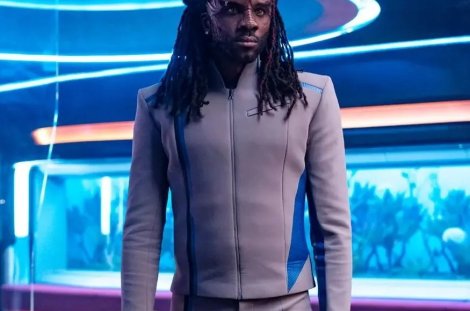
A gay Klingon
The franchise also changed behind the scenes. LGBTQ+ actors became more visible and now speak much more openly about what it means to be part of this special universe. Gay Sulu actor George Takei explained: “I think the strength of Star Trek is creative diversity in infinite combinations – and then live long and prosper.” Karim Diané, who played the franchise’s first openly gay Klingon in “Star Trek: Starfleet Academy” and is himself gay, said: “At first I thought, ‘Okay, whatever. It’s not a big deal.’ I was wrong. It’s a very big deal.” Asked whether his character’s sexuality should be addressed at all, Diané replied: “I’d like to talk about it in more detail. But at some point, I also want to get to a place where we don’t talk about it at all. It is literally the least interesting thing about a character or a person.”
The question is: will the trend towards greater openness to LGBTQ+ people continue, or not? Celia Rose Gooding, who plays Uhura in “Star Trek: Strange New Worlds”, takes a critical view of the situation. “I’m not going to sugar-coat it. I think we’re taking a small step backwards right now.” The lessons of 60 years of Star Trek must finally be put into practice. She also described how moving it is when young Black girls imitate her version of Uhura. “I was once that little girl who desperately wanted to see someone who looked like me experiencing joy, love and acceptance. Being part of that change is overwhelming.” Diané went on to say that, although his gay character had prompted homophobic reactions online, many fans had also been deeply moved. “Many people have found love and hope. Some are moved to tears. So, honestly, I don’t care about all the negativity.”
Following criticism that Star Trek had become “too woke”, however, the series “Starfleet Academy” was cancelled after just its first season; a second season that has already been produced is at least still due to be released. Diané nevertheless remains optimistic: “Let’s wait and see what happens. It could be the best thing you’ve ever seen. There’s so much romance. So many queer stories. So gay!” The LGBTQ+ fan organisation “To Proudly Go” also continues to see the franchise as an important safe haven. Spokesperson John Lutton explained: “We create safe spaces for queer communities and queer nerds. We want everyone to feel welcome.” At the same time, Lutton voiced doubts about the franchise’s future: “Paramount’s merger with Skydance doesn’t make me hopeful.” Actress Stephanie Czajkowski (“Star Trek: Picard”) expressed similar sentiments and therefore stressed: “The world is infinitely diverse, in ways we haven’t even discovered yet. Queer people have always existed. They’ve only now finally been allowed to be themselves.”
The fans and "their" Star Trek
The question will be who those in charge listen to more – to this day, reactions from the worldwide Star Trek fan community, the so-called Trekkies, reflect society’s debates about diversity, representation and identity. Given the community’s size and international significance, there are different perspectives that can essentially be divided into two camps. Many progressive fans and members of the LGBTQ+ community welcome the franchise’s modern development. They see the increasing visibility of queer characters as a logical continuation of the original Star Trek idea. A true utopia, they argue, can only be credible if queer people are also included as a matter of course and discrimination has been overcome.
On the other side are more conservative fans and sections of the nostalgia camp, who often loudly criticise modern “NuTrek” – particularly “Star Trek: Discovery”. According to many of these fans, their criticism is not fundamentally directed at gay or queer characters, but at what they perceive as “checklist writing” – the impression that certain social issues are being pushed too strongly to the forefront. Some also complain that emotional or personal conflicts overshadow traditional notions of logic, professionalism and discipline within Starfleet. One of the biggest debates within the fandom concerns how organically queer characters are integrated into the plot. While the gay married couple from “Star Trek: Discovery” are now accepted and appreciated by many fans after initial scepticism, the characters Adira and Gray from the same series prompted much more contentious reactions.
Critics argued that the portrayal of their journeys of self-discovery did not fully fit a vision of the future in which such questions should actually have long since been normalised. In their view, parts of the storyline felt more like a transfer of today’s social debates into a utopian future. Alongside these internal discussions within the fan community, Star Trek is increasingly influenced by political debates outside the fandom. Newer projects such as “Star Trek: Starfleet Academy”, which specifically sought to appeal to younger and more diverse audiences, were used by some political figures to present Star Trek as an example of current culture wars. Representatives of the franchise, meanwhile, regularly defended its development.
Shatner weighs in
Veteran actor William Shatner, the very first actor to play Captain James T. Kirk, pointed out that Star Trek had been crossing social boundaries since its beginnings. As early as 1966, the series caused a stir with the first interracial kiss in television history, demonstrating that diversity and social progress had been part of the franchise’s DNA from the outset. Ultimately, the disputes over queer characters also reveal Star Trek’s particular significance: the series was never just entertainment, but always a reflection of social change. And it is hard to imagine that the story has truly reached its end – there are now nine live-action series and further animated productions, totalling more than 900 episodes and 13 cinema films.
The development of Star Trek reveals a long transformation: from a series that had to explore LGBTQ+ themes through metaphors and hints to a universe in which gay, trans and queer characters are a natural part of the future. To this day, many queer people associate Star Trek not just with a series, but with a hope: the idea that the future can be better than the present. In a world where LGBTQ+ people continue to face discrimination, political attacks and social exclusion – in some cases with renewed intensity – Star Trek’s message remains more relevant than ever. The series does not show a perfect world, but a world that has learnt to embrace diversity. More than that, after 60 years, the Enterprise’s most important message remains: diversity is not a problem to be solved. Diversity is what makes a society stronger. Infinite diversity in infinite worlds