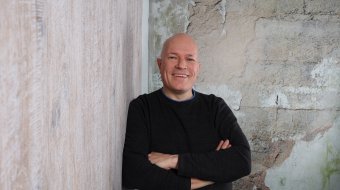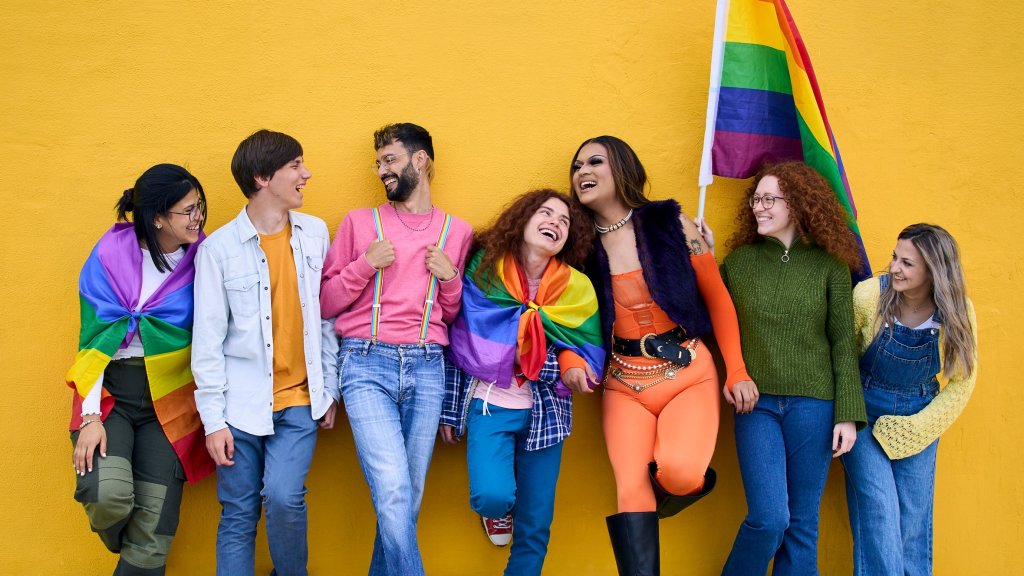
A year ago, Coming-Out-Day-Verein launched the first nationwide video counselling service for queer young people, with fourteen peer counsellors. How has the situation for LGBTQ+ people developed since then? SCHWULISSIMO spoke to the association's head, Sven Norenkemper.
What is your assessment after the first year of video counselling?
The first year significantly exceeded our expectations. Across video and email counselling, we received almost 700 requests for support. That is an enormous number for a new service – and, above all, very clear evidence for us of just how great the need is. What works particularly well is that the two counselling formats complement and strengthen each other. The peer approach is a key factor in our success. Young people speak to counsellors from the community who know many of the questions, uncertainties and experiences surrounding coming out and growing up queer from their own lives. This often very quickly creates a special kind of trust and the feeling that the person opposite me understands what I am talking about not just in theory. At the same time, our peer counselling is not simply a pleasant chat between queer people. Our counsellors receive intensive training, professional support and regular supervision. And those almost 700 requests for support tell us something else: we are filling a gap in provision that really should not exist in a country like Germany.
The project is funded through the federal programme “Demokratie leben!”. Federal Education Minister Karin Prien recently said that the programme would be refocused on combating extremism, with support for diversity sharply reduced. Is the future of your video counselling service secure?
No, unfortunately it is not secure in its current form. Like all innovation projects under the federal programme “Demokratie leben!”, our project will receive no further funding after the end of this year. In principle, we understand the thinking behind regularly reviewing funding programmes for their effectiveness and reassessing political priorities. That actually needs to happen. What we cannot understand, however, is pitting diversity against the prevention of extremism. If young people are attacked, excluded or subjected to online hate because of their sexual orientation or gender identity, you cannot say on the one hand that we want to take stronger action against extremism, while on the other weakening precisely those structures that support the people targeted by this hatred. That is why we are currently doing everything we can to reorganise the counselling service from next year and find new sources of funding.
The Federal Ministry of Education has also cut all funding for the youth network Jugendnetzwerk Lambda for 2027. The gist of the explanation was that many associations now have structures for queer people, so specialist support services are no longer needed.
We do not share that assessment at all. And in our experience, it rests on a fundamental misunderstanding of what specialist queer youth work actually does. Of course it is wonderful when a sports club, a youth fire brigade or a general youth centre says: queer young people are naturally welcome here. That is exactly where we want to get to. But “being welcome” and having a specialist counselling and support structure are two completely different things. And we must not forget one thing: organisations such as Lambda have built up knowledge, structures and trust over decades. Funding cuts can destroy something like that relatively quickly. But you cannot simply restore it two years later by approving a grant.
The Islamist attack on Berlin Pride continues to leave its mark. What effects are you noticing among young queer people?
In our email counselling, we repeatedly encounter a fundamental fear about people's own future, and sometimes indeed about their very existence. The questions include: how will the social climate develop? Will I still be able to live as openly in a few years' time? Will things get worse? Will I eventually have to be more careful again about who I am and whom I tell? So our concern is less that every young queer person is suddenly afraid to attend Pride. It is more this feeling: are the freedoms and the sense of normality we have worked to achieve over recent decades actually secure in the long term? And we should take that seriously. At the same time, we do not want to give young people the impression that they have to be constantly afraid. Society's reality is not just hatred, attacks and bad news. There are incredibly many people, families, schools and institutions where queer young people are now accepted as a matter of course.
Since the attack, the community has once again been debating more intensely whether the greater danger to LGBTQ+ people comes from far-right extremists or Islamists.
We see little value in constantly weighing these two threats against each other. What matters is not which form of extremism ends up higher on some ranking. We must be able to talk about both – clearly, with nuance and without ideological blinkers. Far-right extremism is a massive threat to queer people and to our democracy as a whole. We see this in attacks, online hate, disruptions to Pride events and political language that has become markedly harsher in recent years. And we must be just as able to talk about Islamism as a matter of course. An Islamist ideology that condemns homosexuality, deprives people of their rights because of their sexual orientation or legitimises violence is equally fundamentally at odds with a free society. The distinction between Islam and Islamism is very important to us here. We ourselves counsel young queer people who are Muslim. For some of them, a central issue is precisely how they can reconcile and live their religion and their sexual orientation or gender identity.
The EU and the German government are planning a blanket ban on social media platforms for young people under 14. What is your view?
In principle, we think age restrictions for social media make sense. And in our view, the discussion is long overdue. We accept age limits in many other areas of life as a matter of course. Not because we want to patronise or punish children and young people, but because we recognise that certain things carry risks and that development matters. We find it interesting that many young people themselves also take a much more critical view of social media than adults sometimes assume. Of course, we also recognise the particular importance of digital spaces for queer young people. For a 13-year-old boy in a rural area, the internet may be the first place where he realises: I am not alone. There he finds information, role models and perhaps, for the first time, other people with similar experiences. But that is precisely why we must not reduce the discussion to “social media: yes or no”. TikTok, Instagram and other commercial platforms are not synonymous with digital participation. The crucial question is: how do we give young people access to information, counselling and community without at the same time exposing them to the mechanisms of commercial platforms as early as possible?

The Federal Criminal Police Office (BKA) recently stressed that more and more young people are becoming radicalised online. Hatred of LGBTQ+ people in particular is spreading like wildfire there.
We consider this one of the most dangerous developments of recent years. These days, radicalisation no longer necessarily requires some backroom venue, a political group or an extremist circle of friends. A smartphone in a child's bedroom is enough. At the same time, for young people, digital space is real social space. But the algorithms have a fundamental problem: outrage works. Provocation works. Anger works. Once someone lingers on this kind of content, they are quickly offered more of it. And at some point, “Gender-inclusive language annoys me” can turn into an entirely different worldview, in which queer people supposedly threaten children, destroy families or are part of some conspiracy. Young people are at a stage when they are looking for belonging, testing boundaries and need guidance. Extremist actors now understand very well how to appeal to precisely these needs online. That is why, for us, media literacy is now also education for democracy.
This coming Sunday (11 October) is International Coming Out Day, when people celebrate coming out and seek to encourage others. At the same time, we are seeing a rise in hate crime and a decline in acceptance. Is this really a good time to come out – or is it particularly important right now?
Both. It has become more difficult – and that is precisely why it matters. But we would like to correct an idea that sometimes accompanies Coming Out Day: nobody owes the community a coming-out. No 16-year-old has to come out to make us more visible in society. If someone says, because of their family, their social circle or fear of violence, “I am not telling anyone at the moment”, that may be exactly the right decision. Coming out must benefit the person coming out – not a social ideal. At the same time, of course, we know what visibility can achieve. When people have a gay son, a lesbian colleague, or know a bisexual friend or a trans* girl in their class, an abstract social debate suddenly becomes a human being. That is why Coming Out Day may be particularly important right now.
What are the biggest problems facing young queer people in 2026?
Surprisingly, many of the questions are essentially the same as they were 20 or 30 years ago: am I normal? Will my parents still love me? How do I tell my friends? Will I find someone who loves me? New questions have been added. How safe am I online? Do I actually have to give myself a clear label? Am I gay, bi, pan, queer – and do I even need to know that yet? How do I deal with hatred? How open can I be at school? And trans* and non-binary young people face a whole other set of questions, extending to fears about their very ability to live a self-determined life. More than 80 per cent of our counselling enquiries now relate to a TIN* issue, meaning the lived realities of trans*, intersex and non-binary people. What concerns us is this permanent state of crisis. For years, young people have been growing up with the pandemic, war, the climate crisis, inflation, political polarisation and an incredibly charged digital public sphere. Sometimes we simply wish young people could have more normality. A youth in which you fall for someone who does not feel the same, get a failing grade in maths, argue with your parents and do something silly – without your own identity constantly becoming a fundamental sociopolitical question at the same time.
Cases of child endangerment have recently risen significantly in Germany, with most crises involving young people's own parents – is this an issue that particularly affects young queer people too?
We would caution against saying that most parents react with rejection. Many parents today respond to a coming-out much more naturally than they did 20 or 30 years ago. But the teenagers and young adults who seek counselling from us are, of course, not the statistical average. We are more likely to hear from those who are facing difficulties. And we still encounter the full spectrum. From “Mum just hugged me and said she had known for ages” through to controlling behaviour, emotional blackmail, religiously motivated rejection or threats to throw the child out. Interestingly, rejection has sometimes become more subtle today. It is not necessarily “You are not allowed to be gay”, but rather “Do you have to tell everyone now?” Or: “Just keep it private.” That initially sounds more tolerant, but it still conveys the message: part of you is something that would be better kept invisible. And the old phrase “What did we do wrong?” has not entirely died out either.
What is the situation with bullying in schools?
School remains one of the most important places of all, because young people cannot avoid it. We see very committed schools and wonderful teachers. There are schools and teachers who pay close attention, take a stand and make an enormous difference to individual young people. The problem arises where adults dismiss hostility towards queer people as normal teenage banter. If “gay” is used as an insult every day, that naturally leaves its mark on a twelve- or thirteen-year-old boy who is just realising that he himself is gay. And for us, the adults' response is crucial. Young people test boundaries. If a teacher clearly says, “We do not talk about people like that here”, they are setting a boundary. If they turn a deaf ear, that sends a message too.
What would need to change so that queer young people can grow up more safely?
For us, the first thing would be reliability. Young people need support structures that are there when they need them. The second would be to start much earlier. We must not always wait to respond until a young person is already being bullied, develops a mental illness or seeks counselling after a coming-out has escalated into a crisis. And the third may sound the least remarkable, but for us it is almost the most important: we need to have more faith in young people again, while also giving them a sense of security. Our goal should be for them to have enough security, time and support to work out for themselves who they are and how they want to live.
Sven, thank you very much!
Find out more at: www.comingoutundso.de